

From ‘Slice of Life’ to feast of art: Why Larry Alcala still matters
Sunday used to arrive with a gentle dare. Before algorithms ruled our attention, before the endless scroll, there was the rustle of newsprint—and the weekend hunt for one mischievous face.
This was Mang Larry Alcala’s invitation: a treasure hunt hidden in plain sight.
Mere statistics cannot explain Larry Alcala’s endurance. His real achievement was more mysterious: He made Filipinos recognize themselves—and laugh.
For generations, he wasn’t merely a cartoonist. He was a fun ritual.
His “Slice of Life” drawings for the weekly cartoon page in the Sunday magazine of the Daily Express were sprawling, glorious tableaus of Filipino existence—a jeepney’s sardine-packed chaos, a fiesta’s humid revelry, the neighborhood sari-sari store, a wedding where apparently the entire barangay had been invited. Somewhere, tucked behind a street vendor’s basket or peeking from a window, was his unmistakable grinning face.
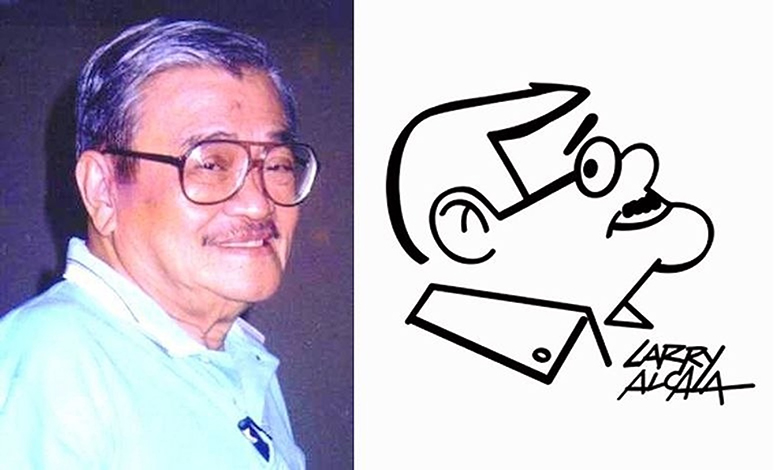
Finding him was the punchline.
CONTINUE READING BELOW

The moment you did, you’d smile and think: “Ay, oo nga—ganyan talaga tayo!”
That was Larry Alcala’s inimitable magic.
Born in Daraga, Albay province, on Aug. 18, 1926, he spent 56 years drawing our collective soul. He created more than 500 characters and 20 comic strips, including the legendary “Kalabog en Bosyo.” He became known as the “Dean of Filipino Cartoonists,” taught generations at the University of the Philippines, and helped introduce the country’s first college degree course in Commercial Design. In 2018, he was posthumously named National Artist for Visual Arts.
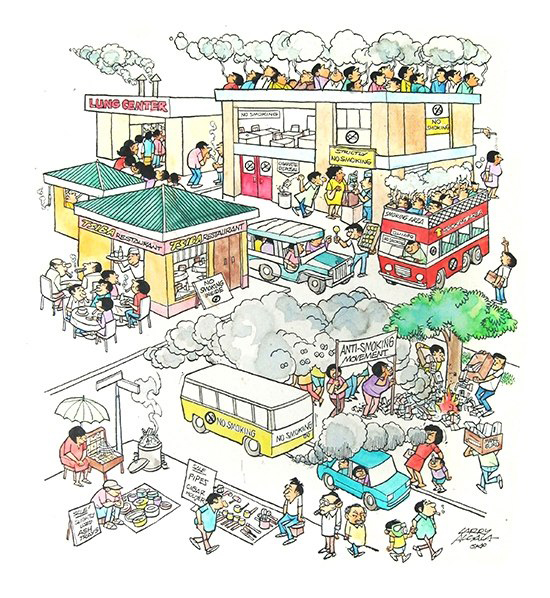
But mere statistics cannot explain Mang Larry. His real achievement was more mysterious: He made Filipinos recognize themselves—and laugh.
This art form has a lineage. Dr. José Rizal drew caricatures; Fernando Amorsolo, our first National Artist, also experimented with cartoons.
Then came masters such as Nonoy Marcelo, creator of Ikabod Bubwit. I still remember, as a student, Marcelo contacting me to borrow my copy of Gabriel García Márquez’s novel One Hundred Years of Solitude, after reading my book review—a cartoonist borrowing magical realism, one storyteller tipping his hat to another.
I also remember Dengcoy Miel’s brilliant drawings dancing beside my youthful articles in The Philippine STAR. He later brought his pen to Singapore and became a celebrated cartoonist for The Straits Times.
And years later, after I bought the 87-year-old Kamuning Bakery Café, I commissioned award-winning customer Gilbert Daroy to immortalize in ink some of the panaderya’s iconic customers—Chino Roces, Cory Aquino, Nick Joaquin, Doreen Fernandez, Gloria Romero, Pepe Smith, and others. I have also collected original works by the late Jun Lofamia, including original colored drawings that once breathed alongside poems and novels in Liwayway.
These aren’t merely memories. They are a family tree.
Cartooning is journalism with a pencil, a nation’s conscience wearing a funny face.
And now Mang Larry has reached his centennial.
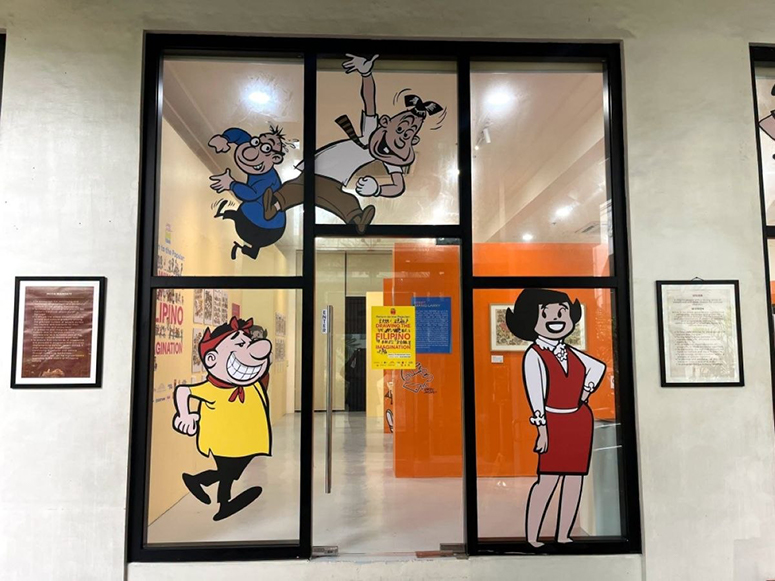
The exhibition “Return to the Popular: Drawing the Filipino Imagination,” curated by UP Fine Arts Professor Dr. Jose Santos “Chong” Ardivilla and supported by the National Commission for Culture and the Arts (NCCA), opened Aug. 19 at the Metropolitan Theater.
It brings “Slice of Life” back to life alongside works by members of the Samahang Kartunista ng Pilipinas, of which Alcala was a co-founder. The heartwarming exhibit runs until Sept. 19.
A new anthology book, Baha, Baha, Paano Ka Lumala, is also coming soon, featuring works led by the late Mang Larry and other Filipino cartoonists, edited by Prof. Ardivilla and published by Fire Horse Media, Inc.
Both the exhibition and book remind us of something easily forgotten amid today’s glowing screens: Art does not always need to shout.
Sometimes it hides in a corner of a newspaper. Sometimes it makes us laugh before it makes us think. And sometimes, if we are lucky, it stays with us long after the page has been folded and the coffee cup emptied.
I imagine Mang Larry never really left.
He simply learned to be everywhere.
Perhaps his smiling face now hides in the steam of a hot siopao, in the dust rising behind a jeepney, in the flickering glow of an MRT screen, or at a crowded carinderia table where five people boisterously argue about politics while defending the last piece of adobo with the solemnity of a Supreme Court case.
He is still drawing us: rushing through traffic, complaining about prices, falling in love, surviving typhoons—and somehow finding time for coffee, hot pandesal and merienda.
The newspaper is still here, carrying stories from one generation to the next. The pencil has learned to live beside the stylus. The cartoons remain a small window through which we recognize ourselves.
And the boundless Filipino appetite for laughter remains.
Happy 100th birthday, Mang Larry! Your pencil may be still, but your smile keeps moving.
It keeps hiding.
It keeps finding us.
And perhaps that is the joke, and the hope.
Somewhere in the corner of tomorrow’s chaos, Mang Larry is still there, winking back. Reminding us that as long as we can laugh, draw, question, criticize, remember and dream, we are never truly lost.
Perhaps that is why he still matters.
He taught us that even in the messiest slice of life, there is always another frame, another joke, another reason to look—and smile.
* * *
The exhibit was co-organized with the Larry Alcala Estate, the Filipino Heritage Festival Inc. (FHFI), the Cultural Center of the Philippines, the NCCA and Lennon Group, and runs until Sept. 19 at The Metropolitan Theater, Gallery 2, Padre Burgos Ave., Ermita, Manila.

WATCH: Do you still believe in marriage? (Generations Ep. 17)
August 19, 2026