

The radical act of remembering
Remembering is a political act in a nation riddled with a history of forgetting.
We commemorate our independence, and we commemorate as well the declaration of martial law in 1972 as a way of tracing our histories of struggle, but more so to find this very struggle enduring into the present—in the midst of us Filipinos who are alive today.
Ten years after the Duterte administration’s war on drugs, we remember the atrocities committed by the regime against artists, activists, journalists, lawyers, human rights defenders, peasant advocates, and the urban poor all under the pretense of eradicating the nation’s supposedly massive narcotic problem. Blood tainted the streets, and most notably the puroks and the sitios where informally settled communities often reside. Cardboard signs reading “Pusher ako” or “Wag Tularan” left leaning against haphazardly wrapped bodies in the streets became a familiar nightmare broadcast on our television screens as a cautionary tale for all.
As the death toll rose, we were somehow supposed to believe that such numbers were nothing but a testament to the efficacy of the drug war, when in truth, we were witnessing a massacre in real time: the regime’s expedient solution to a broken system, while the dying pleas of an innocent boy begging to be spared by armed men and the cries of families left behind by the victims echo as testimonies to the injustice of it all.
Presently on view at Ateneo Art Gallery, “Dekada ng Sama-samang Pag-alala” is a collaborative and commemorative exhibit presented by a coalition of EJK-affected families, artists, professionals, church groups, activists, and human rights defenders. Through a series of photographs, sculptures, paintings, illustrations, prints, multimedia works, poetry, and installations, the exhibit recollects the atrocities of the Duterte regime and the lives it took. While these lives were rendered nameless and faceless by an administration that ruled with an iron fist, here they are grieved, remembered, and most of all—enfleshed. They linger not as ghosts, but as actual people who continue to be part of the living through the enduring memory of their loved ones.
CONTINUE READING BELOW

“Dekada” opens with a series of photographs entitled “Pagsubaybay,” captured by various photojournalists (Ezra Acayan, Rico Cruz, Kimberly dela Cruz, Vincent Go, Raffy Lerma, Eloisa Lopez, Hannah Reyes Morales, Basilio Sepe, Br. Jun Santiago, CSsR). “Pagsubaybay” documents graphic incidents of extrajudicial killings alongside more intimate moments of domestic grief from families and communities these photographers have integrated with.
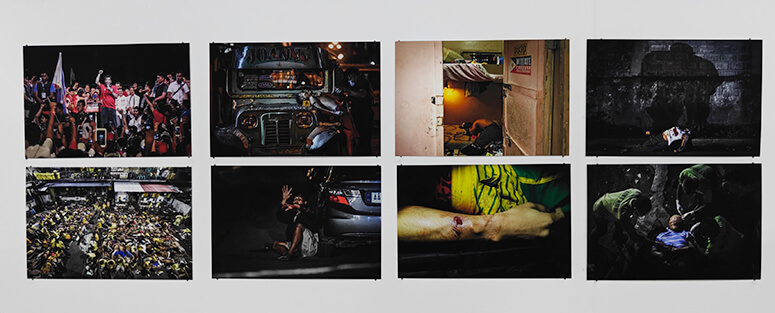
One wall shows a series of photographs taken at the onset of the drug war in 2016, the same year Rodrigo Duterte was elected president. A packed Quezon City Jail is shown to be populated by over 4,000 detainees despite being built to hold only 800 at a time, while haunting shots of blood-stained bodies on the streets are seen as follows: a dead body lying on the hood of a jeepney; an injured man either in surrender or begging to be spared as he hides helplessly beside a parked vehicle; an unmoving body seen through an open door plastered with campaign stickers in support of Duterte’s candidacy; a close shot of a bullet wound on the wrist of a body in the morgue; the silhouette of a police man hovering monstrously over a bloodied body on the pavement; and funeral workers removing layers of haphazardly wrapped tape around the head of a corpse.
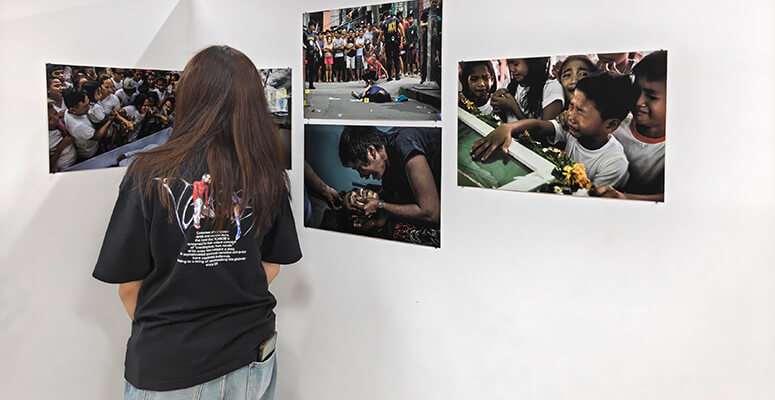
On another wall, family members grieve their dead in excruciating sorrow: a woman reaches out in desperation at a body lying on the concrete as a crowd of onlookers from the purok gather behind her, a woman cries holding the lifeless body of her brother at the morgue, and a child grieves with his hand resting atop the casket of a loved one.
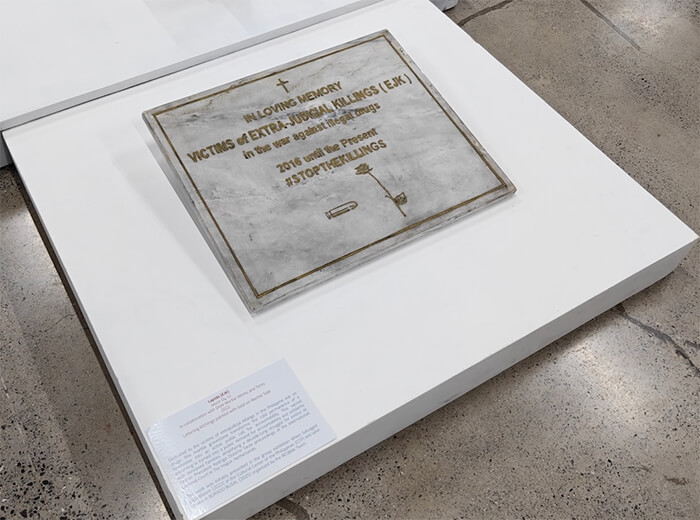
Across the space, a long protest banner in faded yellow letters reads “Stop the Killings,” while below it lie three headstones: “Lapida (EJK),” a work by Jason Dy, SJ, in collaboration with DGM Marble Works and Tents, and Mary Ann Domingo’s “Para kay Luis, Para kay Gabriel,” which uses actual headstones retrieved from the Manila North Cemetery.
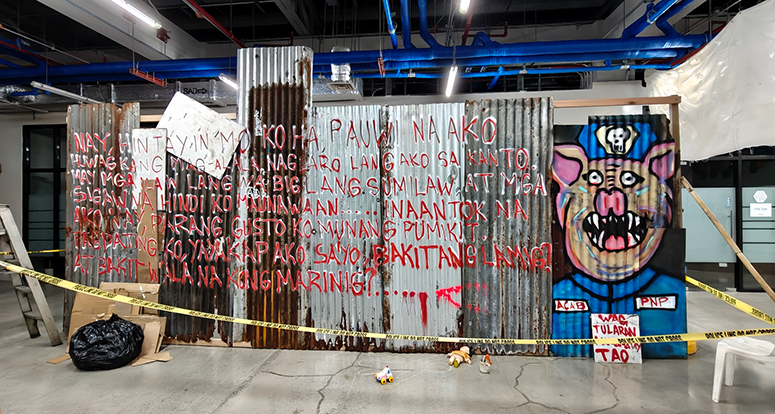
Behind the banner, a row of corrugated iron sheets is patched together and fenced by a string of caution tape tied to a plastic chair and a metal ladder. The barong-barong installation stands surrounded by dilapidated cardboards and trash bags, while children’s toys scatter around a childish police chalk outline drawing of a small human figure. On the row of corrugated iron sheets, one reads the last words of a young EJK victim, viscerally painted in red graffiti.
Materially adjacent to this work is the collaborative “Memorabilia,” an installation constructed together by EJK-affected families using furnishings and personal possessions gathered from their homes, some formerly owned by their loved ones who had passed. Viewers are invited to this makeshift home enclosed by cardboard walls and curtains to glimpse the victims’ domestic lives as they are known, remembered, and cherished by the ones they had left behind.
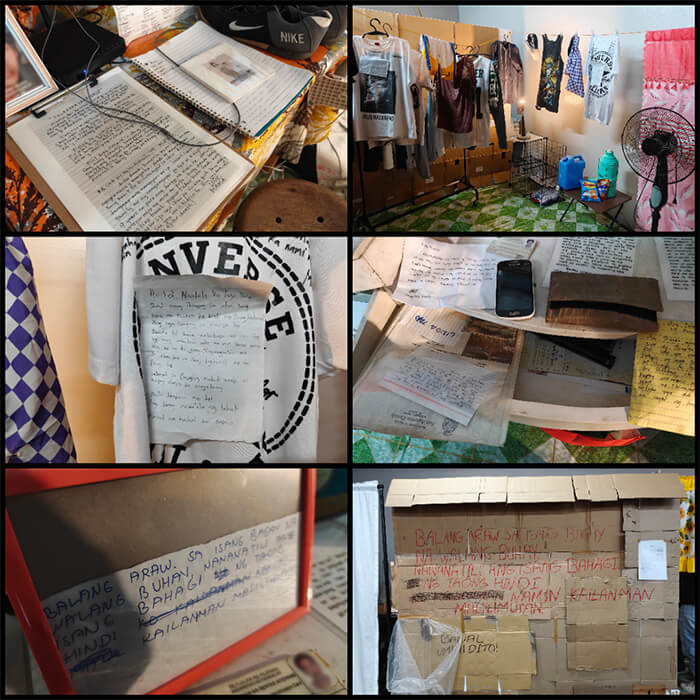
In one corner beside a mattress occupied by creased blankets, clothes, hangers, snacks, and handwritten notes, one finds an altar-like display of shoes, photographs, a CD player, and a mother’s letter addressed to their son who had passed. Another corner of the room is occupied by a clothesline from which hang various garments belonging to the victims. Occasionally, these clothes are accompanied by notes and letters addressed to their former wearers.
On the cardboard exterior of “Memorabilia,” words written in red graffiti echo a framed note inside the makeshift home: Balang araw, sa isang bagay na walang buhay, nananatili ang isang bahagi ng taong hindi namin kailanman malilimutan. In this display, one finds these lives enfleshed through possessions such as a list of favorite songs handwritten on the back of a calendar page, an old CD player, an empty cigarette pack, a pair of sneakers, a favorite shirt or snack, and a lucky charm in the form of an old wallet its once-living owner had stubbornly refused to part with.
It is here where the heart of “Dekada” lies: in the visceral materiality of life and death, espousing a radical refusal to be forgotten and to remain homeless, faceless, and nameless. More than a recollection of the victims, “Dekada” is an ongoing cry for justice. It is a reclamation of the humanity that had been violently stripped away from them by a regime so obsessed with greed and power that it resorts to expedient “solutions” to a broken system of its own making.

WATCH: LGBTQIA+ people with unlikely professions
June 28, 2026
WATCH: How to experience Bangkok and Kanchanaburi in one trip
October 21, 2026
WATCH: Do you still believe in marriage? (Generations Ep. 17)
August 19, 2026