

First Timers Club: What happens when you join a Mahjong Maven Club event
There’s a certain charm that surrounds mahjong—a blend of clacking jade tiles and easy laughter, where family stories flow freely, yet the air remains thick with strategic observation.
For those of us in the Filipino-Chinese community, it’s a childhood staple: We’d grow up seeing our family members huddled around the square table, playing games and exchanging playful taunts, before eventually teaching us, the “next generation,” the tricks of the tiles.
The goal of the game is simple: Be the first to complete a winning hand of 17 tiles, usually consisting of three-of-a-kind “pungs” or consecutive “chows,” and a matching pair. On each turn, a player draws a tile and discards one. You can opt to “steal” certain discards to complete your set.
While achieving a winning hand requires a stroke of luck, my parents taught me that the game’s depth lies elsewhere. It is a test of strategy and mental fortitude: staying sociable without letting your guard down and tracking your own hand while deducing exactly what your opponents are hunting for.
That specific “tension”—the balance between social exchanges and a high-stakes mental fight—is exactly what seems to have piqued the curiosity of a whole new generation of players. From local family tables to youth-centric pop-ups, mahjong is finding a vibrant second life well beyond its traditional roots.
That’s why I channeled my inner Rachel Chu (or perhaps Eleanor Young) from Crazy Rich Asians for this episode of PhilSTAR L!fe’s First Timers Club and visited Mahjong Maven Club’s “Tiles & Tea.” It’s a space where mahjong enthusiasts and beginners alike can mingle and test their skills with the tiles.

I was joined by theater actor Nic Chien—of Matilda the Musical, Into the Woods, and Spring Awakening fame—who is also no stranger to the game. Having both been trained by our respective parents and lolas, we were ready to take what we learned at home to the square tables of the outside world.

A social club—among other things

Mahjong Maven's "Tiles & Tea" was held for the second time at the Podium in Ortigas. We were told to expect “an afternoon of mahjong, tea, and great company.”
True to its description, the event housed multiple mahjong tables, packed with participants of all generations. Every couple of minutes, the players switch tables to play with different opponents. Between rounds, the players are served light snacks and refreshing drinks as the afternoon’s social anchor.
This was the vision shared by siblings Sheena, Sharlene, and Siegfried Lim, head honchos of the Mahjong Maven Club.
The trio saw potential in the game’s social aspect. They wanted to provide a space where friends and friends-to-be gather and experience the thrill of mahjong, mirroring their own first encounter with the game.
“[The] number one goal of Mahjong Maven [was] to go out and share this culture,” Siegfried said, adding that it was their parents who inspired them to set out on this venture.
Apart from being the head organizers, the siblings also acted as the event’s primary hosts. They would weave through the crowd, mentoring first-timers and chatting with the casual players while occasionally stepping in to keep the fun competition alive.
And while you can get matched with an experienced player, the club’s participants are often very patient towards newcomers and first-timers.
“Most of the time [players] are happy to cater to other new players and to help teach other people. This has also been a great conversation starter where others will ask, ‘Do you want me to teach you?'” Siegfried explained. “That initiative to start the conversation sums up the whole social aspects of the mahjong game.”
The invisible connection
Mahjong requires at least four players in a round, which meant Nic and I needed to find a pair to play one game. Luckily, after registration, a table needed two more players to begin. We shared a table with casual player Gwen and mahjong newbie Aldrich, who were also meeting each other for the first time.
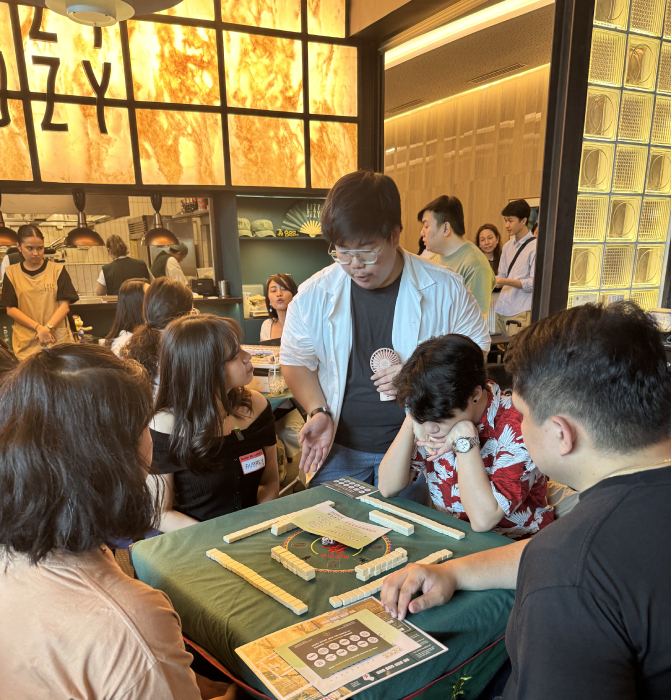
Siegfried gave our table a quick crash course on the game and stuck around for the first few rounds, serving as our guide. From time-to-time, he would lighten the mood with well-placed “Are you sure?” jabs every time we would dispose of a tile.
Interestingly, the table fell quiet as everyone locked into the strategy of the game. The real talking happened after the round, but during the game, it was all shared grins and the occasional “You’re better than you said you were!” banter.
I took the time to observe how the other tables were acting. Some were quieter, like ours, sharing laughs and reactions throughout the round. Others fell on the louder side, giving hoots and claps every time someone won a game. Some players would walk past a table of strangers, share tips, and even banter as if it wasn’t their first time meeting.
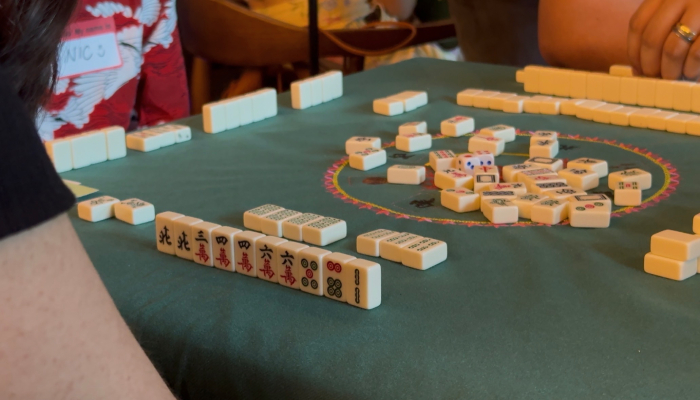
This was when I realized that the social aspect of mahjong was more than just talking during the game—it was that connection you’d get from a community sharing joy and love of a certain hobby. As you play through the round, you’ll learn how your opponents strategize or react under pressure. You’ll see those who can’t help but groan when they discard the wrong tile, those whose faces have “subtitles” for every emotion, and the true masters of the poker face, whose sudden wins leave the entire table in a state of shock and awe.
By the end of the game, we were all excited to see each other in the next edition of “Tiles & Tea.” We took pictures, shared well wishes, and parted ways to meet with our next batch of opponents.
Beyond the tiles
Throughout the experience, we played an estimated six games. I walked away with three wins, while Nic had two—an impressive turnout considering we both walked into the room not expecting to win a single round.
“The game is super fun, and it’s definitely making a comeback,” Nic said as our final session concluded.
Nic was excited to share the news of his wins with his family. I followed suit, immediately texting my family group chat as if I aced my midterm exams.
We both understood why mahjong had this pull on both newcomers and longtime members. Sure, the thrill of a winning hand is a total rush, but the real magic is the community that builds itself one tile at a time. Beginners can lose their “newbie nerves,” while veteran players can still find a challenge.
Before we left, the siblings mentioned that the club is nearing its first anniversary and that they were planning “something big to celebrate” the occasion. Nic and I made sure to mark our calendars, making a mental note to bring our friends and family.
As we ended the session, I recalled my father telling me that mahjong “was never just about the tiles, it was about really knowing the person holding them." Maybe that’s why everyone leaves the table feeling a little closer to one another—even after a round or two.
Watch the fourth episode of First Timer’s Club below.
Disclaimer: Mahjong Maven Club events don't involve any form of gambling.

WATCH: Can you still trust someone who betrayed you? (Generations Ep. 22)
September 23, 2026