

Katya Angara: Sorceress supreme
Artist Katya Angara’s origin story does not start in some sterile, white-walled studio. It began at home, among books and gardens, under the influence of her parents, Edgardo and Gloria, who taught her to stay curious, get her hands dirty, and pay attention to the world around her.
“Both my folks influenced me and my siblings in the best way possible,” Katya says. Her mother was a teacher; her late father was, for her, the exemplar of “what a good education can do to uplift one in life.”
Her brother Sonny, the current Department of Education Secretary, continues their father’s legacy. “I am eternally grateful that we were not only educated in good schools, but that our parents taught us by example.”
The lessons at home extended well beyond academics. Gloria loves gardening and is an advocate for Philippine native trees, while Edgardo, who was born in rural Baler, remained close to the land throughout his life. “He was no stranger to farming,” Katya recalls. “Throughout his life, he found joy and solace in tending to his farm and teaching us the simple pleasures of nature.”
In her childhood home, the family library became a portal to places real and imagined. “I felt the astonishment of being able to go on adventures and travel the world through books,” she says.

Her reading was characteristically wide-ranging: art, history, science, poetry, philosophy and psychology. But the books that stayed closest to her imagination were often those that slipped past the edges of the mundane world.
“My favored stories were always in children’s books, comic books, fairy tales, mythology, esoterica, fantasy, science fiction, and horror,” she explains. “These experiences continue to illuminate and transform me to this day.”
That childhood appetite for other worlds eventually found its way onto paper. Before becoming known for exhibitions that move through drawing, collage, assemblage and photography, Angara began as a book illustrator.
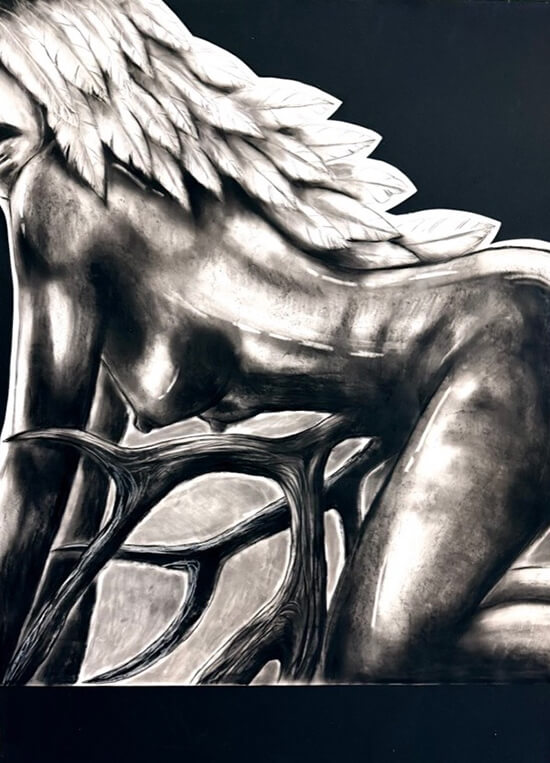
“Drawing has always been my first love in the arts,” she says. And for her, drawing is inseparable from the habit of paying attention. “To draw, you need to observe life as it breathes, and to pay careful attention to the smallest details. Nature is the perfect artist. Who better to learn from?”
There is a lifestyle philosophy embedded in that statement. Angara’s practice is concerned not only with what an artist makes, but with how an artist moves through the world. She is drawn to the Japanese concept of ma, which she describes as “an energetic pause or an intentional silence.”
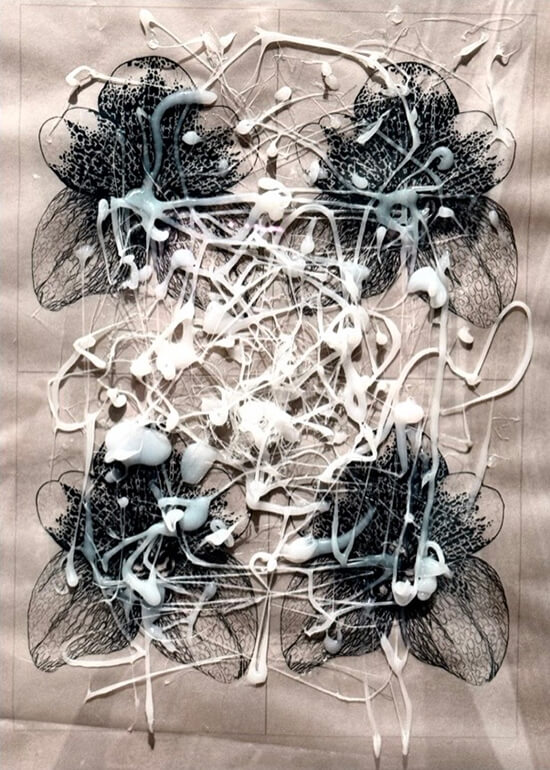
It is a philosophy that feels especially pointed in an age of constant connectivity and relentless output.
“I often feel out of place and time, when technology is hurtling at breakneck speed, and we’ve become slaves to a cult of efficiency and productivity,” she says. For Angara, ma offers another rhythm: “to slowly enjoy the process of making art, and to notice beauty in the mundane.”
To notice, not merely to consume. To allow time for something to develop. To leave spaces unfilled. To be or not to not-be. Angara’s work suggests that creativity is not necessarily produced by doing more, but sometimes by learning how to look longer.
That instinct began early. As a child, she drew and made her own comic books. She remembers herself as “a shy and sensitive child,” for whom drawing provided “a consolation and a way of making sense of an absurd world that often discomposed me.”
Even then, her pictures tended towards darker territory. “My childhood art was already very dark and melancholic to reflect my disillusionment,” she says. The impulse to draw was never simply decorative. It was a way of processing experience and dealing with existential terrors.
There is something unexpectedly tender in the way she looks back at that younger Katya. “I’d love to make a time machine to meet my ten-year-old self,” she says, “and to tell her that everything is going to be right as rain.”
She puts a spell on you
That combination of darkness and tenderness would continue into her adult work.
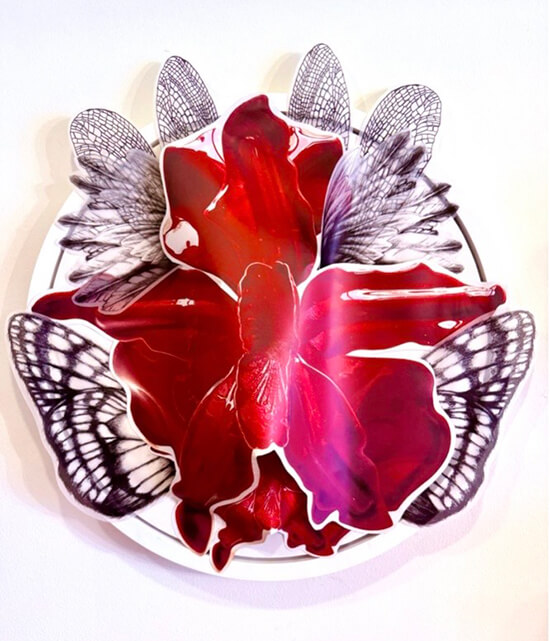
Her first one-woman exhibition, “Vampire Flowers” in 2022 at La Collina, represented an important moment of departure. Angara describes it as “a liminal event,” a point at which she had to decide whether to remain within what she already knew or risk moving into unfamiliar territory.
“It was at this fraught crossroads where I had to choose between remaining in my comfort zone, or finding the courage to traverse beyond anything I’d ever done before,” she says. She privately referred to the exhibition as “Exhibit Zero,” deliberately choosing not to heavily publicize it because she felt she “had not yet awakened to my full potential.”
Looking back, she sees it less as an arrival than as a beginning. “‘Vampire Flowers’ was a portal and a prologue. It was the deep breath before the plunge. It was also proof that I chose not to abandon myself.”

If “Vampire Flowers” opened the door, “Dendrophilia” in 2023 at The Crucible Gallery brought Angara more deeply into the natural world. The exhibition introduced ideas of symbiosis, impermanence and transformation through paper, charcoal and the figure of the Plant Diwata.
Her description of gardening could almost stand as a description of her approach to life. It requires, she says, balancing “between sovereignty and surrender”; the garden “teaches me to release what I cannot control.”
She connects this sensibility to wabi-sabi, the Japanese philosophy that finds beauty in “impermanence, imperfection, and the transience of life.” In her work, that philosophy is not merely theoretical. It exists in the materials themselves. “Paper and charcoal, which are the revenants of trees, are given a second life.”
The phrase “second life” says much about Angara’s sensibility. Her art repeatedly returns to things that change form rather than simply disappear: trees become paper and charcoal; childhood memories become images. It was probably her way of approximating the exact shape and texture of her present presence. Katya figuring out a way of being the Katya of now.
“I fear being fully known or defined,” she says. “I’ve spent so much time building and living in the castles and gardens inside myself.”
It is an unusually vivid description of interior life: not a single hidden room, but an architecture of castles and gardens, constructed over time. It also helps explain why Angara is reluctant to dictate how her work should be interpreted.
“I don’t tell people how to see my art,” she says. She is “far more curious about their interpretations,” comparing the experience to receiving a Tarot reading or hearing bulong and orasyon from an albularyo.
What interests her is not simply what people articulate in front of an artwork, but what remains private. “I’m interested in what people don’t say, and what they see in their mind’s eye.”
That openness extends to the way she works. Angara has never restricted herself to one medium, moving among drawing, paper art, collage, assemblage and black-and-white photography. Her practice appears to be led as much by curiosity as by predetermined method.
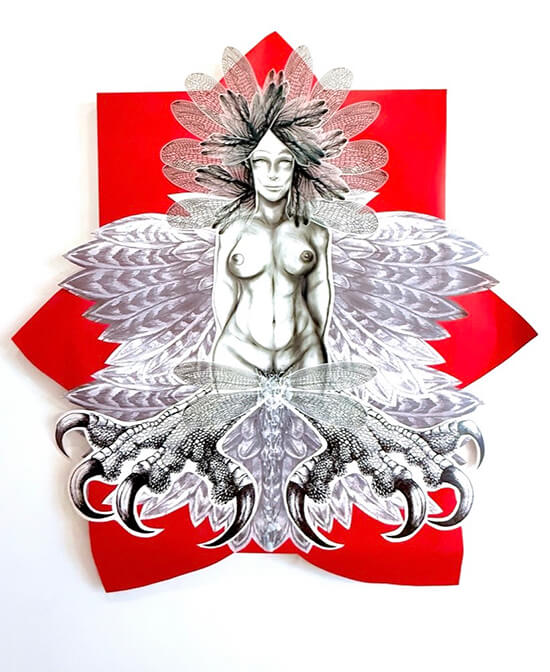
“I did not plan how ‘Sorceress’ was going to turn out,” she says of her ongoing show at The Crucible. “The materials and the process took on lives of their own.”
Perhaps that willingness to relinquish control connects the artist she is today with the family garden of her childhood. There is intention, certainly, but also observation, patience and surrender to processes that cannot be fully managed.
Angara is equally drawn to contradictions. “I enjoy the interplay and tension between opposing forces,” she says. “While I understand the gray complexities that color our world, I tend to perceive things in black-and-white. All light casts shadows, and shadows cannot exist without the light. They are two sides of the same coin.”

For Katya, mystery does not have to be solved in order to matter. Nor does everything in a life need to be optimized, explained or made productive. There are more things in heaven and earth than are dreamt of in spreadsheets and performance metrics.
Books taught her how to travel without leaving home. Gardens taught her when to intervene and when to surrender. Drawing taught her how to look closely enough for the ordinary world to become, well, strange again.
Taken together, they suggest a philosophy that is quieter than the Gothic imagery often associated with her work: pay attention, allow things to change, resist the demand to define everything too quickly, and make room for what cannot be controlled.
Or, as Angara puts it more simply, learn “to slowly enjoy the process” and “notice beauty in the mundane.”
Wonder is all there, actually, just ripe for the picking.
Ah, art, love, family… Is there any kinder, more seductive sorcery than this?
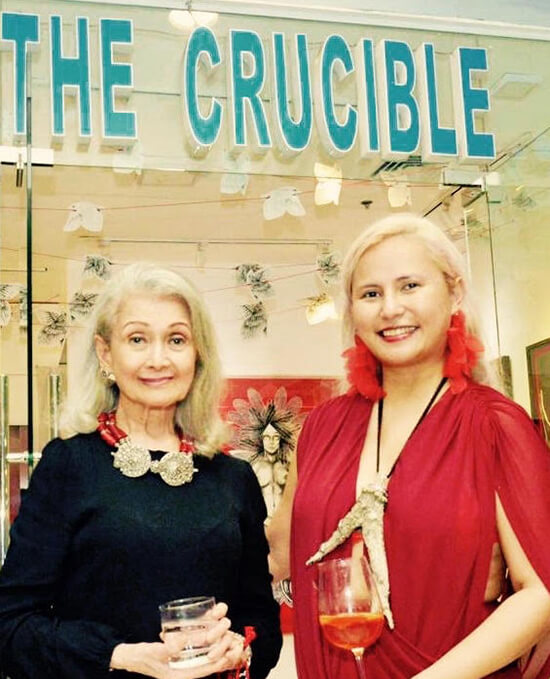
Katya Angara’s “Sorceress” is on view until Aug. 30 at The Crucible Gallery, fourth floor, SM Megamall A, Mandaluyong City. For information, visit The Crucible Gallery on social media.

WATCH: Is OPM still as good as it used to be? (Generations Ep. 20)
September 9, 2026