

[ANALYSIS] Duterte impeachment trial Day 22: Battle of aliases and interpretations
Who is afraid of Army Col. Raymund Dante Lachica? Can his testimony hurt the prosecution panel in the impeachment trial of Vice President Sara Duterte? Could Lachica's appearance open a “Pandora’s Box” in the handling of millions of pesos in the VP's confidential funds?
At no time in the past many weeks has the impeachment trial heard the call for the appearance of Lachica, Duterte's former security command chief, and his assistant Col. Dennis Nolasco. It's becoming a running, burning issue to determine whether or not the VP should be held guilty for the alleged misuse (or “paglulustay,” the prosecution’s word) of the confidential funds as defined by Article I of the four complaints against her.
Lachica and Nolasco had been identified by a number of witnesses that Duterte had tasked them to handle confidential operations and subsequently to disburse confidential funds, thus supposedly breaking the “chain of accountability” because they were not the duly recognized “special disbursing officers,” the only ones allowed to dispense the funds—P500 million for the OVP and P112.5 million for DepEd.
The call for Lachica and Nolasco to take the witness stand resurfaced as the prosecution presented on Day 22 the country's assistant national statistician Marizza Grande, who testified on some of the names printed on the liquidation reports of the OVP and DepEd as among those who received confidential funds.
Senator-judge Raffy Tulfo sought their appearance early on Monday, Sept. 7, saying he was morally convinced that the names were just aliases, and these were a common practice in the intelligence community, especially in the Armed Forces of the Philippines and the Philippine National Police. But Lachica should come to the hearing to provide flesh to the names as listed in the acknowledgment receipts in the liquidation reports of both the OVP and the DepEd.
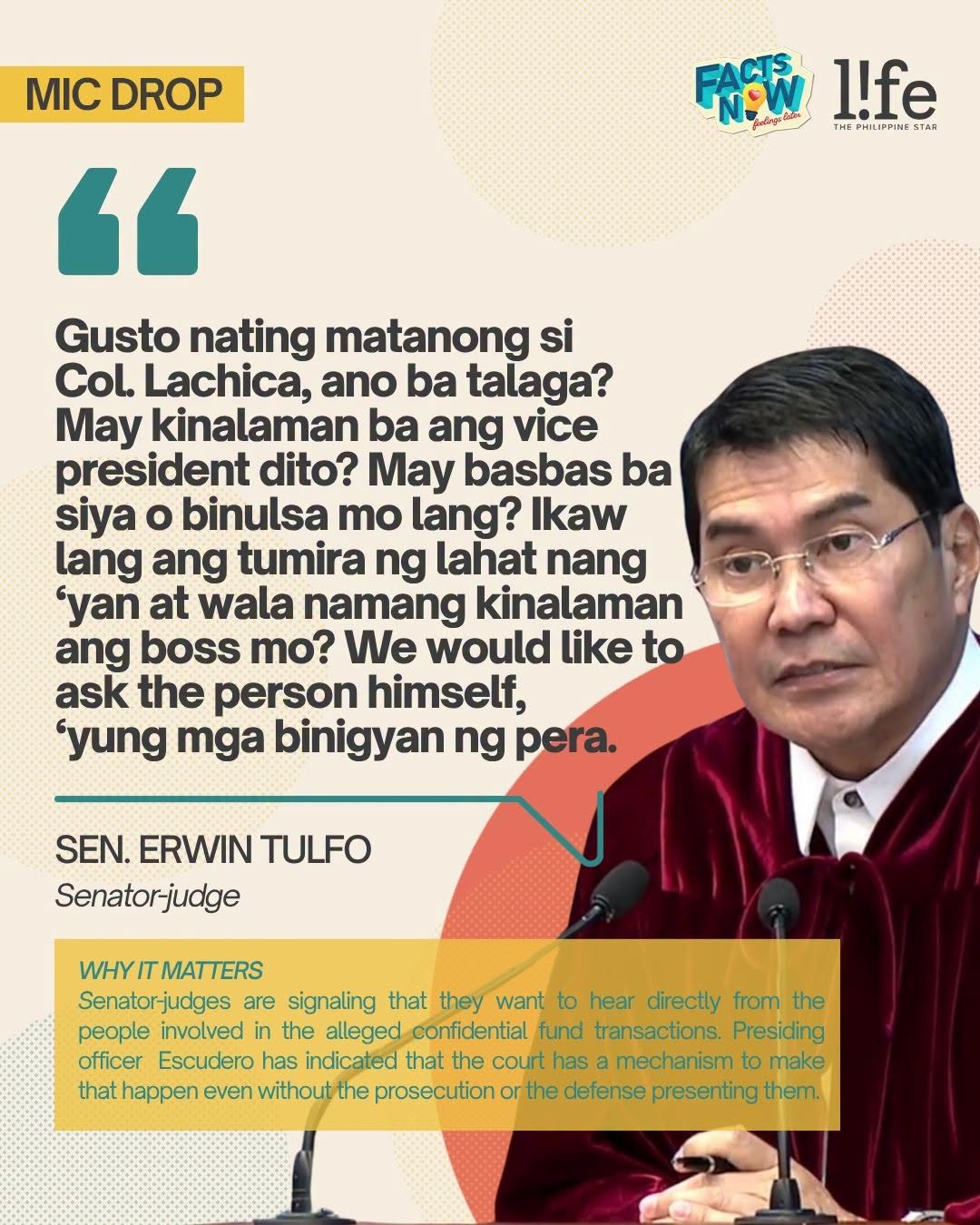
His brother, senator-judge Erwin Tulfo, the first to ask if the prosecution would present Lachica, reiterated his call before the end of Day 22. Having some police background in their previous careers, the Tulfo brothers seemed to understand police and military work and thus sounded passionate in articulating the calls.
CONTINUE READING BELOW

If only because it was Lachica who dispensed the funds, they said.
“I don’t see anything different,” Raffy said of the practice of using aliases in intelligence and confidential operations. “Even the NBI uses aliases,” he added.
Two committees of the House of Representatives had asked the Philippine Statistics Authority to verify the names—or the identities—of some people—1,992 for the OVP and 677 for the DepEd—who received confidential funds, if these were their real names.
Are these confidential agents real people using aliases? Or are they not real at all? Could it be possible that the questioned funds went to only one person?
Perhaps only Lachica and Nolasco can shed light on their true identities.
Based on her testimony, Grande said the PSA had verified the names and found out that so many of these had no records in the agency’s database, quoting its data on birth, marriage, and death certificates, raising questions about their true identities.
Some were already dead when their names appeared to have received the funds. Two were as young as one year old. Only one matched the name listed in the PSA records.
Young or old, alias or not, Raffy pointed out that the names submitted by the PSA were dubious based on their signatures. It seemed that only one person signed the receipt papers, he said.
“Pare-pareho ang pirma,” said Raffy, though admittedly not a signature expert, not a forensic document examiner who analyzes handwriting and signatures to detect forgery. “’Yung nagtama ang pangalan, tsamba lang 'yan.”
And the most famous of them all, Mary Grace Piattos, appeared not once in the PSA records. "Wala po," said Grande.
Raffy's theory bolstered the prosecution's belief that Duterte had misused the funds, on top of the prosecution’s claim that she violated the joint circular by allowing Lachica and Nolasco to disburse the funds, the two not being the SDO of either the OVP or the DepEd.
But whether or not the names of the confidential agents appeared or not didn’t mean they were not real people.
Presiding officer, senator-judge Chiz Escudero challenged Grande’s testimony.
“Hindi porke't nag-match 'yung isang pangalan (sa PSA records), siya na ‘yun,” he said.
Grande said yes, the PSA’s limitation stemmed from the fact that its staff never did fieldwork to verify the identities of the names the House had requested. Her testimony referred only to the available PSA records.
Here lie some holes in the PSA records. The country’s repository of records is not 100% complete. It does not have the records of all the millions of Filipino people born, got married, or died in the Philippines and elsewhere.
The country’s estimated population of 112,729,484 as of July 1, 2024 was based on the census, not actual live birth records.
The PSA database captured live birth registrations for roughly 97% of the population, leaving about 3% unregistered individuals, mostly in remote regions, indigenous and Moro communities, or specific cultural groups. Neither were marriage records as accurate.
“It is not perfect,” said Escudero. “May pagkakamali.”
While her testimony provided some interesting tidbits about the probable identities of the confidential agents, Grande showed no direct bearing on the allegations that Duterte had squandered the funds.
Two officials from the Commission on Audit had testified that it was no big deal for them if the OVP and DepEd had used aliases in their liquidation reports, as the joint circular was silent about it.
Still, it was a battle for interpretation between the prosecution and the defense.
Prosecution lawyer Mae Divinagracia couldn’t help but find fault that the defense has not stated its position on whether or not the names were fake.
The defense said the confidential agents were real people who provided the Duterte camp with some information to keep her out of harm’s way in her activities. They would prove so when it's time to present its own witnesses.
Wait till their time comes, said lead defense lawyer Sheila Sison. For now, Sison and Escudero said it was for the prosecution to still prove its allegation.
The prosecution presented Grande arguably in the hope of winning public opinion that all these aliases could give further credence to its theory that Duterte had misused the fund, which “it has proven well enough,” as it has been saying for the past many weeks. And thus, it found no need to call either Lachica or Nolasco to the witness stand, according to lead prosecutor Rep. Gerville Luistro.
Other prosecutors and spokesmen have rejected similar calls in various news conferences held after the trial over the past many weeks.
A lawyer-guest of a TV show who has been sympathetic to the prosecution said Lachica’s testimony could be “risky” for the prosecution. “Nobody knows what Lachica would say,” the lawyer said.
Nobody knows if Lachica would tell the truth? Nothing but the truth?
Erwin thought otherwise. Lachica should show up and answer all the senators’ questions, he said. “All our questions would provide answers: Where did the money go? Did he pocket the funds?”
Escudero promised the court would call Lachica at the proper time even if neither the prosecution nor the defense would ask for him. When that time comes, he said, only the senator-judges shall have the right to interrogate Lachica.
Meanwhile, the truth, as interpreted by Erwin, is still hanging in the air.
Disclaimer: The views expressed in this article are those of the author and do not reflect the opinions of PhilSTAR L!fe, its parent company and affiliates, or its staff.

WATCH: Can we talk about death and grief? (Generations Ep. 25)
October 14, 2026
WATCH: Save for retirement or enjoy life now? (Generations Ep. 21)
September 16, 2026