Yuson’s 4th foray into the energy jungle
The fourth printing of Alfred “Krip” Yuson’s first novel, Great Philippine Jungle Energy Café, launches on Sept. 10, Thursday, at Karrivin Plaza, Makati. In the run-up to a retelling of the great Philippine comic novel, sent questions to the author were gamely fielded in diverse manner: referring interviewer to the book’s preface for the first two questions, from which we quote liberally, and for the rest relying on good old conversational email exchange, informal use of Tagalog or Filipino, which language Yuson has been experimenting on in his social media verses.
Can you walk us back to the writing of the novel, when it first took root? I know it won the Palanca grand prize for novel and remember you dropping by my father’s office at FC1074 to request him to write one of the intros for publication. Did they also reuse Tence Ruiz’s drawing for the cover?
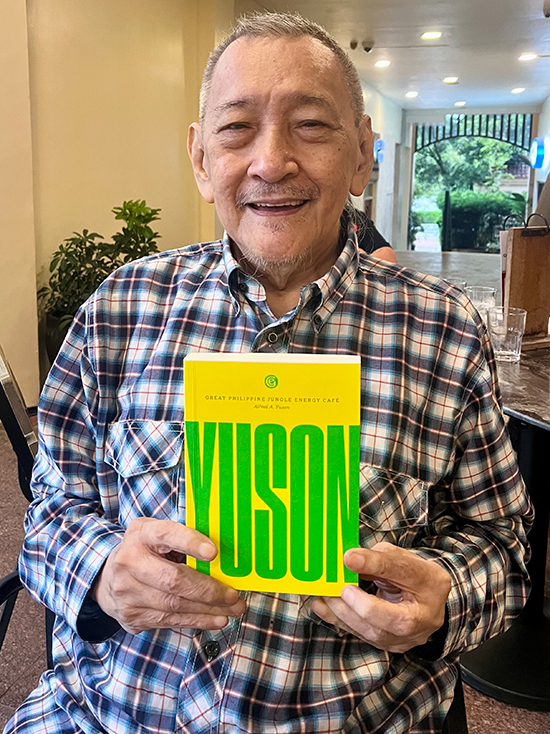
ALFREDO “KRIP” YUSON: It’s been 40 years since I wrote this novel… I think I started writing the manuscript sometime in 1984 or early 1985, upon learning that Adrian Cristobal had announced a Cultural Center of the Philippines grant for a novel-in-progress that would be chosen from among contending submissions.
I got the grant that came with initial funding from the Philippine Writers Foundation for its completion within a year. Of course, 1986 was a landmark year, when a people power revolution replaced a dictatorship.
While also engaging more robustly in print and TV journalism, I only managed to devote enough time to on-and-off expansion of my novel, until I completed the full manuscript in a little over a year.
After a positive report on its quality by the designated official reader, Franz Arcellana who had been one of my Humanities professors in the University of the Philippines Diliman, my reward was twofold: The balance of the cash grant and eventual publication by Adriana Printing Co. under the auspices of the BDAP New Literature Series, a program initiated by the Book Development Association of the Philippines.
I thought of sending a copy of my manuscript—with Arcellana’s heartwarming approval—to Nick Joaquin, another senior writer I greatly admired. Like Franz, he often encouraged, and challenged, our generation to take over the torch from their own.
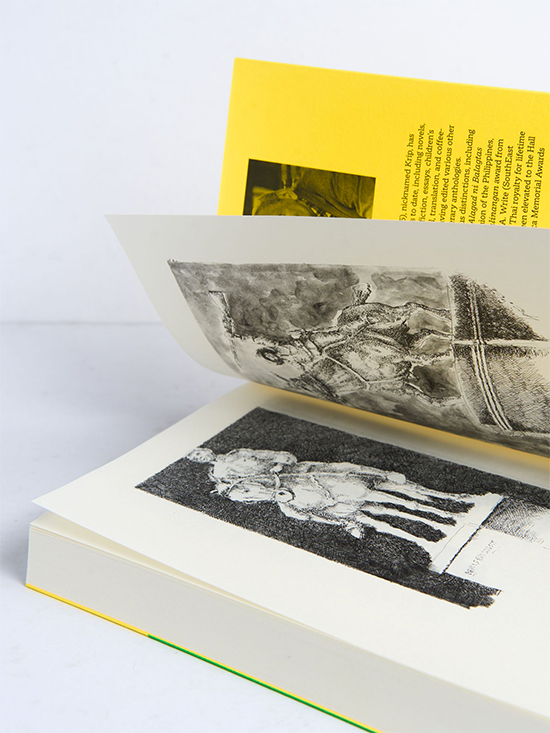
The bookend photos of actual statues of Pantaleon Villegas a.k.a. Leon Kilat, in the towns of Bacong and Bais, are now rendered as illustrations by Danilo Sollesta, a notable artist and sculptor of Dumaguete City.
In retrospect, GPJEC seems prescient if not almost clairvoyant, a good chunk of it set in turn-of-the-century revolution (if memory serves). Was there a conscious decision to have as one of the heroes Leon Kilat of Bacong? The novel has a strong Visayan presence.
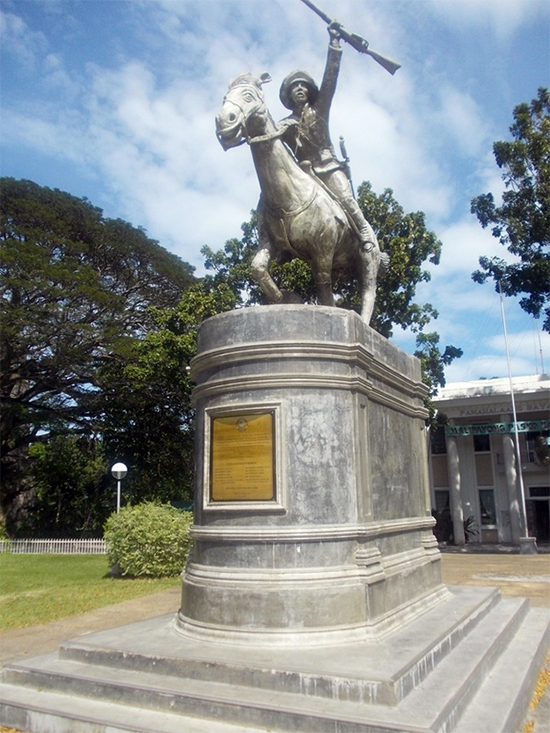
I had first heard about Leon Kilat, my central character, from Cebuano writer-friend Resil Mojares. The accounts he shared about Leon Kilat fascinated me. That he had been a real person—Pantaleon Villegas of Bacong—stimulated my interest.
It was the first town directly south from Dumaguete City in Negros Oriental, my adopted hometown owing to the Silliman University National Writers Workshop, where I gained a fellowship in 1968. It was all coming together—the lore about the revolutionary hero Leon Kilat who was said to be attended by magic, his real-life friendship with the older Buhawi who had founded a religious sect in southern Negros—a partnership chronicled by the American anthropologist and scholar A. V. Hartendorp—and other tales of picaresque nature, plus my own friendship with Silliman writer-comrades like the poet-magus Cesar Ruiz “Sawi” Aquino.
In my scriptwriter’s head, I began to imagine him as Buhawi’s reincarnate. I kept stumbling into additional snippets of stories about how Kilat crossed over to Cebu, found sundry employment there, before he wound up joining the revolutionary Katipunan that had risen against the Spanish before the turn of the century. So Kilat sailed to Manila to join the rebels, and by the time he returned to Cebu City, he had already been appointed as yet another man-boy General.
This was where my liberated imagination took over—exulting in rollicking, rowdy, ribald burlesque of actual history. As a result, thanks to a train of literary friends—peers and mentors such as Resil, Sawi, Adrian, Franz, and Nick—I managed to compose a comic, comedic retelling of Philippine history.
Has your literary technique or style changed much since? What would you sort of amplify or tone down if given a chance to rewrite or come up with an alternative version, if there’s such a thing (maybe a counter-novel or anti-sequel)?
I’ve never been much into revision, unlike our old friend. I wouldn’t amplify or tone down anything I did for GPJEC (as I’ve also touched on in my Preface). As for evolving techniques or style, I still try to introduce different novel ways, Which I do in my new novel, my fourth, which (BTW) was completed last month, and submitted to Andrea (Pasion)’s Milflores, to her delight. She wants it out by November.
The title alone reminds me of the heady Penguin days and nights of old, but I’m sure the cafe itself is a composite of the cultural bohemian hangouts of the time, and it hardly sounds dated, though I may be biased being a sleepy eyed young man near novel’s end who approaches Gina Apostol as Sandra Dee when she had yet to write her own novels.
Ah, oo nga, no, nasali pala kayo sa what a dazed dazzling party. Nice to hear it doesn’t sound dated. Curious din ako how millennials, Gen Z and Gen A young readers react to it.
Nag-iibang mga appreciation ng mga bata. Para sa launch nga sa WhyNot, the proprietor Marta is thinking of preparing the venue to have daw the atmosphere of Penguin Café and other Remedios-flavored vibes of the 1980s. Bahala sila kako.
By the way, did you know for a fun fact that when you won the Midweek prize for “Music Child” in the late ‘80s-early ‘90s, you edged out Lav Diaz’s long short story in Tagalog about solvent-loving street kids seeing all these colors, not eight hours long though?
Didn’t know that. Sana ginawa na lang sine ni Lav ang “Music Child,” with Shaina Magdayao ba yun na naka sheer nightie rin in slo-mo erotic scenes. Kahit 10 hours.
I guess Exploding Galaxies is doing a service for Philippine literature by reprinting long “out-of-stock” classics: Nolledo, Castillo, Fernandez & Alegre, Ty-Casper. Do you have other titles in mind for exploding consideraton?
I tried to interest Mara in Carlos Cortes’ two novels, eh bigla namang pumanaw. I also spoke about Antonio Enriquez’s novels, may pinublish yata ang UST and out of stock na. But I tried contacting his daughter Vanessa who’s still in CDO pa yata, 'di ko makontak.
Being a semi-recluse these days, do you ever miss the workshops of the post new criticism? And as a former college lit prof, what’s your take on the young writers of today, and would someone like, say, Polyphemus find a place in their work?
Curious nga ako sa kung anong nagugustuhan nila ngayon, at mga ginagawa o gagawin pa nila, pero mostly ang naririnig ko lang mga trabahong fiction ng mga Fil-Ams na unfamiliar ako. Magagaling daw.