

The pointillist of no return
Visual artist Joshua Carlos Barrera finds mythology in the smallest of things. Flora and fauna have been favored subjects in his oeuvre, the minuscule lives of the outer world often treading into the human psyche. In “Psychomachia,” presently on view at M Galerie, Barrera’s insectariums rendered in acrylic, metallic ink, and paint situate fauna in a chromatic explosion of natural, cosmic, and fictive worlds.
Drawing from the medieval allegory “The Psychomachia,” literally meaning the conflict of the soul or “soul war,” Barrera’s works weave together fragments of spaces and times, histories and cultures, myth, and reality in his own tapestry of the fool’s journey, here told allegorically through the insect as humble peregrine in a world that increasingly proves vaster than their frail miniscule existence. Here, the artist seems to dare ask: In spite of such a terrain so explosively vast, chaotic, unpredictable, and oftentimes treacherous, what does it mean to reach for something? What does it mean to still dream?
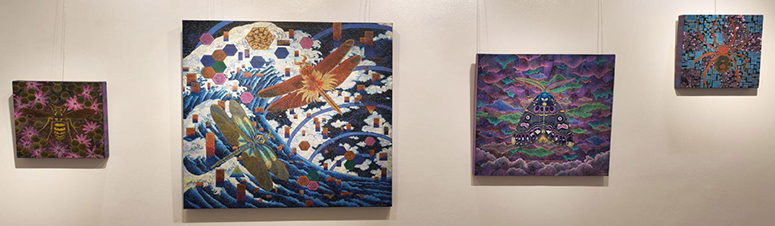
Barrera aptly begins the series with a suite of small pieces. Rendered in meticulous pointillist style through stippling and chromatic hues, he depicts a red widow (Latrodectus bishopi), a southern yellowjacket (Vespula squamosa), and a rust scorpion (Hottentotta rugiscuitis) in their respective habitats, although the environment he situates them in are clearly abstracted into tile-like fragments of the terrain they each thrive in and traverse. Despite their smallness, these fauna unassumingly possess a venom that allows them to survive threats within their environs. It is here that Barrera seems to introduce us to a mythology of small things—an odyssey of sorts that always begins with the smallest of strengths and the slivers of possibility.
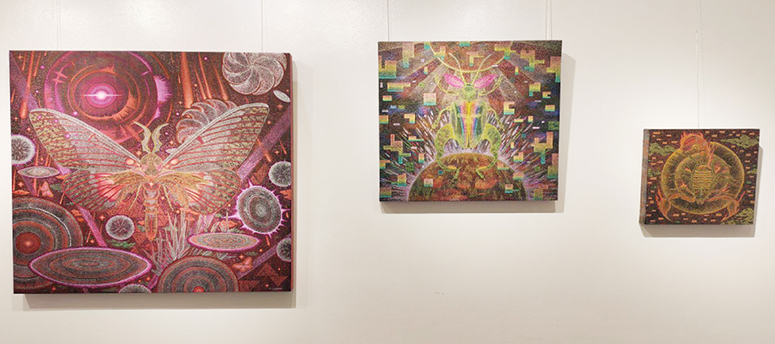
In a slightly larger series of canvases, we find fauna set against cosmic and psychedelically vibrant skies, each insect seemingly in the act of ascending towards a world beyond the great firmament. The ascendance takes place in an environment of shimmering chromas—psychedelic, dreamlike, and celestial. It is here where the mythology Barrera has begun to construct takes flight. The life of insects is conceived as a metamorphosis or a biological evolution of forms, but here, evolving becomes akin to an ascendance that only becomes possible because of the desire to reach out for something beyond the skies, or to dream of something much bigger than ourselves and the worlds we live in.
CONTINUE READING BELOW

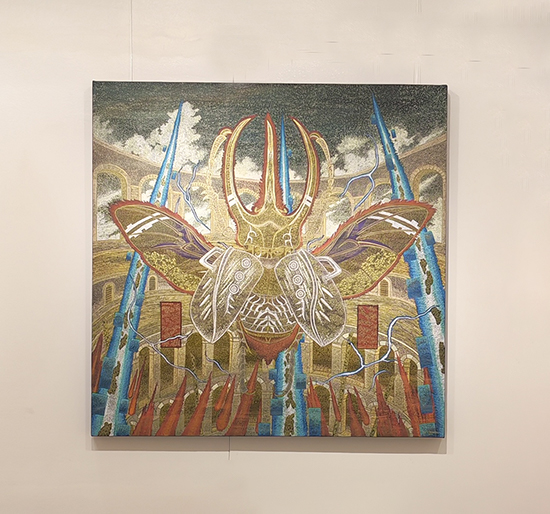
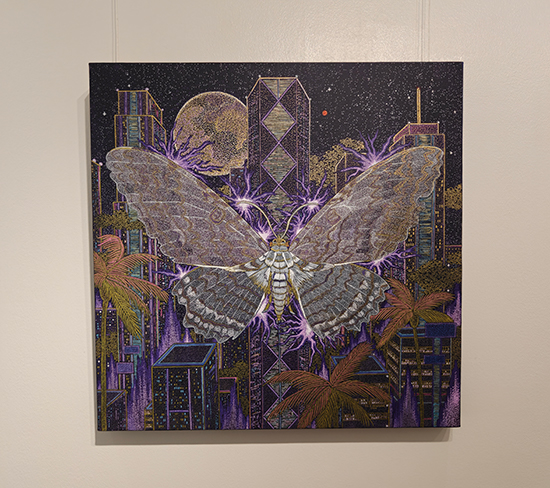
Barrera’s largest canvases depict insects in significantly extreme environments: the pine-devil moth (Citheronia sepulcralis) within a cosmos of apocalyptic chaos, the flame skimmer (Libellula saturata) and blue dasher (Pachydiplax longipennis) dragonflies rising against sublime crashing waters, the Moellenkampi beetle (Chalcosoma moellenkampi) in a cruel battleground exulted in by despots, and the white witch moth (Thysania agrippina) in a neon-lit city whose electric lights crackle with something calamitous. The allegory of the soul seems to reach its climax in these turbulent images of chaos and conflict, visually akin to either illustrated prophecies or testaments to a richly storied history. In Barrera’s mythology, even a miniscule existence that dares to hold on to a sliver of a dream or possibility can find itself soaring over oceans rising and a witness to empires falling.
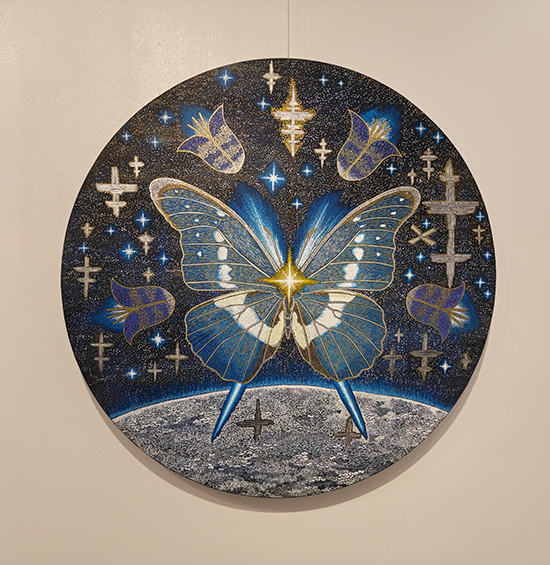
What is the fool’s journey, if not a metamorphosis made possible by a vast terrain of encounters that shape us as we tread through an inhospitable landscape? The miniscule dwellers of Barrera’s insectariums find their existence always in encounter with elements and existences far greater than their own, yet here, they rise as leviathans of their odysseys, or rather, mythologies of their own making. To reach for something and to still dream despite it all is perhaps a testament to simply wanting to be alive.
After all, how does one really live without a bit of dreaming?

WATCH: Pixar Summer Fest adventure at Hong Kong Disneyland
August 10, 2026
WATCH: Can we talk about death and grief? (Generations Ep. 25)
October 14, 2026
WATCH: LGBTQIA+ people with unlikely professions
June 28, 2026