

Ooh, ube bey-beh! The purple food craze
MILLIE: Our purple yam—that nutty, vanilla-flavored ube—has finally become an international food craze! Cultivated across the country with special varieties found in Panglao Island, Bohol, and Antique, this tuber is also grown in Northern Luzon, Western Visayas, and even Northern Mindanao regions. It is usually colored purple like the variety from Zambales, but some varieties are white like those grown in Leyte. In Basco, we have seen white ube with a purplish tinge.
It is starchy and moist in texture, and like the sweet potato can be boiled, steamed, or baked. In the ‘60s, I remember my mom would always bring gallons of Magnolia ube ice cream packed with dry ice to her friend Bruno Dedual at The Peninsula Hong Kong. Whether it was for personal consumption or to serve at this prestigious hotel, I can’t really say, but Dedual would always send the hotel car to meet my mom at the airport like a VIP.
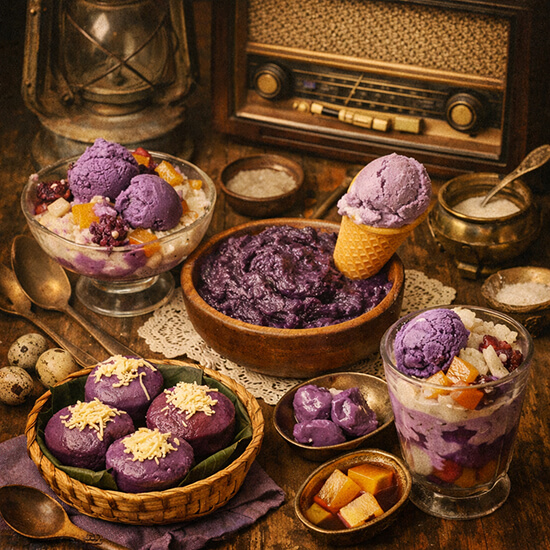
In 1976, we catered for some 5,000 delegates who attended the International Monetary Fund and International Bank for Reconstruction and Development Conference at the Philippine International Convention Center, and First Lady Imelda R. Marcos wanted us to serve typical but memorable Filipino dishes. It was then when we first offered it and international event items such as the ube-macapuno cakes and putong ube, as well as the ube halaya and, of course, the ube ice cream with halo-halo.
One of the dishes served that comes to mind is the Manok sa Ube, which was a dish from Mindanao recreated by one of The Plaza’s chefs, Emong Baldago. It consisted of chicken cooked in coconut milk with simmered chunks of ube and chili seasoned simply with salt and pepper.
In the ‘80s, it became the inspiration for one of my other chefs, Florencio Fegalquin, when he joined the HRAP’s Chefs on Parade culinary competition and won for his entry, Duck Breast with Purple Yam, which he served with ube-flavored rice. We had a silver-plated duck press just like the one used at the famous La Tour d’Argent in Paris. The duck press is a classic French tool which somewhat looks like an old-fashioned ice shaver. It is used to squeeze out the juices of the roasted duck to create an exceptionally flavorful sauce.
KARLA: While ube has started to become an international sensation across the United States of America, Europe, and Australia, our farmers have struggled to keep up with the demand. This is according to the article published in The New York Times last Dec. 29, 2025. From decades of trying to elevate Filipino cuisine, our ube is finally on a global stage. Yet here we are, unable to fully offer supply. How did it come to this? What support do our farmers require? Are they equipped with proper knowledge and technology? Are there enough subsidies, grants, or other forms of financial assistance for them to be able to start a harvest? Do they even know how it has become a global trend, and if so, has it motivated them? Or the opposite?

In this article, we share our recipe of Manok sa Ube, or chicken stewed in coconut milk and purple yam. We hope this inspires the Filipino farmers to continue planting this staple in Philippine cuisine.
Manok sa Ube
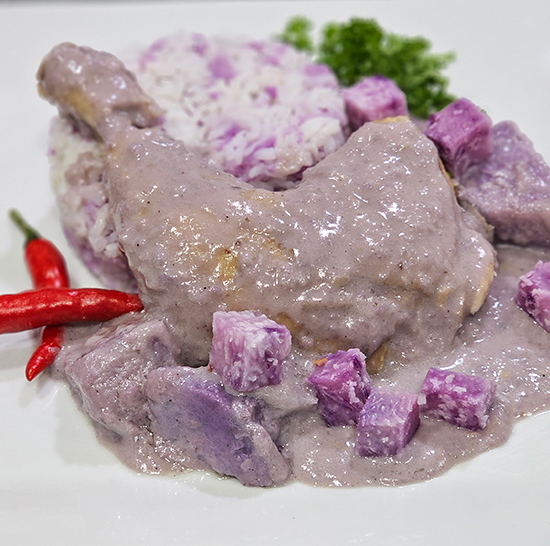
Ingredients:
- 4 pcs chicken leg quarters
- 1tbsp cooking oil
- 1tbsp garlic, minced
- 1tbsp ginger, minced
- 1 whole red onion, chopped
- 1L coconut Milk
- 400g ube, chunks
- 2 pcs red chili, chopped
- Salt and pepper to taste
Procedure:
- Heat the oil and sauté the garlic, ginger, and onions.
- Add the chicken and cook until brown.
- Pour over the coconut milk and bring it to a boil.
- Add in the ube chunks and let it simmer until soft.
- Mash some of the chunks to thicken the sauce.
- Add the chopped chilis.
- Season with salt and pepper to taste.

WATCH: Save for retirement or enjoy life now? (Generations Ep. 21)
September 16, 2026
WATCH: Can you still trust someone who betrayed you? (Generations Ep. 22)
September 23, 2026