

Bang a Gong: Tad Ermitaño’s ‘Somatodelic’ at Ateneo Art Gallery
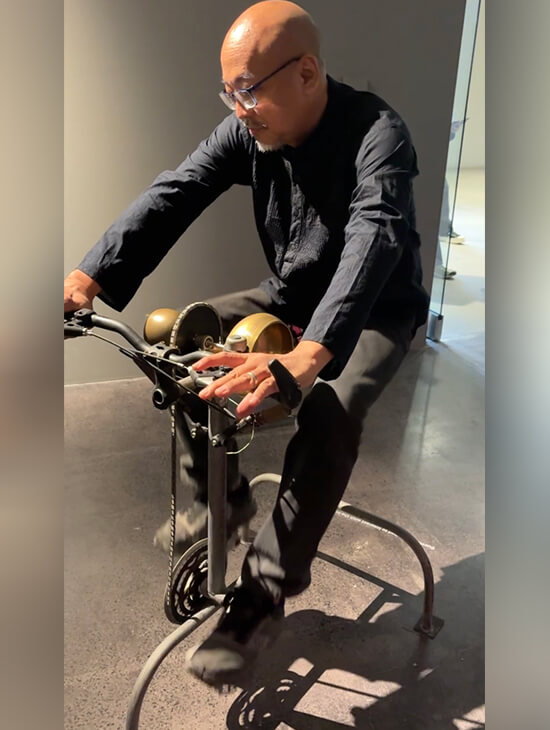
We pause at the entrance of Tad Ermitaño’s solo exhibit “Somatodelic” at Ateneo Art Gallery, as the artist, educator, mechatronics builder, and noise pioneer hops on an old bicycle and starts pedaling: an unearthly shriek emerges, not the happy ringing-bell sound of a kid’s Schwinn that you’d expect.
It’s a 2015 piece called “Hasa,” in which Ermitaño has rigged up the bike with handmade “friction bowls” to emulate, when pedaled, the sound of the blade-sharpening man who roamed his neighborhood, growing up. The resulting sound may not reflect happy childhood memories, but it is evocative: rather like a reverse slo-mo sound of two knives being scraped together.
Ermitaño’s sound-and-vision experiments remind me a little of Odysseus, strapped to the mast, enduring the Sirens’ song. He likes to joke it all started with the second Led Zeppelin album: “Sometimes I say I was born inside the song Whole Lotta Love. In that mix, there’s this bit where everything stops, and then Jimmy Page starts basically scratching his guitar, and it just becomes this noise composition, a sound you could get lost in. Ever since, I just loved music that promised to be weirder or further out than what you listened to before. It’s like, okay, that’s for me.”
Has Ermitaño heard the Sirens sing and clocked the morphing of Circe’s dark magic? Or was it just a Theremin sound faintly heard among the misty mountains?
Maybe he’s more of a technical wizard, with a punk attitude. The show’s title, “Somatodelic,” can read as “body-manifesting,” and Ermitaño uses that manifesto as a means to get people to react, interact—and hopefully think. With a proclivity towards sound engineering from early on, he founded The Children of Cathode Rays, an experimental media collective, and would soundtrack experimental films for Mowelfund, back in the day. Lately, he’s been blissing out with noise ensemble Somatosonic.
He does not like “pre-chewed” opinions when approaching art. “When I make stuff, my instinct is to have fun: things you can do stuff with. For the show, I asked Ian (Carlo Jaucian), the curator, to shrink the text down as much as possible. I find if you’re puzzled about something, you start developing your own opinions—basically you construct understanding in the face of puzzlement.”
CONTINUE READING BELOW

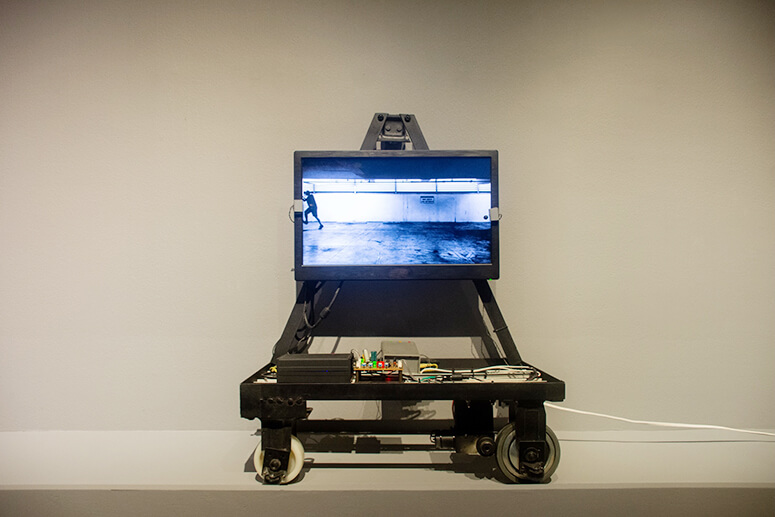
We pause our walkthrough at another piece (“Spinning Jimmy”): a horizonal shelf along right wall of the exhibit, where an open laptop displays a video of what looks like a tiny Ermitaño, running across the screen from right to left: motion sensors in the laptop compel it to move incrementally on wheels each time his image hits the edge. It’s a nifty demonstration of the artist’s approach to materials, the idea of engagement, without meaning supplied for you; the laptop will eventually touch the left wall, then will be reset back to its original right edge.
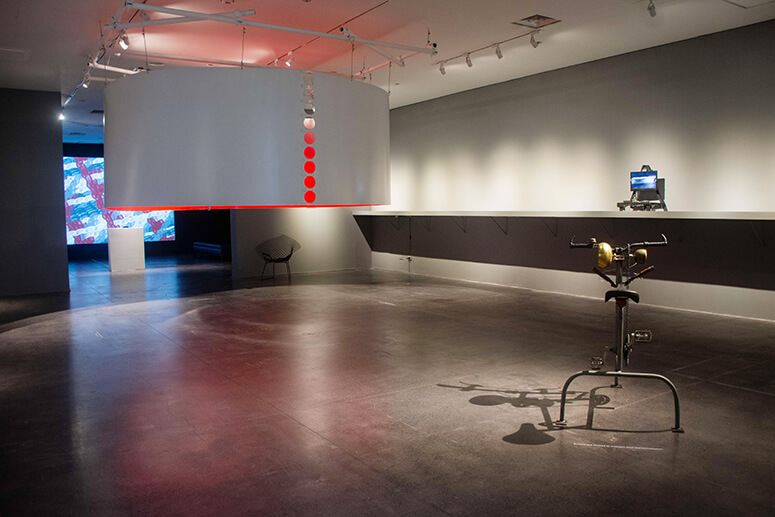
We move under a large red-dotted metal cylinder suspended from the ceiling, a piece begun in 2010 called “Bell.” There’s an AC transformer attached. “It’s plugged into the household circuit,” he notes. Inside, “you’ll hear the hum change and wobble, depending on where you stand.” The low-volume drone is akin to prayer wheels, meditation circles, Buddhist gongs. Ohms become “oms.”
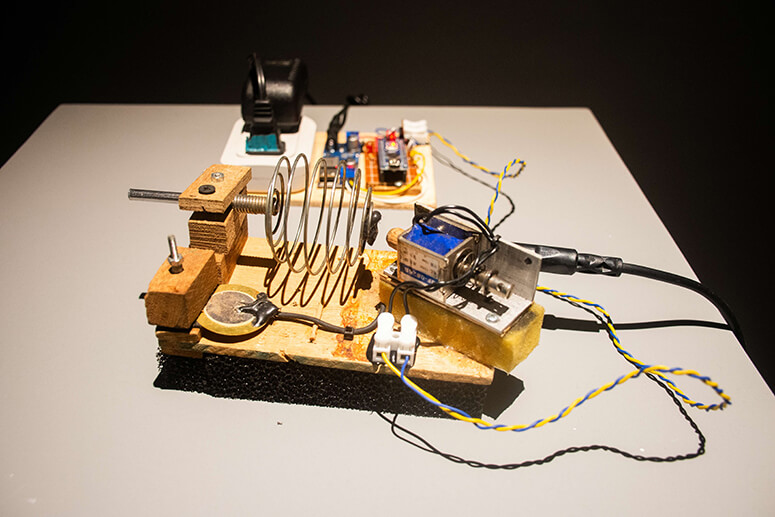
Throughout this room of “Somatodelic,” there are little clicks and drones and rings. A kinetic sculpture called “Hasen” involves a twanging egg beater attached to a solenoid and a Vox amp. Another piece (“Otomachiku”) features a hollow bamboo periodically struck by an electronic hammer, then amplified.
The back room is more of a retrospective: we see pieces that formed Ermitaño’s punk ethos, his fascination with early computer graphic tools.
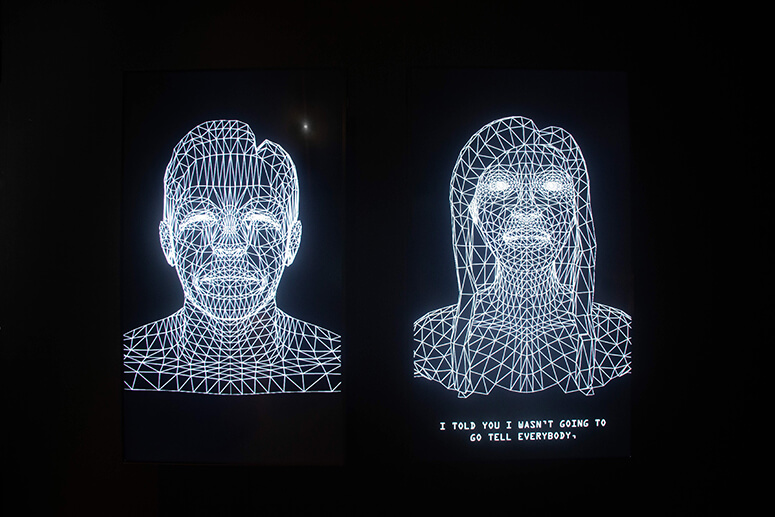
Most amusing, to me, is “Sex to Speech” (2017), in which a transcript of bedroom talk between former president Ferdinand Marcos Sr. and American actress Dovie Beams is fed through text-to-speech software—summoned, in a sense, from its material absence (because there are no existing audio tapes) into something eerily reborn, set to crude 3D animation of the two parties, nattering on in computer voices about keeping secrets, cleaning the soap off in the shower and other random pillow talk. The extrapolation and recasting through technology gives it all a weirdly intimate quality.
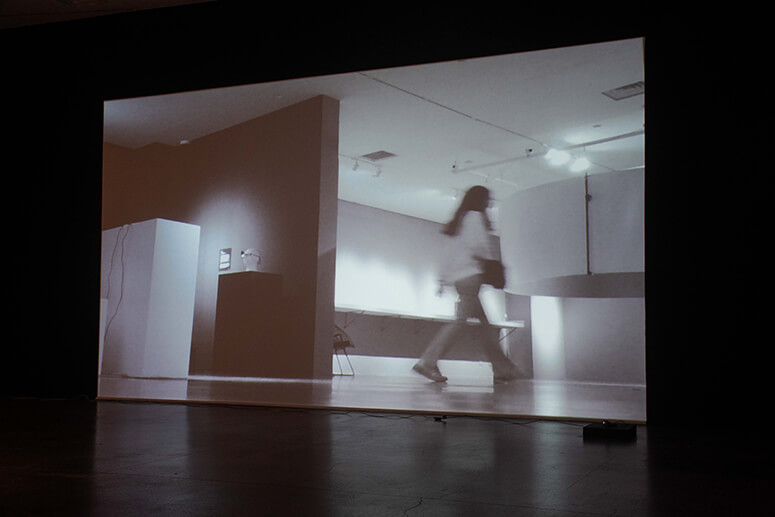
The 2013 video installation “Sammy and the Sandworms” allows viewers to sketch out lines on a tablet, turning pen strokes into worm-like animated lines, up to four at a time, each sounding a note as it moves and redraws itself across the screen, while “Twinning Machine” from 2009 uses the delays of video feeds to create disjunctions between how we see ourselves on camera and what we’re currently doing: images are sped up, reversed and delayed, manipulated into a kind of “anti-mirror” effect.
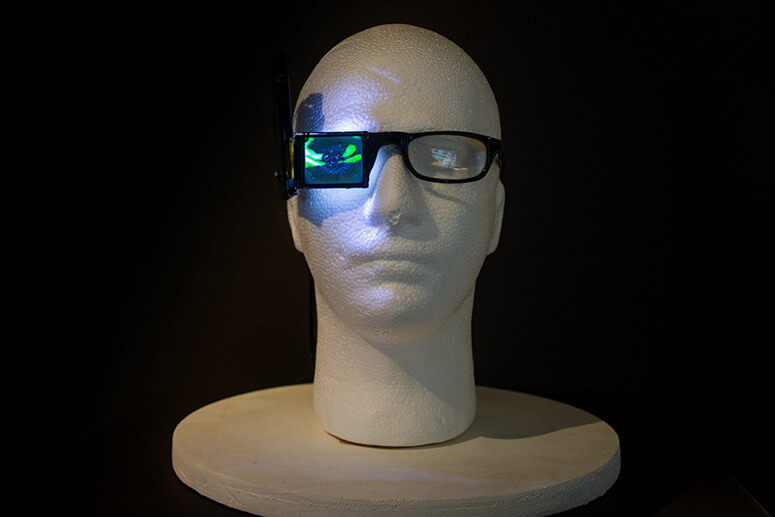
Finally, there’s “Teddyvision” (2007), named for the late Teddy Co, a “towering figure in Philippine independent cinema who lost sight in one eye.” A prosthetic white head is outfitted with a miniature video player, which cycles through flipped footage of Teddy’s remaining eye, hand-drawn animations, the word “eye” in 40 languages, and a line from Erasmus: “In the land of the blind, the one-eyed man is king.” Its intimacy draws you in.
Ermitaño’s work does invite kinetic interaction, but it also demands viewer interpretation. Despite claiming the curator’s text has been shaved down, there’s enough info to become oriented to the artist’s unique outlook. And there’s enough sonic and visual puzzlement to suck you right in.
***
“Somatodelic” is at the Wilson L Sy Prints & Drawings Gallery, 2F Ateneo Art Gallery until Oct. 10, 2026.

WATCH: Save for retirement or enjoy life now? (Generations Ep. 21)
September 16, 2026