

The after Lives of light
For curator and photographer Teo Esguerra, photography begins with light: it reveals encounters in the physical world and leaves something behind. He speaks of photography as of something spectral—in its sheer attempt at capturing what has already happened. As Esguerra himself writes: “We rarely see light itself. We see what it touches.” To ask how a room is filled with light, then, is perhaps, more than asking about the physics of illumination, but more so about the encounters that have taken place, to look back and to realize the ephemeral nature of light and being in the world.
Presently on view at Vinyl on Vinyl, “How a room is filled with light” features the works of Bene Arcayan, Eric Bico, Geric Cruz, Teo Esguerra, Denver Garza, Tessa Martinez, Sean Philip Olalo and Ennuh Tiu. The exhibition is curated by Teo Esguerra, whose practice in photography threads through the exhibition as a fascination with light and its encounters—even long after it had been captured and left behind its traces.
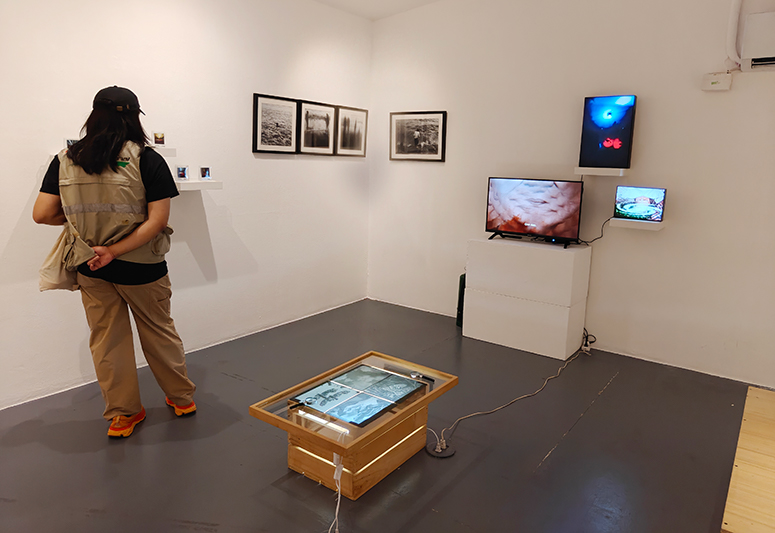
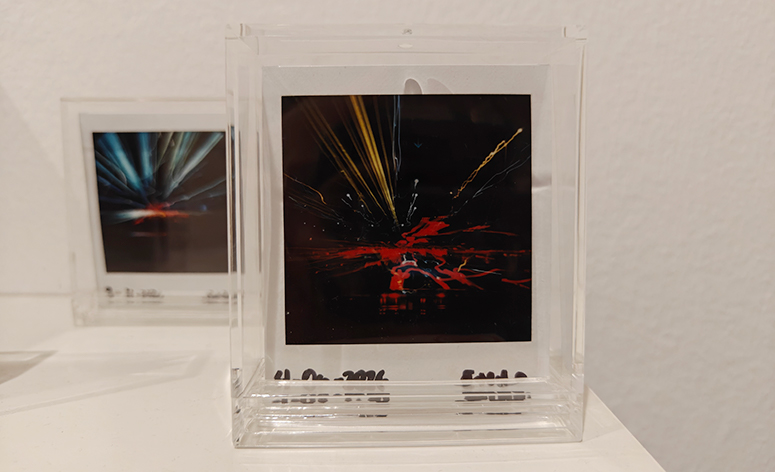
To ask how a room is filled with light seems at first a scientific inquiry. Denver Garza alludes to this in presenting a series of instant photos encased in small acrylic boxes. Framed like specimens or studies of light in the act of being preserved, the explosion of light trails Garza captures seems to betray its own encasement, hinting at a cosmic beginning or end—akin to a star being born or the last trails of a supernova. As celestial the image seems, the photos are born from mundane encounters, taken in long exposures during Garza’s drives from Manila to Cavite and back. In this way, the explosion of light trails takes on a less scientific inquiry and more of a sentimental one: perhaps a wayfinding in search of where home might end or begin.
Sean Philip Olalo’s “Spica: The Distance Between Lights” similarly evokes a cosmic imagery, here referencing the brightest star in the constellation Virgo, Spica. It seems impossible not to see one’s own reflection in the framing glass of Olalo’s tenebrous photograph: one sees themselves among the charming scatter of stars, in a dainty illusion of a galaxy that Olalo captures. Viewed in the exhibition space, one inevitably becomes a part of this galaxy, seeming to constellate among stars that have long passed—light years away from the present viewer.
CONTINUE READING BELOW

Ennuh Tiu’s “You Have Your Father’s Eyes” plays on both domestic and cosmic imagery to create tensions between intimacy and distance in a series of photographs the artist narrates over. As Esguerra writes, light touches the world and leaves something behind. Here, Tiu seems to situate themselves in that very space—where one is left behind in the shadows. She sheds light on the distance it creates between kin and ponders on this experience of familial estrangement as a sort of cosmic alienation.
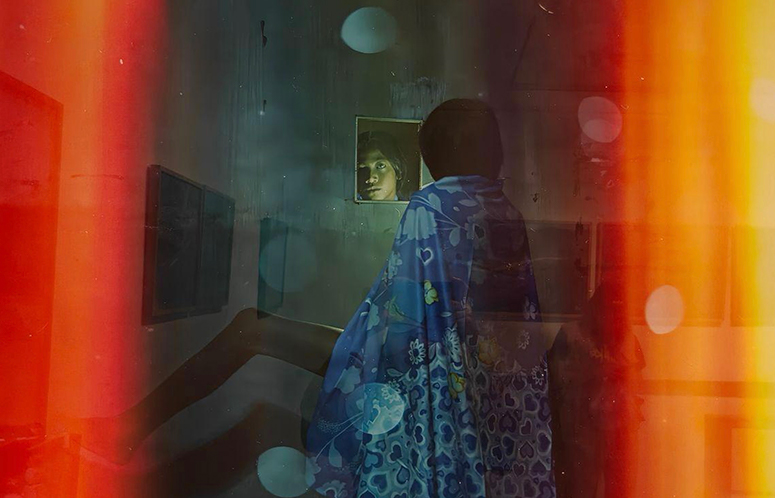
In a series of photographs that draws the viewer with a splash of chroma among white walls and monochrome palettes, Geric Cruz captures the intimate theatrics of the subjects who pose as muse in his photographs. Draped in light leaks and lush landscapes, the subjects of “Maria, Maria” are captured as if caught in the middle of a performance—some in the dark, hiding within the dingy and cramped confines of their homes, while other Marias are able to “come out” into the light, becoming bold in the untethered wilds of the landscape, posing gracefully like nymphs born anew.
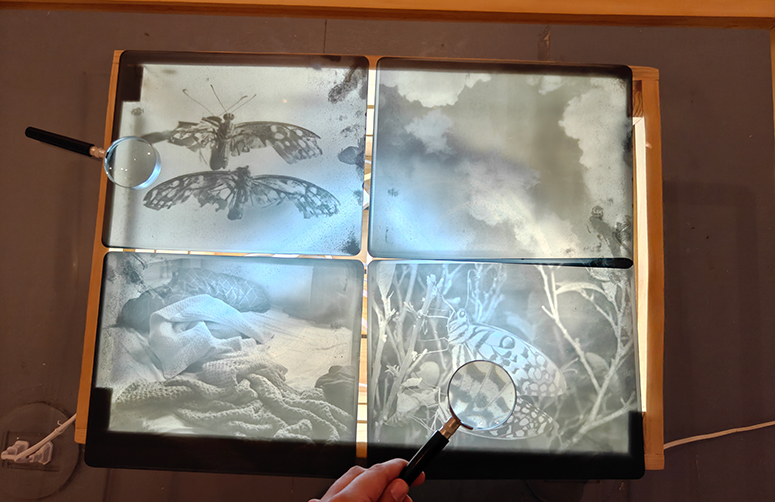
Teo Esguerra’s “Dream artifacts, alteration 1” similarly plays on a dichotomy of the outside and inside in a set of x-ray films showing butterflies both dead and alive, clouds, and an unmade bed. Like Garza’s work, Esguerra’s “dream artifacts” seem to frame his images as specimens to be studied—this time from the anatomy of an internal world, or perhaps a dream. Esguerra’s images possess a softness and lightness that seem to embrace their own ephemerality as light peeks daintily through the film—as if to say that light remains in life and death, and in flight and in rest.
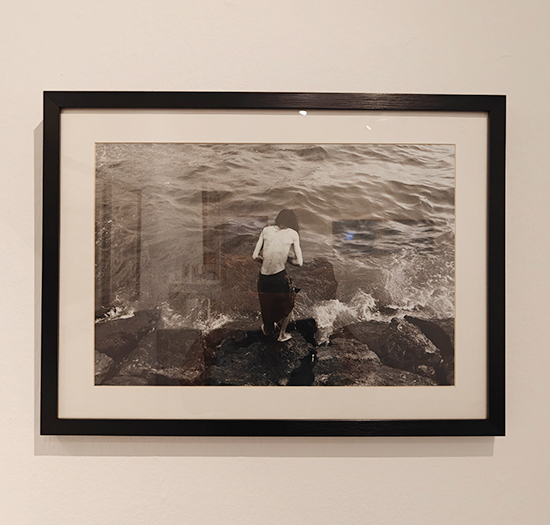
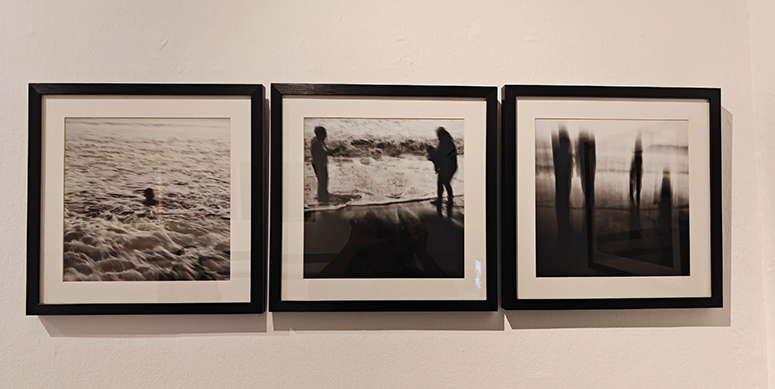
Bene Arcayan’s series of monochromatic photographs finds the sea a witness to a trajectory of life towards death. Silhouettes in a dark blur are seen amidst the waters or standing before the shore in the first three images in the series. In the last photograph, “Sea (death),” the ghost-like blur of silhouettes are no more. The figure in the last photograph, now clearly illuminated, seems all too aware of their own ephemerality as they are captured mid-jump, about to dive into the same turbulent waters that have given them life.
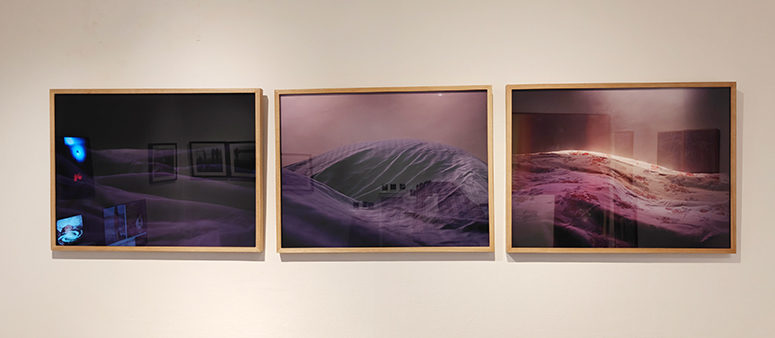
Eric Bico’s photographs similarly speak of a trajectory, this time through a series of photographs that suggest a rousing from sleep. The three images are arranged horizontally next to each other, forming a wave-like pattern from gently illuminated bedsheets. From the quaint intimacy of the dark to the moment of waking, one sees light cradled along the soft waves of slumber. If sleep is seen as a temporary death, here, it is anything but a violent one.
Tessa Martinez plays on the image of water as well in a pair of cyanotype works that translate to “Umaapaw ang pera, binabaha ang bayan.” The fine mesh of a net is imprinted as if floating on the surface of water, suggestive of possessions left in the flood (or the lack of it) or something that needs saving.
Despite the sheer tragedy implied in this image, there is something here that remains as in all the other works—that is, light entangling in a mesh of encounters. As threads of light leave their mark upon the world, they reveal a constellation of people and things, all inevitably fated to become dead stars, light years away—a memory.
If, indeed, as Esguerra writes, photography begins with light, then perhaps the world also begins with it.

WATCH: Discovering Vietnam in three days
June 9, 2026
WATCH: Can you still trust someone who betrayed you? (Generations Ep. 22)
September 23, 2026