

Maria Tan: Late nights, household objects, & the inextinguishable light of art
SINGAPORE — Maria Tan, a Filipino-Chinese contemporary artist, points to a space in between two paintings in her first solo show in Singapore. That one, she tells me, had already been shipped to Seoul for the Kiaf art fair. I find this very interesting. An absent painting, at the center of a trilogy of sorts, amplifies the story of Maria’s exhibition about transformation and transcendence: from her landscapes of flowers to abstract shapes and colors to painted light and, eventually, to something that goes well beyond existence. The ethereal, the effervescent, not of this world.
“It wasn’t necessarily planned as a trilogy, but I started off with the middle one first, and that was more of a play on how I can show the movement of darkness to light,” she explains. For a body of work concerned with atmosphere, uncertainty and the passage between visibility and disappearance, the explanation is strikingly literal. “The entire thing is inspired by when I paint late at night—because I used to work a full-time job—and then stop in the morning. I always see the transition from darkness to light. And then once I see the light, that’s when I stop painting.”
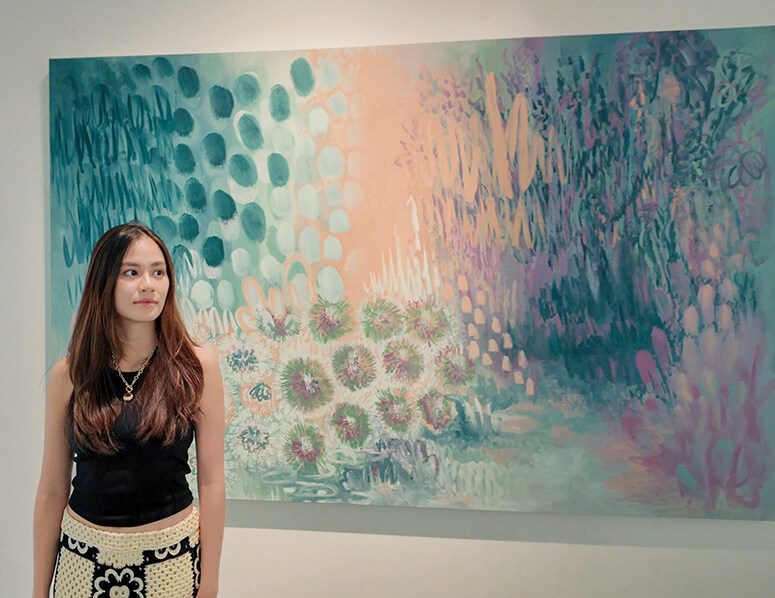
And light is everywhere on the canvas.
Maria Tan’s “First Light” exhibition, which opened July 1 at The Columns Gallery in Singapore’s Gillman Barracks, was full of ironic twists: a not-present painting speaking volumes, a young artist already tackling challenges like capturing light and plotting atmospheric spaces, as well as painting these profound subjects by using spoons, forks, combs, toothbrushes, hair rollers, eyebrow brushes, contour brushes and floss, among other household items, alongside conventional paintbrushes.
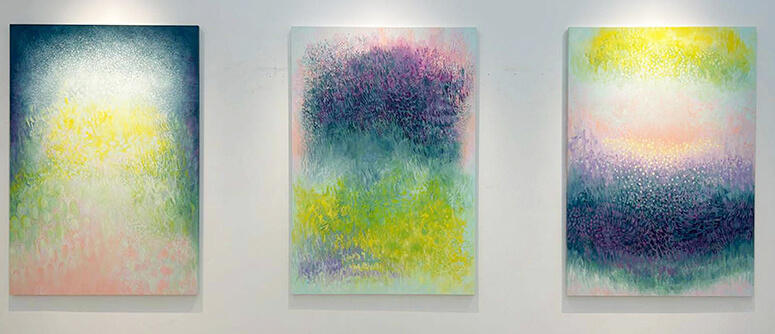
Dig this: the materials used to arrive at this “First Light” state are decidedly less ethereal. (Beauty blenders, anyone?) A soup spoon produces a different mark from a regular spoon because, she notes matter-of-factly, “it’s flatter.” There is something almost alchemical in the translation of domestic objects into painterly epiphanies, but Tan’s explanation is more grounded in labor than symbolism. “I really put a focus into mark-making,” she says. Her choice of tools grows out of daily routine: cleaning, eating, brushing her teeth. “These are the tools that I touch every single day,” she explains. “There’s not a single moment in every day that I don’t hold at least a single tool.”
The important word here may be every. Against the romantic figure of an artist waiting for inspiration, Tan insists on repetition. “You have to go in the studio every day, work a lot,” she says. “I work a long time every day and develop discipline.” The paintings are meant, in part, to make that labor visible through scale and repeated mark-making. “I wanted to show how I work as an artist,” she continues, “which is, I think, very different from someone who gets a spur of inspiration and then paints. For me, I try to be in the studio every day.”
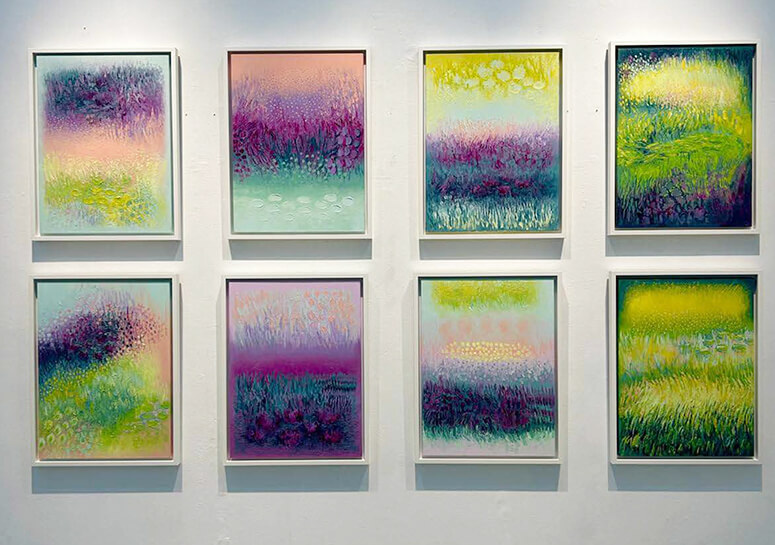

Light, in Tan’s paintings, is less a subject than a material problem. “Light should sort of trickle down or trickle up or trickle outwards,” she says. Painting it is “very difficult because it’s not as simple as, like, black and white.” Color is accumulated intuitively, adjusted until a painting begins to produce something more atmospheric than descriptive. “I’ll put this here and there and then figure it out,” she says. “Very spontaneous, all of it. No plan whatsoever.”
This apparent spontaneity is, however, built upon a surprisingly rigorous routine. Tan paints on the floor in a shared studio in an abandoned former school near Newton hawker center in Singapore. The dimensions of the studio have directly determined those of the work. One group of three paintings became a triptych partly because “that’s the width of wall space that I had.” The architecture of the studio enters the paintings almost accidentally: “I’m very much influenced by the largeness of the space I work in.”
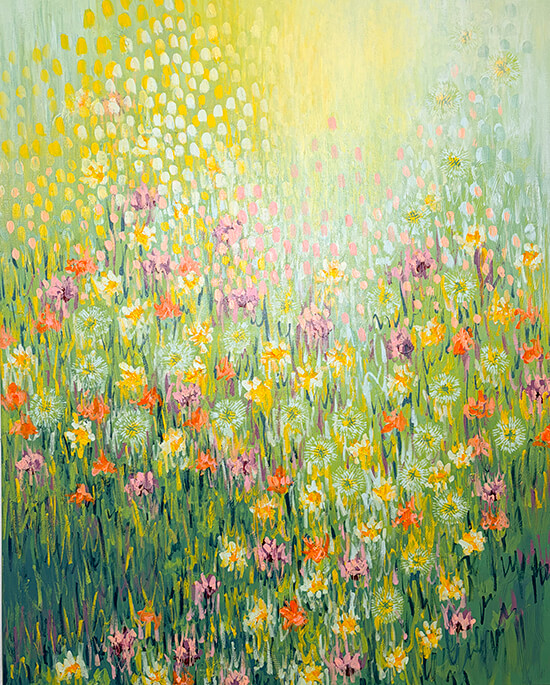
The result is something close to a spatial record of a particular period in her life. The exhibition moves through “Innerworkings,” “Pond” and “Dandelions,” progressing from recognizable forms toward increasing abstraction. Tan describes this as “a play on ambiguity versus what you can actually visually see in terms of botanicals and atmosphere.” At the center of her compositions are often areas that appear unresolved or emptied out. “I wanted it to feel like there’s a bit of a horizon in which you can’t see anymore,” she says. “So that’s why I created a lot of blur and clarity, which is the tandem that I’m playing throughout.”
That uncertainty is also where Tan locates the viewer. She has noticed that people who gravitate towards her more figurative paintings tend to want recognizable forms. “If they gravitate to, for example, the dandelions, it means that they’re more practical,” she says. By contrast, those drawn to her more ambiguous works are “okay operating in a bit of the uncertain.” She is amused by the impulse to decode abstraction: “Everyone’s searching for something to look at, but some are okay with not knowing, which I like.”
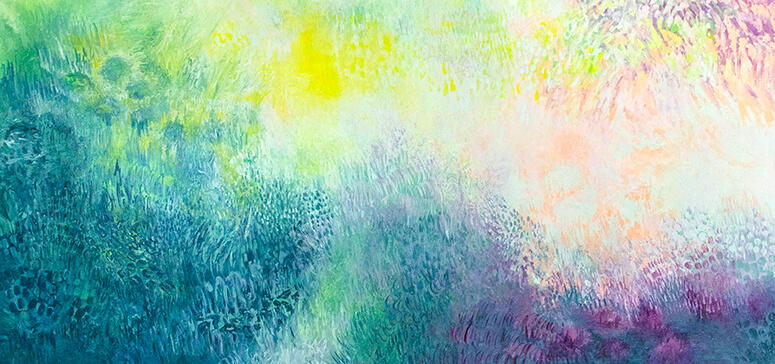
Tan’s own criterion for completion is similarly resistant to certainty. She stops when a painting “provides an atmosphere or a whimsical thing that satiates my imagination.” If it does not, she continues looking and working. The process is almost bodily rather than analytical, governed by whether “the energy and the balance and the proportions and the movement of the light” have settled into place. A work is finished, she suggests, when “it’s just no longer to the point where I’m losing sleep over it.”
This emphasis on work complicates the softness that viewers sometimes project onto the paintings. Tan recalls being told that the exhibition feels “very feminine,” an interpretation she distrusts. “I don’t know where that comes from,” she says. “Is it because of flowers? Is it because of botanicals? Is it because of the use of pink or purples?” She does not regard certain colors as inherently gendered: “For me, it’s just colors I gravitate to.” The complication, she admits, is that the artist’s physical presence can reinforce what viewers already want to see. “I do love fashion, I do love makeup. My persona adds to femininity. So sometimes I don’t like to go to my shows because then it influences the perception.”
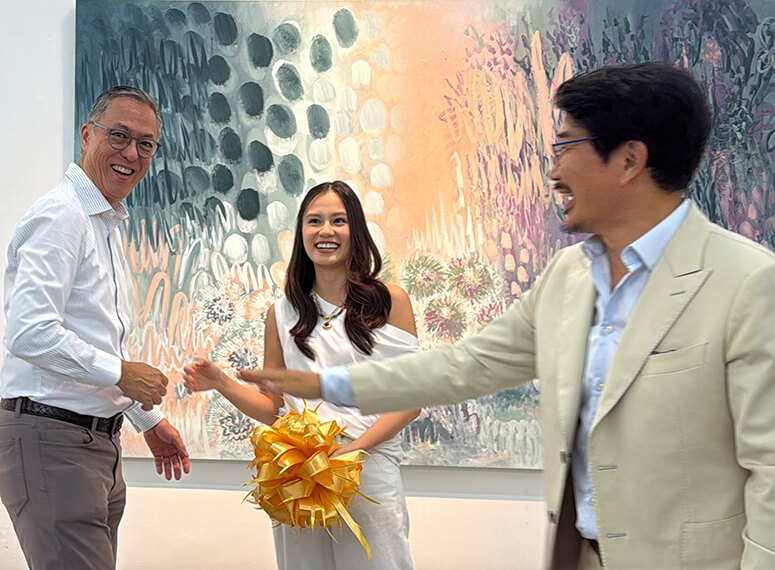
The comment reveals one of the more interesting tensions in Tan’s practice. Her paintings appear to invite projection, yet she remains acutely aware of the ways biography can constrain interpretation. She accepts, rather than resists, another biographical fact that accompanies her career. Asked how she deals with people who might dismiss her through family associations, she replies with unusual equanimity: “If you go to the root of what they’re saying, it’s not false.” She does not attempt to argue the point away. “It is what it is and you just have to keep going.” What matters, finally, is that “nothing will stop me from painting.”
This insistence on painting predates exhibitions. Tan says she was already working nightly in high school and considered herself serious about art long before it became a professional identity. “It was a matter of when, not if,” she says. For years, she painted without knowing whether the work would be shown. “All of this was created before I even knew I had a show.”
Maria Tan’s typical day in Singapore starts at 8 a.m. with running, Pilates and strength training. She goes to the studio at 10 a.m., working until evening. In her past life in New York, she painted often into the early hours of the morning. In Singapore, she had to adapt to the rhythm of the city. But in both places, Maria conjures vast imaginary spaces and lights fantastic.
This dedication began even before Tan’s “Mustard Seeds” show in 2024 at New York’s Jutta Gallery. From that show, the artist went on to participate in Rakuten Fashion Week Tokyo 2025, where her work was digitally translated onto textiles. The Columbia University graduate also participated in last year’s “Homage to Gaia” exhibition at Pinto Art Museum. All roads led her here to The Columns Gallery, which has presented works by a diverse roster of artists, including Park Seo-Bo and Yayoi Kusama.
Maria’s current abstraction does not strut itself as a stylistic leap. She spent years learning figurative and technically demanding modes of painting, looking at artists including Jenny Saville and Chuck Close. Eventually, she says, “I felt like I could paint anything, and now it’s up to you to choose what you feel is most representative of you.” Her abstraction emerges less as a rejection of representation than as the result of having worked through it privately. “You kind of go through years and phases and series that are just purely for you,” she says.
Some of those works remain in storage in New York, “in a basement,” as she puts it, where they may never be seen. There is an appealing contradiction here: an artist preoccupied with light whose earlier paintings remain literally out of it.
New York itself belongs to another version of Tan’s life. She moved there at 18, studied economics and later worked in investment banking and management consulting. “My life was so, so busy and super chaotic,” she says, and her paintings reflected that compression. After returning to Southeast Asia, a quieter life allowed domestic objects and color to enter the work differently. “Now I’m able to use the stability of living in Singapore as like a grounding force in everyday objects,” she says. “I wouldn’t have thought of them if I didn’t move here, because then you’re stopped by like the busyness of New York City. Now you’re looking at domestic affairs.”
In Singapore, where Tan is completing a master’s degree in Fine Arts at LaSalle College of the Arts, she takes the bus home from the studio, watching the city pass while listening to music, podcasts and audiobooks. “Here it’s just a more peaceful, quiet life,” she says. Asked whether the focus is now entirely on art rather than finance, the answer is unequivocal: “My mind is consumed with art now.”
For all the talk of atmosphere, whimsy and imagination, Tan’s paintings seem ultimately rooted in this friction between the immaterial and the stubbornly ordinary: light and a soup spoon, ambiguity and a toothbrush, fantasy novels playing through headphones while paint dries on the floor. The paintings may attempt to catch something that cannot quite be seen, but the method is resolutely physical. Tan keeps returning to the studio, keeps making marks, keeps waiting for mornings that creep in this petty pace from day to day.
Light comes, light goes.
Maria stops.
And yet it is the beginning of everything.
* * *
Special thanks to Michael and Ann Tan.
Maria Tan’s “First Light” was on view from July 1 to Aug. 8 at The Columns Gallery, 22 Lock Road #01-35 Gillman Barracks, Singapore. For information, visit www.mariaangelicatan.com or www.columnsgallery.com.

WATCH: Pixar Summer Fest adventure at Hong Kong Disneyland
August 10, 2026
WATCH: Is Philippine cinema still thriving? (Generations Ep. 19)
September 2, 2026