

You’re so critical
What’s the best approach to writing about art? Should art critics simply report on what they see in a gallery show, what it makes them feel, what the artist (or curator) has in mind? Or should they take a more critical approach, place the work within the local art milieu, adopt an adversarial stance?
The Kalaw-Ledesma Foundation Inc. (KLFI) held a deep dive discussion on this very topic, featuring two Southeast Asian perspectives: Philippine art writer and educator Pristine de Leon (our former Purita Kalaw-Ledesma Literary Criticism Award Winner in 2016), and Singaporean art writer and educator Corrie Tan, who operates the online independent literary journal Jom, sat for a day-long chat about our roles as art critics.
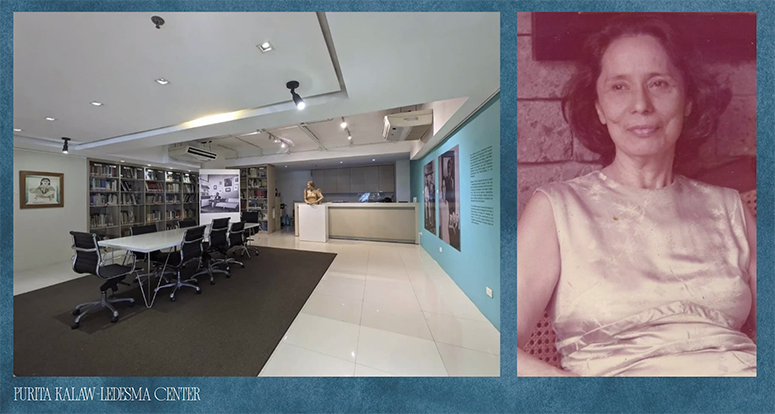
Their approaches couldn’t feel more apart. In her talk (“Eye to the Undercurrent”), de Leon took up the cudgels of the Filipino critic, citing Cesare Syjuco’s pieces through the 1980s and ‘90s as one approach: feisty, “mataray,” but spot-on about the shifting scenes of Manila’s art spaces, commercial and otherwise. (A typical Syjuco title: “The Critic: Villain or vital cog?”)
Sifting through the seminal essays of Kalaw-Ledesma and others that followed (many of them archived at KLFI), de Leon rightfully sees that we might lose something if we don’t extend our pieces beyond “reportage” (i.e., describing the artworks, what the artist wanted to say) and into “commentary.” This requires a more holistic—or individualistic—appraisal of the art scene. We have to “respond to the milieu,” as she puts it.
CONTINUE READING BELOW

I must admit, that level of inquiry is sometimes beyond a newspaper’s 1,000-word space limitations. But are we missing out on the forest for the trees if we don’t try? She suggests our writers go beyond “describing” and look more towards “reframing” our observations into critical questions. Alternately, instead of using a piece to slam an artist’s shortcomings, we could look at the “broader tendency or sensibility” at play in the art scene.
Good points from de Leon, who knows the inquiry can always go deeper, become stronger, if we are to help “drive” the artistic dialogue between artists, the public, academics and institutions. “If there’s no conflict, there’s no community, or place of discussion,” she says. The art critic can be a provocateur, an imp, and a disruptor (something de Leon cautions us to never mistake for “actual power” in the system).
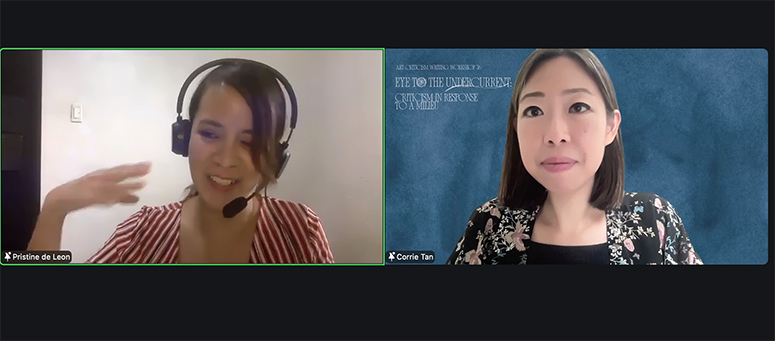
For Corrie Tan, Jom takes a seemingly opposite approach: longer pieces (2,000-5,000 words) revised for over up to 10 weeks, “reader engagement” through literary devices, and a kind of “care work” mission as art critics. It’s “slow journalism” as a response to an often highly antagonistic, fast-take-driven new media landscape. Tan warns her writers not to “get too close” to artists, or risk losing their interrogative stance; she sees their pieces as “a journey of collective exploration” between reader, public, artist, and art world. She questions: “How can our critic role be less unilateral and leeching from (using the word kapwa, or parasite), and more symbiotic and co-beneficial?”
Tan admits Jom’s long window for developing and honing their pieces is “a delicious luxury” that print journalism lacks. One might also point out the relative role of media in Singapore vs. the Philippines. The latter has always credited itself as a “mataray” force in reflecting the milieu, political or otherwise; Singapore, not so much.
There is definitely a space for more reflective, user-friendly criticism in Singapore. The goal, shared by the government, seems to be a more-inclusive art ecosystem, though in reality this may result in a marginalizing of certain voices by evening everything out. (This was my experience in covering, say, the Singapore Biennales.)
Far from the hot takes online, in the Philippines, I’m not sure there is still a strong undercurrent of critical print journalism. (That moment may have belonged to the post-EDSA milieu.) Maybe things are just too atomized for there to be a consensus on the local art scene; maybe there’s a gap between academic perspectives and on-the-ground reporting. (Or readership, such as it is.)
I liked how Pristine and Corrie discussed their respective roles in crafting readable pieces: Pristine spoke about “smuggling in” our passions and thoughts to “invite readers in.” (Maybe all good pieces do open with a subjective take.) Corrie described it in terms of “hooks” and “zingers,” and leaning into the pleasures of reading through style and literary tactics.
It’s worth noting the KLFI four-hour forum drew about 40 paid attendees online, people either curious about the state of art criticism or wanting to learn more about becoming art critics. As anyone will tell you, it’s not the kind of job you can retire on comfortably.
In a daily newspaper such as The Philippine STAR, we do allow a broad range of approaches: we encourage our writers to examine the scene through their own lens, connecting it not only with their personal reactions, but to a broader take on trends or the “world at large.” As de Leon says, citing an essay by Chessica Santiago, criticality should be “equal parts curiosity and skepticism, generosity and doubt.” We have to be open-minded, but at the end of the day, as critics, we must take a stance. And we should be brave in doing so.
* * *
The next onsite sessions will be on Dec. 5 and 12. Visit klfi.ph for more information.

WATCH: Is Gen Z too soft? (Generations Ep. 23)
September 30, 2026