

Marvin Montefrio and the stories adrift beyond the frame
There are folks whose circumstances can improve, collapse, recover, and change again before an outsider has even decided what story he thinks he is looking at.
In December 2025, Marvin Montefrio was staying in a fisherman’s house on stilts in Capiz when a storm came in.
“The storm pushed the water so high that it was already touching the floor of the house,” he recalls. “A boat anchored nearby was rocking violently and repeatedly hitting the side of the house. I couldn’t sleep that night.”
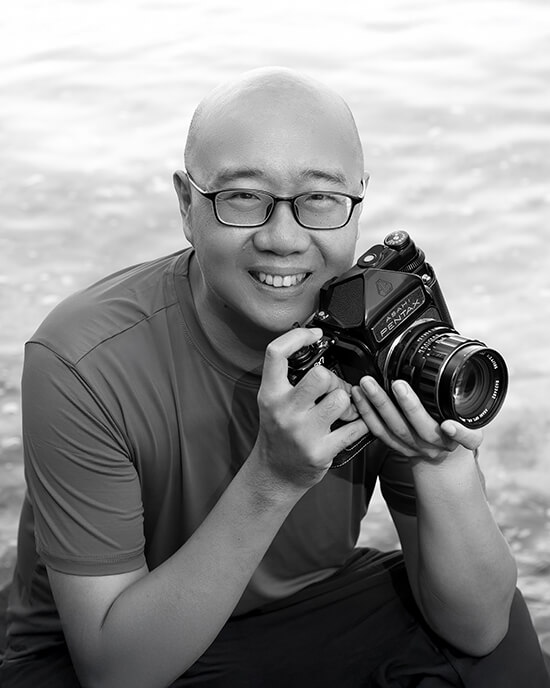
He had his cameras with him. They remained in their cases.
“I wrote field notes, but I never brought my camera out. I only took a quick photo with my phone of what was happening outside the house and sent it to my family to let them know I was safe but prepared to evacuate.”

By morning, he began surveying the damage.
“The experience frightened me,” he says, “but it also gave me a more visceral sense of the anxieties fisherfolk live with in times of bad weather.”
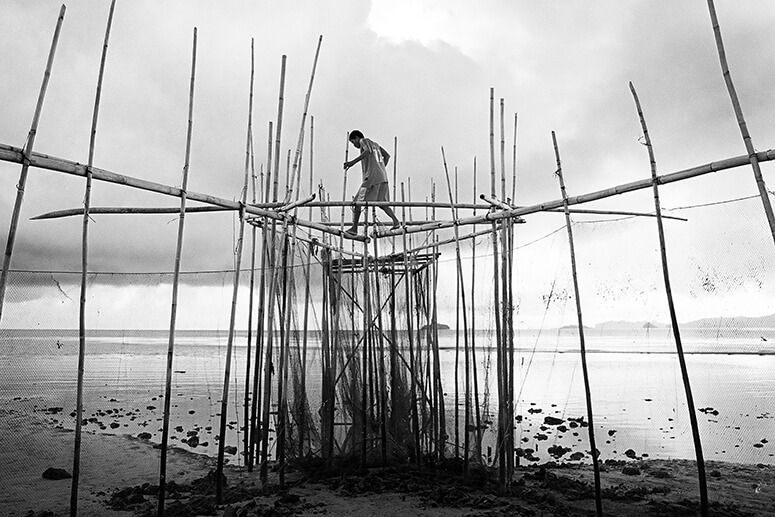
That distinction between witnessing and photographing runs through Montefrio’s work. It is also a useful way into “Báskug,” his series on fishing communities in Capiz, which opens at The Crucible Gallery in SM Megamall on Oct. 13.
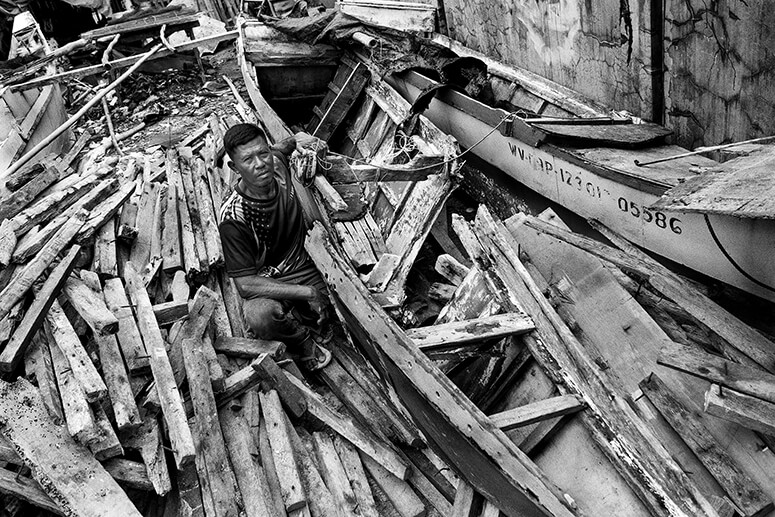
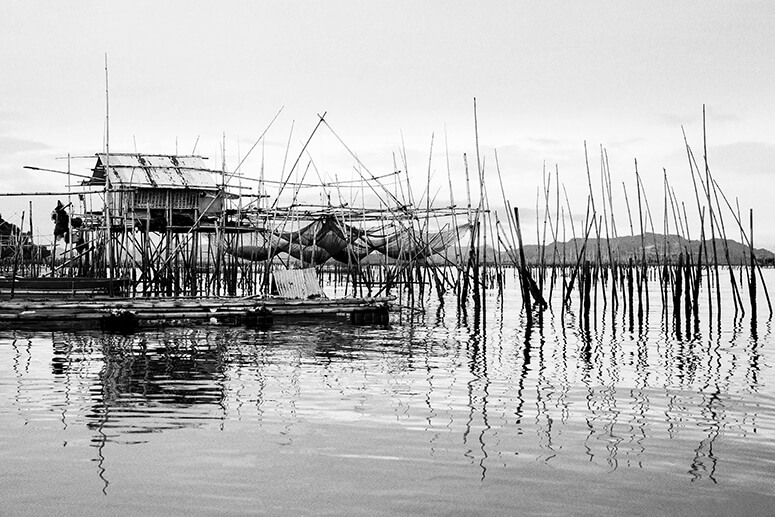
The photographs in “Báskug” were made during periods of ethnographic fieldwork between 2023 and 2026 in three coastal communities in Capiz: Basiao in Ivisan, Lonoy in Sapian, and Pawa in Panay. Across these locations, Montefrio documented the daily rhythms of fishing life, from quiet routines on shore to encounters with unstable weather and changing seas. Together, the images form a portrait of coastal life shaped as much by place as by uncertainty.
He worked with two fully manual film cameras: a Pentax 6x7 medium-format camera and a Pentax Spotmatic 35mm, built for demanding field conditions. Their manual operation also forced a slower, more deliberate way of looking, making patience and attention part of the photographic process.
The man is not primarily a photographer who later became interested in social research. The order is the other way around. He is a visual ethnographer and Associate Professor in the Department of Sociology and Anthropology at the National University of Singapore. For around 15 years, he has studied rural life in the Philippines, and his current research follows fisherfolk in Capiz as they deal with extreme weather, unstable livelihoods, and other overlapping pressures.
That background matters because it determines what he does when something happens in front of him.
“As an academic, my priority is, of course, to do research and to be a participant observer,” he says. During fieldwork, he often notices a potentially strong photograph in the middle of a conversation.
“I would think, ‘Oh, wow, this would make a great photograph! But should I run and get my camera, or should I continue having this conversation with a fisher?’”
Usually, he stays.
“More often than not, I let the photographic moment pass. In the end, as a researcher, the ethnographic moment comes first.”
That sentence explains a great deal about “Báskug.”
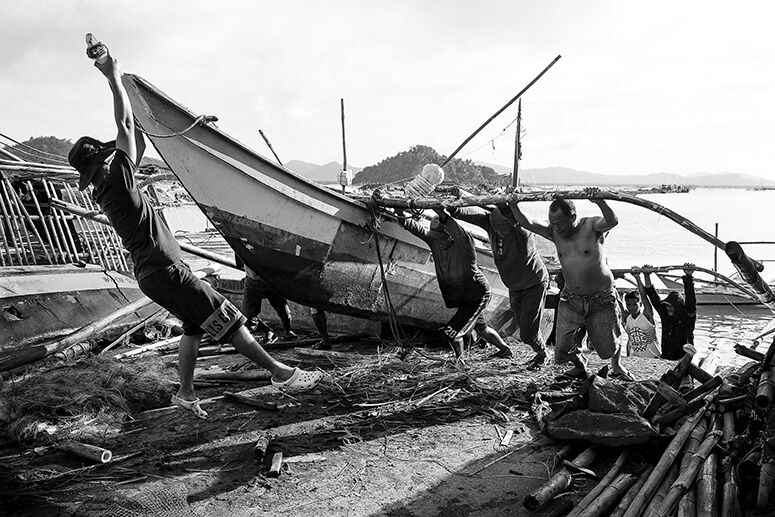
The photographs are not built around spectacular storms, wreckage, or the obvious theater of hardship. Montefrio is more interested in what happens around those moments: waiting, repairing, washing fish, dragging boats, mending nets, standing by the water and watching conditions change.
The poetry in the interim, you could call it that.
His images can be beautiful, sometimes unexpectedly so, and he is aware of the discomfort in that.
“There is a tension there,” he says. “Uncertainties and hardships may be in the air, but when I press the shutter button, many of the resulting photographs create surprising visuals that depict, for example, beauty and tranquility.”
He does not see that as a contradiction to be solved.
“When a moment is frozen in a photograph, much of the context surrounding it becomes hidden.”
A viewer may see still waters. A good catch may look like abundance without showing how much of it has already been claimed by fuel costs or earlier losses. A photograph can make a difficult life appear peaceful simply because life is sometimes peaceful.
There is the conundrum of beauty being presented while it is actually not there at all or not as idyllic as we would like to think.
But there are stories of struggle, Montefrio says, “just not explicitly portrayed in the image.”
And then comes the more important point: “The stories of coastal life are complex and cannot be simply reduced to hardship.”
The title itself refuses a single reading.
Montefrio explains that báskug can refer to “tumultuous weather, the physical strength of bodies, the vitality of one’s health, or the stiffness of materials.”
The word carries roughness and strength at the same time. So do the photographs.
He did not arrive at this understanding through one dramatic encounter. He says it came slowly.
“There was not one particular fisher, family, or encounter that made me reflect on the idea of báskug. Rather, it was the accumulation of encounters with individuals, families, communities over time.”
That accumulation changed the way he understood words that are often used too easily when discussing poor or vulnerable communities.
“Coastal life cannot be understood through poverty, precarity, adaptability, resilience, or fortitude in isolation.”
On one visit he might find a family doing relatively well. Later he might return to the same household and find them struggling with debt. “Following and documenting their lives across time was revealing, because it showed me how quickly circumstances could shift.”
This is where his long-term work becomes more important than any single photograph: a casual sees an event; Montefrio has had time to see cycles.
“There are times of the year when I witness abundance, and other times where there is scarcity and hunger,” he says. “There are periods when the coast is remarkably calm, as between the Amihan and Habagat seasons, and there are times when the rough sea seems to never take a break.”
Even then, patterns only tell you so much.
“On a seemingly calm and uneventful day, one might find fishers mending nets or repairing boats damaged by illegal trawlers or by an unexpectedly strong wave.”
His conclusion is simple: “What one sees during any single visit is partly subject to the luck of the draw.” Fishing itself, in his account, begins to resemble sugal.
Montefrio has wanted to accompany fishermen farther out to sea, particularly on deep-sea trips, but they have been reluctant to take him. “I think they know the dangers at sea well enough that they do not want to be responsible for my life.”
He has gone on shorter trips to fish corrals and cages. Even those changed his sense of the water.
“I realized that even in calm waters, everything could feel very fragile and unstable. There were moments when I found myself wondering whether I was ready to drop my cameras into the sea if something happened.”
There is another story that says even more about his position in these communities.
Montefrio has photographed fishermen hauling boats ashore before bad weather. But there have been times when there simply were not enough men to do the work. “In those moments, I simply put my camera down and helped.”
Then the ethnographer in him appears again. Carrying the boat taught him something that watching it could not. “Feeling the weight of the boat myself made me appreciate the kind of communal cooperation that emerges spontaneously in such situations.”
That may be one reason “Báskug” avoids the usual distance between photographer and subject. Montefrio is still an outsider in obvious ways, but he is not pretending the camera makes him invisible.
He keeps returning. He talks, helps, and takes notes. Sometimes he misses pictures.
But whenever he gets to take photographs, we, the viewers, get the picture of a life of a community surrounded by sometimes hushed, sometimes turbulent indigos and sustained by heroic gamblers going out to sea.
“I always wonder what they themselves see in these photographs, and what emotions the images might reveal or evoke about themselves and their communities,” Montefrio concludes. “I may ask them that one day.”
* * *
“Báskug” is on view from Oct. 13 to 25 at The Crucible Gallery, fourth floor, SM Megamall A, Mandaluyong City. For information, follow The Crucible on social media.

WATCH: Is Gen Z too soft? (Generations Ep. 23)
September 30, 2026
WATCH: Pixar Summer Fest adventure at Hong Kong Disneyland
August 10, 2026