

Duterte impeachment trial Day 33
[ANALYSIS] Battle of laws on confidentiality—and leaks
Day 33 of Vice President Sara Duterte's impeachment trial was so far the height of legal technicalities, this time over questions of whether the laws on secrecy involving suspected fraudulent transactions allow an official of the Anti-Money Laundering Council to take the witness stand.
Citing a “tabular summary” of AMLC reports, Buenaventura disclosed multiple financial entries during the testimony, including two PhilSavings Bank transaction records from December 2018 exceeding P1.9 million each. He and several other AMLC officials had prepared the report.
A 2011 transaction reported by the Bank of the Philippine Islands totaling P9,785,744.55 was held jointly by Duterte and her father, former president Rodrigo Duterte.
Next to the huge transactions, it was likewise a day of more verbal jabs between the prosecution and defense lawyers, this time between Mae Divinagracia and Mark Vinluan, respectively, over practically every detail disclosed by lawyer Ronel Buenaventura, AMLC executive director, on the witness stand, up into early evening of the trial, where parties would become visibly tired and impatient.
The defense wanted Buenaventura excluded from testifying, and its position took about 30 minutes to argue its case, until finally presiding officer Chiz Escudero ruled to allow him to take the witness stand.
Vinluan argued that disclosing bank and financial transaction reports violates confidentiality provisions under the Anti-Money Laundering Act.
CONTINUE READING BELOW

Quoting Buenaventura’s report, Divinagracia also reported there were at least 40 other “covered transactions” tied to alleged dollar accounts under Duterte and her husband, lawyer Mans Carpio.
Why was Divinagracia disclosing the 40 other transactions? Vinluan asked. “Evidence should come from the witness, not the prosecution lawyer”—an oft-repeated remark from the defense. She said she only wanted to abbreviate the proceedings.
“Let us focus on what the witness has to say,” said Escudero.
Though these were based on reports from different banks, Buenaventura’s disclosures were not actual banking transactions, but a summary of bank transactions.
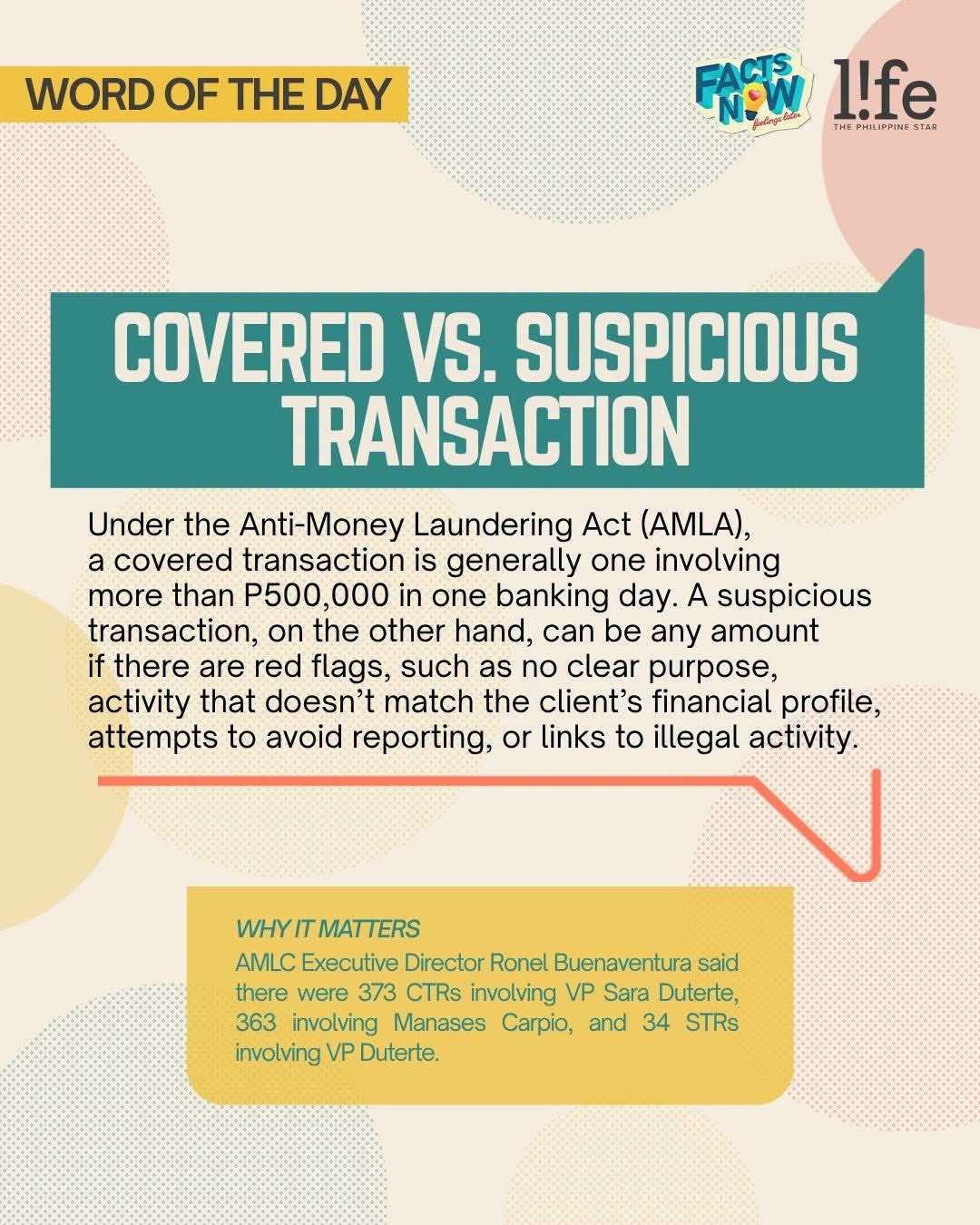
Banks classified these either as “covered transactions” or as “suspicious transactions” and report the same to the AMLC for investigation. So-called because the transactions deviate from a bank customer's normal profile and lack economic justification, which AMLC officials suspect might link to illegal acts, such as money laundering, especially if the source was questionable.
Selected bank officials are expected to take the witness stand for Duterte’s specific bank transactions after the defense cross-examination of Buenaventura.
The amounts disclosed by Buenaventura were a fortune by any standard, especially by the Filipino everyman watching the trial.
But Divinagracia could not say where the amounts in the transactions came from, but she said she was sure these were not declared in Duterte’s Statement of Assets, Liabilities, and Net Worth from the time she was still the Davao City mayor.
Her mayorship was not covered by the impeachment, but Divinagracia said she was trying to present a “pattern and baseline” on Duterte’s wealth acquisition.
But these documents were not supposed to be treated as evidence, according to senator-judge Ping Lacson, quoting a previous Escudero ruling on transactions before Duterte became the VP. “Gusto ko lang po tumulong,” said Lacson for his interjection, sensing what was becoming a tense exchange between the defense and prosecution panels.
Neither could Buenaventura say if the transactions were proper or improper. The STRs and CTRS could be useful to the AMLC for an investigation related to suspected money-laundering offenses, the defense said.
But for an investigation to commence, the council must establish the presence of a “predicate crime” for the transactions to be called “illegal,” as Lacson pointed out.
Neither Divinagracia nor Buenaventura managed to establish the predicate crime during the trial.
Buenaventura said he was “unable to say” if there was any investigation before and after his appointment as AMLC chief “since he could testify only on the documents requested by the court and the prosecution.
“I have no personal knowledge of why the banks called the transactions suspicious,” Buenaventura said.
He said he had no idea if the huge amounts came from unlawful activities.
His testimony was part of Article II of the impeachment complaint, which focuses on allegations of unexplained wealth involving Duterte and her husband.
Buenaventura said CTRs—mandatory filings submitted by financial institutions—were for single transactions exceeding the P500,000 threshold set by the banking system. He disclosed that BPI reported two separate transactions exceeding P9 million each involving Duterte in 2011 and 2013, all before she became vice president.
In the joint accounts of Duterte and her father, the total amount of unique bank transactions processed in a single day was valued at P193,705,615.88 in March 2014.
Though these were based on reports from different banks, Buenaventura’s disclosures were not actual banking reports. Selected bank officials are expected to take the witness stand for Duterte’s specific bank transactions after the defense cross-examination of Buenaventura.
In the series of hearings that began last July 6, the senator-judges, especially the non-lawyers, and the public through various social media posts, have repeatedly complained of too many legal technicalities.
In several instances, Escudero had to cut the defense and prosecution lawyers short of their legal arguments. “Let us make it about the witness, and not the legal arguments of the counsels; let us try to move forward no matter how difficult it is,” he said.
Next to the confidentiality clause and the huge amounts, Divinagracia and Vinluan dickered over many other things.
When Buenaventura replied to a question about when he passed the bar and what his standing was, Divinagracia made fun of it, though naming no one, saying he got a higher rating than someone she and Vinluan knew, apparently referring to Duterte. The court removed it from the record at the request of the defense.
She took another strike. Taking off from Buenaventura’s testimony, she drew a conclusion that Duterte made a withdrawal transaction that took place 11 days before the SALN’s supposed cutoff date, referring apparently to how Duterte spent some P125 million in confidential funds in December 2022.
“This is a court,” said Vinluan. “This is not a barbershop talk. These are unprofessional remarks.”
It was a day when senator-judges likewise contradicted each other heavily.
While the bank secrecy laws provide no exception, the AMLC does otherwise, but only upon orders of a “competent court.” But Buenaventura first revealed the AMLC documents during a House hearing in April 2026. "Is the House a competent court?" Pia Cayetano asked.
Kiko Pangilinan stood up at once to dismiss Cayetano. He said the amendments to the AMLC laws tried to “harmonize” all the banking institutions. But he did not answer Cayetano’s concern about whether the House was a court or not.
Joel Villanueva stood up to defend Pangilinan and Escudero’s order. Imee Marcos argued in favor of upholding the confidentiality clause.
Only last week, former senator Sonny Trillanes held a press conference detailing some of the contents of AMLC documents.
In her opening statement, Divinagracia said she hoped Buenaventura would testify on the amount of money some Chinese businessmen had given to Duterte, which was exactly one of the details disclosed by Trillanes.
Shortly after Buenaventura’s testimony in the House hearing in April 2026, Trillanes and some House officials reported that Trillanes was saying the right thing all along.
So, where did Trillanes get the documents?
It was the longest trial the court has taken, the first since it began on July 6. The trial usually ends before 3 p.m.
Time and exhaustion visibly took their toll on parties, including the senator-judges, after sunset.
Raffy Tulfo raised his voice after Vinluan asked Buenaventura to read the penalty involved over unauthorized release and production of AMLC documents, unmindful that Vinluan only asked Buenaventura to read certain provisions of the AMLC law and the penalty for unauthorized release of documents.
Why threaten the senator-judges? Tito Sotto said they are covered by parliamentary immunity. Why threaten the media? They were only doing their job, said Risa Hontiveros.
The bickering, the legal technicalities, the huge amounts that left more questions than answers—Day 33 of the trial was indeed so exhausting.
Disclaimer: The views expressed in this article are those of the author and do not reflect the opinions of PhilSTAR L!fe, its parent company and affiliates, or its staff.

WATCH: Is OPM still as good as it used to be? (Generations Ep. 20)
September 9, 2026