

Duterte impeachment trial Day 29
[ANALYSIS] The politics in Sara Duterte's trial
Depending on who is talking, Day 29 of the impeachment trial was a day of celebration or of mourning, with 13 senator-judges voting to lower the required threshold to convict Vice President Sara Duterte.
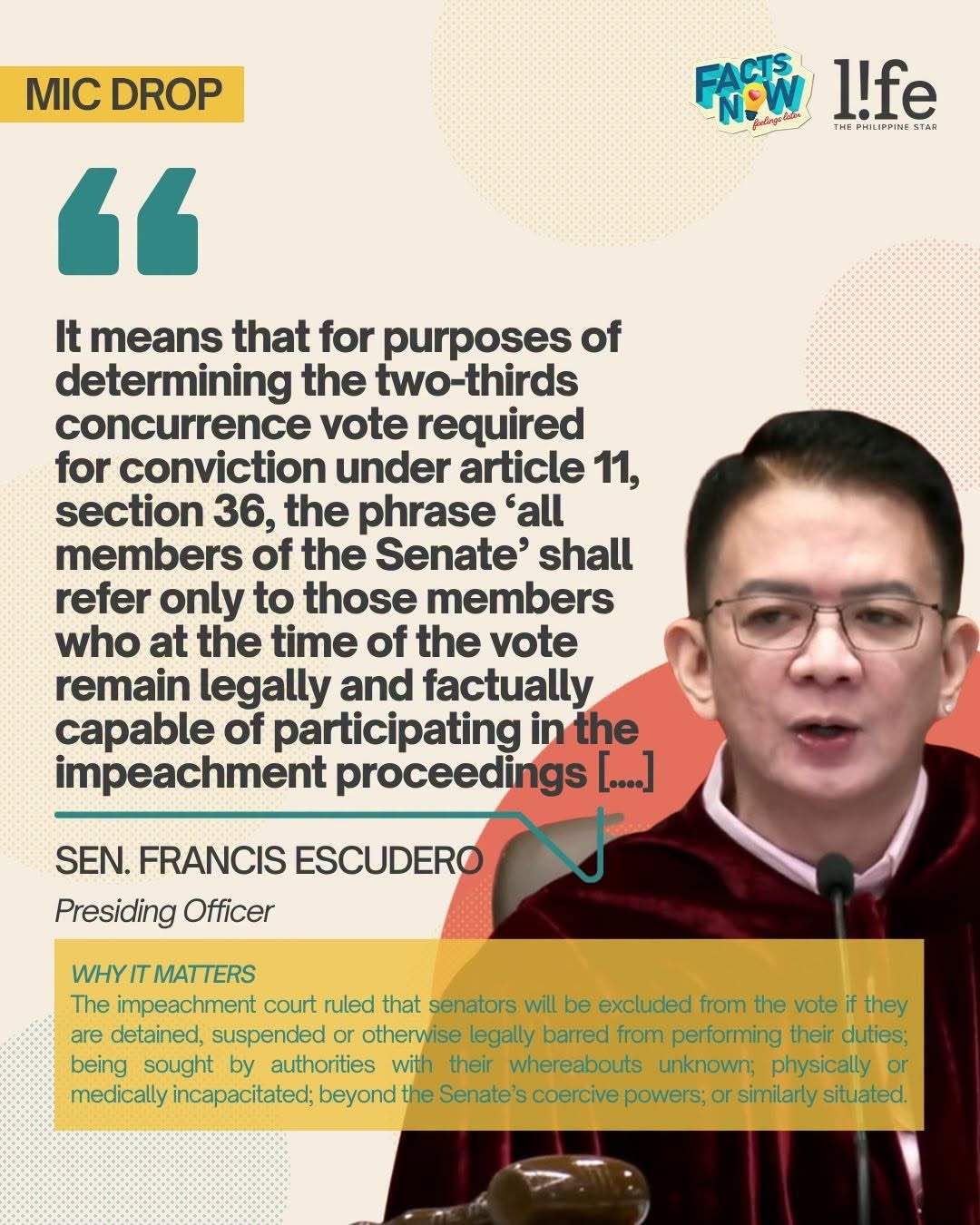
The 13 senator-judges lowered the threshold from 24 to 20, effectively modifying, or amending (as critics of the ruling maintained) Article XI, Section 3(6) of the 1987 Constitution, which explicitly stated that an impeached official “cannot be convicted without the concurrence of two-thirds of all the members of the Senate.” Six voted against it; one abstained.
The 13 senator-judges constituted the Senate majority, the most visible proof that the trial was partly political. Like it or not, the voting somehow gave the public a preview of how the senator-judges would probably vote to decide on the fate of Duterte at the end of the trial.
The “new controlling” threshold now becomes 2/3 of 20, or 14, who can cast their vote come judgment day. It clearly excluded four senator-judges who are missing, detained for corruption charges, and on indefinite medical leave abroad. The four are Bato dela Rosa, Jinggoy Estrada, Rodante Marcoleta, and Loren Legarda—all of them belonging to the minority, or aligned with Duterte or her father, former president Rodrigo Duterte. Legarda left the country shortly after the Ombudsman announced it was investigating her and her son for her son’s solar energy business.
Such voting came a week after the court invited as amici curiae three retired chief SC justices Hilario Davide, Artemio Panganiban, and Reynato Puno, and ex-associate SC justice Adolf Azcuna. The three ex-chiefs told the senator-judges that there was enough elbow room to exclude the four senator-judges. Only Azcuna maintained “all means all,” except in case of death, resignation, and expulsion.
Provided the senator-judges keep the trial fair, independent, and impartial, they said.
CONTINUE READING BELOW

“Tapos na ang boxing,” said an anti-Duterte leader on a Facebook post, commenting on the entire impeachment trial.
A prominent lawyer identified with the former president declared on his social media account: “The rule of law is dead.” The post had an accompanying lighted candle. He expressed fear that the court’s decision would have far-reaching ramifications on the country’s constitutional foundation.
Surprisingly, the House panel, in a subsequent press conference, showed restraint in taking questions. No unnecessary display of jubilation, especially after social media showed several unfavorable comments on the credibility of the possible outcome of the trial.
So, this is about numbers, not evidence, an administration critic said.
While the new controlling threshold required 14 votes to convict Duterte, only 13 voted for the change in the threshold. The new threshold also lowered an acquittal to seven, one vote higher than the six who voted against the change in the threshold. The one who abstained is the man to watch, for he/she would provide the swing vote come judgment time.
By its very nature, the impeachment trial is sui generis, a class of its own, which means it is primarily a legal and constitutional procedure, but with political characteristics.
“It may be sui generis, but it is not a purely political proceeding,” according to a Supreme Court decision penned by Associate Justice Marvic Leonen in July 2025, which dismissed the first impeachment case the House filed against Duterte. “This means that the Bill of Rights, especially the due process clause and the right to speedy disposition of cases, applies to the entire impeachment process.”
When the four justices showed up at the trial to express their respective legal opinions and stayed over for the question hour, the senator-judges made inquiries reflective of their own political issues. Those perceived to favor a conviction sought a change in the threshold. Those who opposed it said otherwise.
We noted that the four justices, wittingly or unwittingly, paved the way for the trial to enter its political side.
The court’s decision came after prosecution lawyer Chel Diokno and defense lawyer Michael Poa argued their respective stances to review and decide on a new threshold, to overrule the July 6 pronouncement of presiding officer Chiz Escudero at the motion of senator-judge Erwin Tulfo.
Both mild-mannered, Diokno and Poa elegantly argued their case. Some senator-judges praised them.
Quoting the four justices, Diokno said an impeachment trial was all about accountability and that the Senate, having been the “sole power” to try an impeachment complaint, should not be limited by the constitutional threshold provision.
Diokno said the prosecution’s position on the constitutional controversy should not be mistaken for an attempt to secure a lower threshold for conviction. “Our responsibility is not to find the most favorable arithmetic. Our responsibility is to prove the Articles of Impeachment within the bounds of justice.”
Poa said the 1987 Constitution should not be used or withheld only when convenient. “When the law is clear, there’s no room for interpretation. The Constitution is not tested when it is convenient. It is tested when it is inconvenient.”
The defense has previously said that the constitutional threshold was 3/4. The framers of the 1987 Constitution did not adopt the US Constitution provision calling for "all members present” and instead used all 2/3 of all members of the Senate.
After the court made its ruling, lead defense counsel Sheila Sison made some emphatic remarks telling the court where the panel stands about the new threshold.
In a manifestation, Sison said: "The Court, being sui generis, does not convert it to a purely political process." She quoted the high tribunal’s July 2025 decision calling for fairness and impartiality and a respondent’s right to due process.
She said the defense would exhaust all means to seek all legal remedies for Duterte, including bringing the court’s vote to the Supreme Court, and that it would continue to participate in the trial, but that it would exercise more caution than usual.
Before the court went into a vote, opposition senator-judges Alan Peter Cayetano, Pia Cayetano, Camille Villar, Mark Villar, and Bong Go stood up, asking the rest of their colleagues to be kind to Legarda, Estrada, Marcoleta, and dela Rosa, saying the four remain senator-judges, even if they could not participate in the trial, though they wanted to, they said.
Speaking on behalf of the minority, Alan said the court couldn’t operate in a vacuum, accusing the Marcos administration of having a hand in the rigorous prosecution of their four colleagues. Outside the court, he said, the opposition senator-judge got pressure from various government investigators.
He likened the trial to the song Spaghetti, a line of which states the number was rising and falling because of the executive's “overzealousness” in running after the senator-judges. His comment prompted the court to make an initial vote on whether it was timely to decide on the threshold at once.
They subsequently lost the vote on the threshold. Most opposition members didn’t show up for the voting on the threshold.
But while listening to Alan, we saw a speech posted on social media by former US President Bill Clinton, a Democrat, criticizing US President Donald Trump, a Republican.
In a speech at the Clinton Global Initiative's 2026 summit earlier this week, Clinton talked about the US Constitution and how the Trump administration dealt with his critics. He probably best articulated what Alan had wanted to say.
"Some days I can hardly believe what is happening in this country that I love so much,” Clinton said. “The people in charge have created one set of rules for themselves and another set for everyone else. They've weaponized the government to settle personal scores, prosecute enemies, stamp out free speech. They've even made the federal government a new profit center for themselves and their allies. That violates the spirit and letter of the emoluments clause of our Constitution."
In the early days of the trial, a prosecution witness, NBI chief Melvin Matibag, talked about Duterte's grave threats against Marcos, as defined in Article IV of the impeachment complaint. But we duly noted that Matibag failed to explain what caused the Marcos-Duterte conflict, where it all began. The collapse of the duo's UniTeam and eventually culminated in the highly politically charged impeachment hearing at the House of Representatives.
In the words of German novelist and 1929 Nobel laureate Thomas Mann: “Everything is politics.” Everything reflects the reality that human values, social structures, and daily choices inevitably carry political weight.
Disclaimer: The views expressed in this article are those of the author and do not reflect the opinions of PhilSTAR L!fe, its parent company and affiliates, or its staff.

WATCH: How to experience Bangkok and Kanchanaburi in one trip
October 21, 2026
WATCH: Is Philippine cinema still thriving? (Generations Ep. 19)
September 2, 2026
WATCH: Pixar Summer Fest adventure at Hong Kong Disneyland
August 10, 2026