

[ANALYSIS] Duterte impeachment trial Day 23: VP Sara urged to testify as Senate weighs voting threshold
The political temperature for Vice President Sara Duterte is rising fast.
Halfway into her impeachment trial, Duterte was asked on the floor to face the heat by taking the witness stand “at the proper time,” or before the prosecution rested its case, which would subject her to intense direct examination. Next to the VP's appearance, a senator-judge sought a review of the number of senator-judges who can vote to acquit or convict Duterte, obviously meant to remove from the equation four missing senators perceived to be sympathetic to her.
The two propositions can boil up the issues surrounding the trial and disrupt its flow. They could push Duterte to the wall and force her to bite the bullet sooner than expected, so to speak.
The prosecution formally sought the request on Tuesday, Sept. 8, in lieu of dropping 15 witnesses for Article I of the four articles seeking her ouster and perpetual disbarment from taking any public office.
“There’s no way but for the Vice President to face the trial and answer all allegations against her,” said prosecution lawyer Lorna Kapunan, setting the tone of Day 23.
Kapunan said the prosecution has presented enough witnesses and pieces of documentary evidence to prove that Duterte had squandered the funds based on Article I. That’s why there was no need to call for the other three witnesses, she said.
CONTINUE READING BELOW

There were other prosecution witnesses in the pipeline for the two remaining articles.
It was the first time the prosecution formally made the petition at the trial, though its lawyers and spokesmen—especially Rep. Benny Abante and former congressman Ace Barbers—had long sought Duterte's appearance during the House's impeachment hearings.
Duterte had defied House committee subpoenas to appear, saying that they had been hostile toward her and her team attending the proceedings. She didn’t want them to feast on her, she said.
The call for her appearance was a gambit, and Kapunan had to be the one to make it, as the eldest or most senior member of the prosecution. This came following weeks of testimony from prosecution witnesses who said essentially the same thing: that they had no personal knowledge as to how the questioned confidential funds had been disbursed to confidential agents, most of whom had assumed names.
“It is like a chess game,” Kapunan said. “There are pawns, bishops, and horses all meant to save the queen.” Duterte was their queen.
But the prosecution refused to present two military colonels—Raymund Dante Lachica and Dennis Nolasco, the missing links between Duterte and the confidential agents. The call for them to take the witness stand seemed risky for the prosecution for still unclear reasons.
Duterte's appearance at the trial could work in the prosecution's favor. Given the circumstances, they hope intense questioning will lead Duterte to lose her cool.
Once unleashed, so to speak, she may indict herself, a self-fulfilling prophecy similar to when she cursed President Bongbong Marcos, his wife Liza, and former House Speaker Martin Romualdez.
That was reminiscent of a brilliant courtroom scene in A Few Good Men, when Tom Cruise, playing a military prosecutor, elicited a confession from a more senior officer played by Jack Nicholson.
Defense lawyer Sheila Sison opposed the prosecution's request, saying it violates the constitutional prohibition against compelling a respondent to take the stand. “There is an innate problem in that kind of request because the Constitution prohibits this kind of testimonial compulsion from the accused herself,” she pointed out.
According to her, Article III, Section 17 of the 1987 Constitution puts in a “guarantee” that “no person should be compelled to testify against himself or herself.”
The request was made in the name of transparency, said lead prosecutor Gerville Lusitro. “We owe it to the people.”
Under the existing Senate rules on impeachment, according to the presiding officer Chiz Escudero, the court can’t explicitly force a respondent to be present or take the stand.
The court said if the prosecution would insist on calling the Vice President, it must submit a formal written motion, allowing the defense to submit a formal comment and reply before the court votes or rules on the request.
The prosecution said it would ask for Duterte’s appearance at a later time, when it has presented all other witnesses for the two remaining articles. But the early request made on Day 23 already galvanized the issue, shocking and awing Duterte’s supporters.
Senator-judge Erwin Tulfo sought a review of the constitutional provision setting 2/3 of the 24 sitting senators who can vote in an impeachment trial, stripping four senators who have not been attending the trial of their duty to vote for or against Duterte. They are Bato dela Rosa, who has been in hiding amid an ICC warrant; Jinggoy Estrada and Rodante Marcoleta, who are both detained for non-bailable plunder cases; and Loren Legarda, who is on indefinite medical leave. All of them are perceived to be Duterte's political allies.
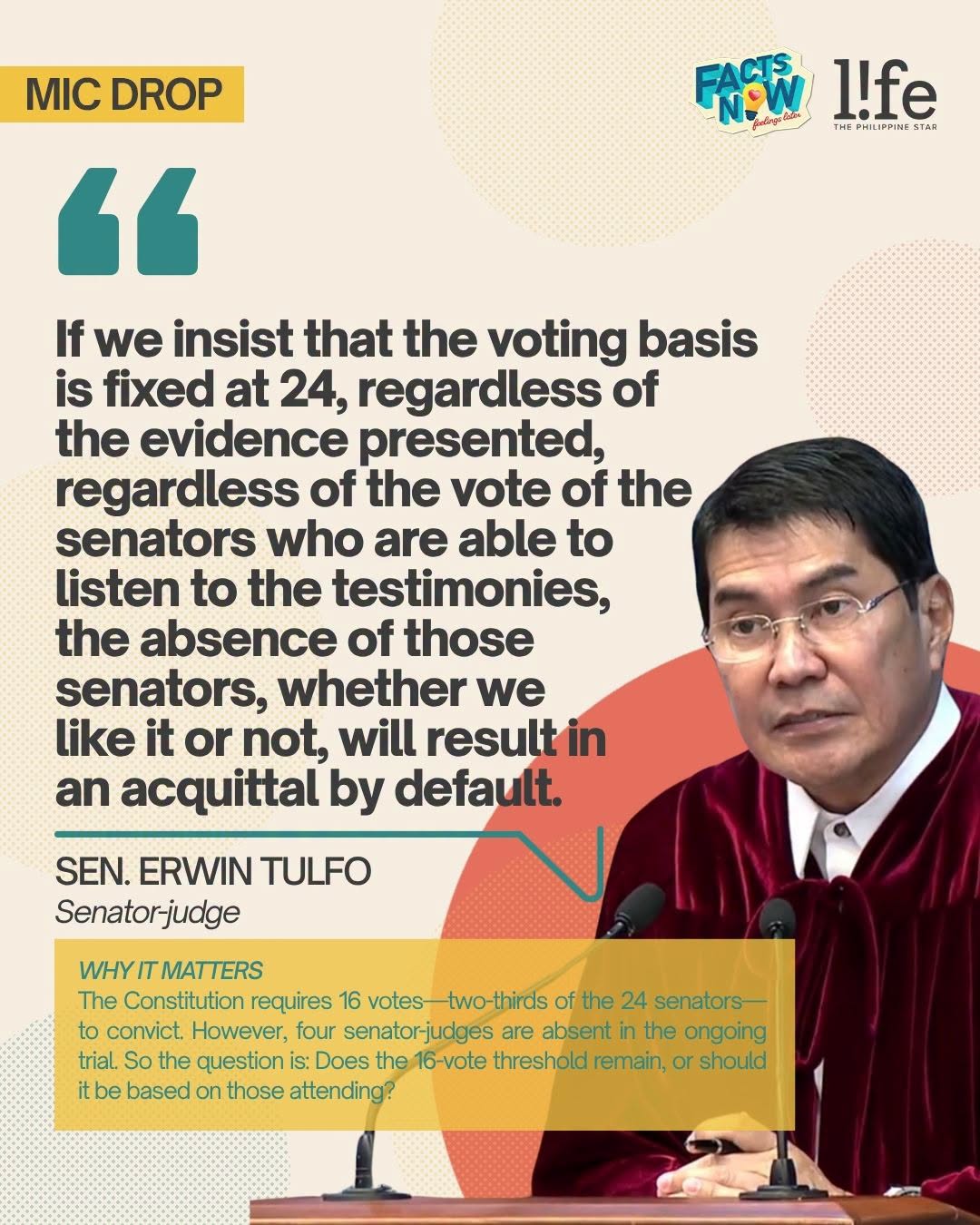
In his July 6 statement opening the impeachment trial, Escudero said that for a conviction, the trial would require 16 votes, quoting the Constitution.
Compliance with the constitutional provision is expected to acquit Duterte. If the four were prevented from voting, it is believed that the court would be heading for a conviction, regardless of the pieces of evidence presented, and would still be presented for the remaining Articles II and III.
The two manifestations happened on Day 23, effectively providing a turning point in the trial, all in the name of “abbreviating” the number of trial days and “providing clarity” as to how many can vote.
The issues nonetheless triggered a spirited debate among the senator-judges.
“The matter of threshold is not a matter of guilt or innocence, but a matter of threshold,” said Bam Aquino.
Pia Cayetano said the Senate had no power to interpret the Constitution, much less amend it. “That final interpretation belongs to the Supreme Court rather than the Senate,” she said. Cayetano rose to the floor more often on the issue.
Robin Padilla said the senator-judges had a sworn duty to follow and uphold the Constitution, not change it.
While he initially viewed the constitutional wording as non-debatable, Joel Villanueva said he was willing to support and study the matter further now that an appeal has been raised.
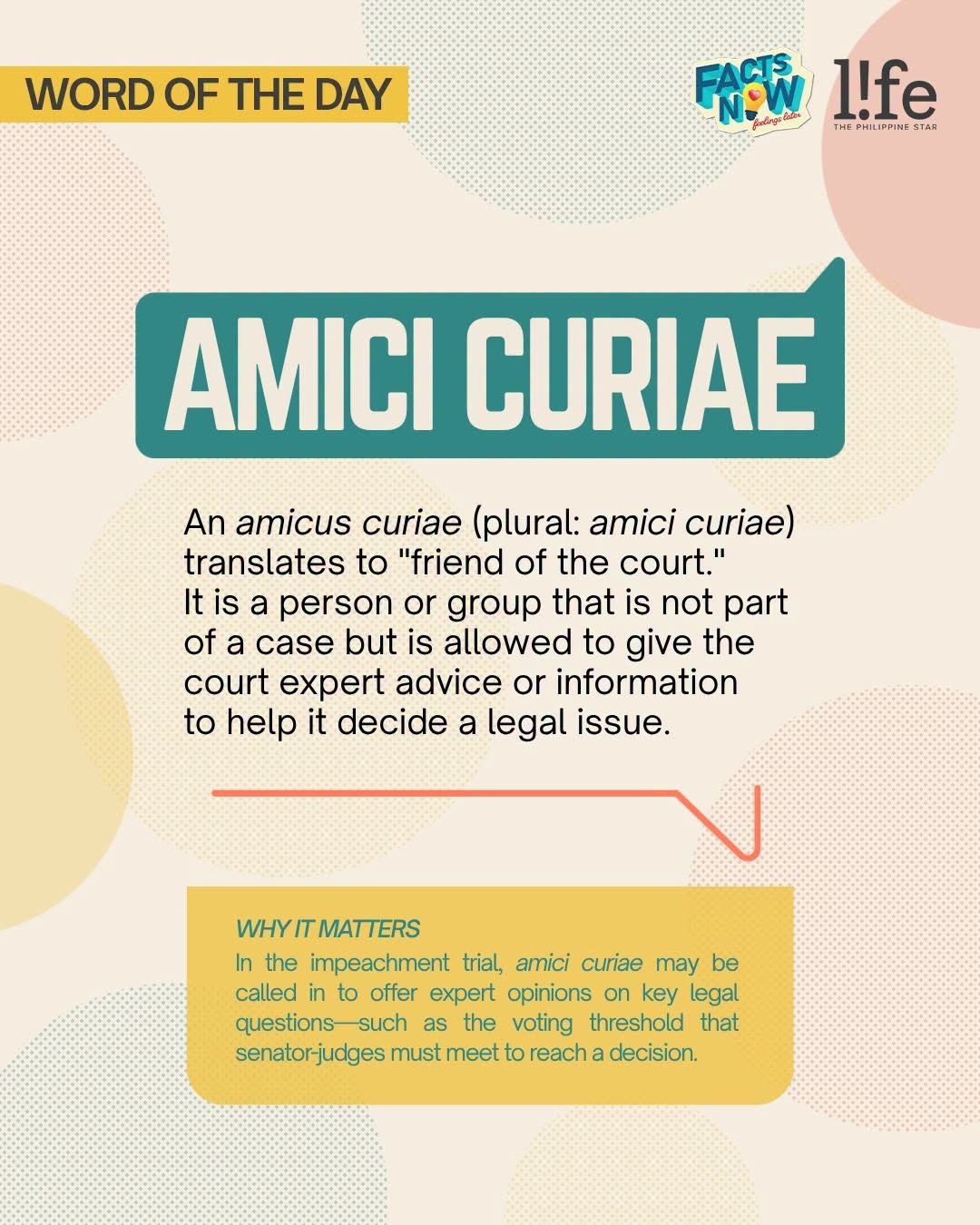
Francis Pangilinan expressed support for inviting more senior legal experts, possibly retired Supreme Court justices, as amici curiae to help the court resolve the issue fairly. An equal number of former justices will be invited from each side.
It was a political master stroke for the prosecution to seek Duterte’s appearance for its shock value. The call to amend the Constitutional threshold posed a danger of amending the Constitution.
Like it or not, the two issues, though inherently part of the trial process, would reflect, if not lean toward, the political side of the sui generis.
Either way, the heat is on for Sara Duterte.
Disclaimer: The views expressed in this article are those of the author and do not reflect the opinions of PhilSTAR L!fe, its parent company and affiliates, or its staff.

WATCH: Is Philippine cinema still thriving? (Generations Ep. 19)
September 2, 2026