When kidlat discovered that even americans farted
Rarely do we come across a lifework of such arduous excellence. Launched last year in New York City, and subsequently made available at the Ateneo Art Gallery, Mt. Cloud Bookshop in Baguio, and the Frankfurt Book Fair, Markets of Resistance is edited by Angel Velasco Shaw and released by Baguio Kunst Book Publishing. A four-volume set that will surely join Filipiniana literature collectibles, it also has a slim booklet titled “General Introduction” that necessarily chronologizes and explains the distinct volumes in thematic order.
Shaw is a visual and media artist, curator and educator who has divided her time between Manila and New York. She has produced experimental documentary films that have been screened in festivals in the US, Asia and Europe, and joined museum collections such as that of the Museum of Modern Art. Among her previous publications is Vestiges of War: The Philippine-American War and the Aftermath of an Imperial Dream: 1899-1999, co-edited with Luis H. Francia (New York University Press, 2002). She was a recipient of the 100 Most Influential Filipina Women in the US “Innovators and Thought Leaders” Award by Filipina Women’s Network in 2011.
Shaw starts with her General Introduction titled (In)Convenient Consumption, and follows it up with separate Intros for each of the thematic volumes: Betrayal & Defiance; (Un)Necessary Fictions; Unfolding Consciousness; and Afterlives of Encounters: The Markets of Resistance Archive.
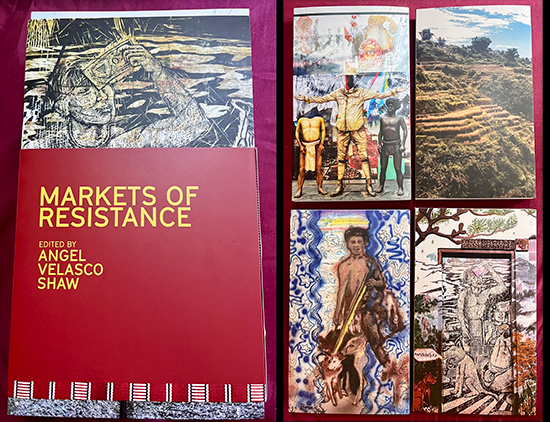
The Cordillera communities produced artists whose “multicultural colonially resistant cultural responses emboldened them to Filipinize dominant Western art practices,” writes Shaw in the initial Intro. The eventual Archive “would materialize from a 36-year relationship (hers) with the Baguio Arts Guild and their offspring, and the city of Baguio, where the inhabitants sustain an integrated matrix of Indigenous and non-Indigenous traditions, heritages, cultures and in a daily struggle against overdevelopment.”
That overdevelopment has ranged from the region’s spotty colonization by Americans who replaced Spain to modern-day conflicts spawned by perennial business interest in replacing Baguio’s public market—that always encountered resistance.
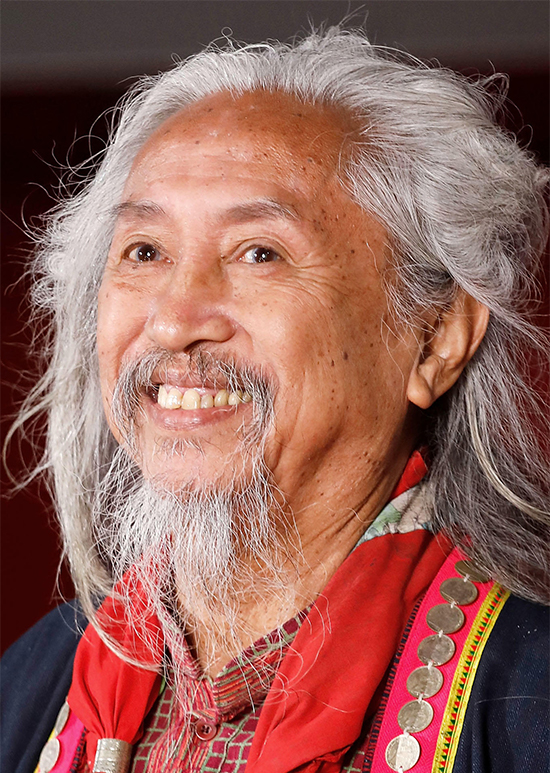
The dedication page for the entire set says that it is “In memory of Santiago Bose, Roberto Villanueva, and Rene Aquitania,” and also “For David Baradas, Ben Cabrera, Katrin de Guia, Tommy Hafalla, Willy Magtibay, Perry Mamaril, and Kidlat Tahimik, founding members of the Baguio Arts Guild.”
One of the more memorable images of the Baguio artists’ impassioned support for the wet market is the sculptural installation of Kawayan de Guia’s “Liberty” mounted on an abandoned rooftop at a market section—featuring a facsimile of the upper half of the Statue of Liberty.
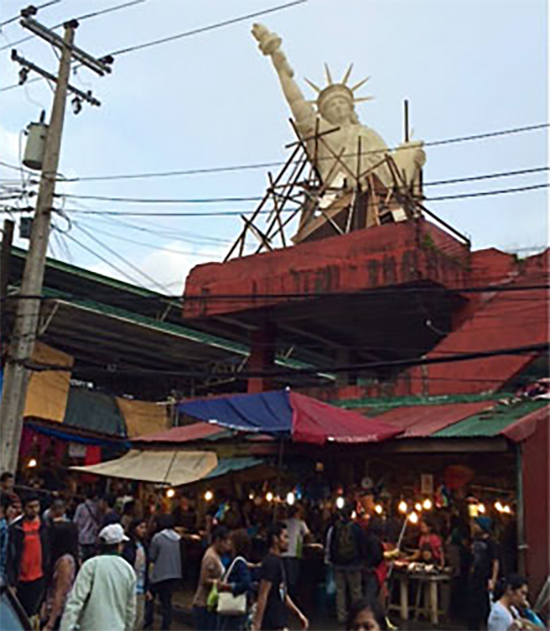
This was in 2014, when I enjoyed participation in the B.A.G.’s activities, including poetry readings at the market. It can be said that it took Shaw more than a dozen years to put this book together, since her concepts of barter trade and mobile markets dated back to her early memories of her mother. Subsequent conceptualization was spurred on decades later by meetings and travels in the Cordilleras, including one with the revered political scientist and author Benedict Anderson. Of course, other readings of a myriad of historical accounts firm up the foundation for the first volume.
Also in 2014, a memorable experience was getting to pose within a virtual standee titled “Fantasy World”—a photo collage printed on clear sticker mounted on plexiglass, with fiberglass figures. At the center was a uniformed American “giant”—eagle-span arms dominating two small Negritos flanking him. It was created in collaboration with other artists by Marta Lovina, who writes:
“My decision to use standees stems from this concept of make-believe identities, momentarily stepping into another time and place with little thought about what typical tourist attraction standees represent. The late Baguio artist Santiago Bose’s mixed media painting, ‘Free Trade,’uses a photograph taken by then U.S. Secretary of Interior and zoologist Dean Worcester of the then former Mountain Province Governor William Pack, as a critique of capitalism, and the ensuing inequality it breeds.”
Given my friendship and familiarity with certain B.A.G. artists at a particular time, I find the third volume most interesting. Its visual contents bring back many fine memories—thanks to Santi (the Guild’s founder), Villanueva, Magtibay, Kidlat Tahimik, Leonardo Aguinaldo, Aquitania, De Guia and Padmapani Perez (who also contributes an essay).
This third volume also has a transcribed video interview that Shaw did with Kidlat a.k.a. Eric de Guia, National Artist, who recollects boyhood memories as a “Baguio Boy.” Apart from remembering when he first realized that the Americans that ruled over Camp John Hay also farted, a first experience for him while sharing urinals in a washroom, Eric shares:
“We were looking at the world in the same way that the Americans were. The Americans were afraid of the Communists. We were afraid of the Communists. They were afraid of Blacks. We were afraid of Blacks. They were afraid of Muslims. We were afraid of Muslims. We had the same framework of the world. And our (Filipino) leaders today, I think, continue to have that (mindset).”
There’s so much to appreciate and hail in this remarkable project gone epic—from early realizations to academic processes and everything else expressive of resistance to any bullyboy culture.
It’s a treasure of a comprehensive compendium, an ensemble mix that also includes poetry, verily its own marketplace of history and its assorted consequences. In a way, they parallel baskets, jars and plastic bags or straws bundling up fresh strawberries, peanut butter, longaniza chains, and Baguio brooms. They’re served up on the shelves of continuing decades of barter, informal and formal. At their best, they inspire art in all its forms, framing Eric de Guia’s “indi-genius.”