

Impeachment Trial Day 26
[ANALYSIS] Retired justices to senator-judges: ‘Be impartial, independent, fair, but threshold up to you’
If it were a chess game, as both the prosecution and defense have once described it, the impeachment trial of Vice President Sara Duterte takes the road closer to a homestretch of the game when very few pieces are left on the board, making it easier to corner—or free a king.
Whether or not which side is facing a checkmate remains a question.
Day 26 heard three of four retired Supreme Court justices who provided the impeachment court a leg to stand on in case they want to exclude non-participating senators from casting their vote for or against a conviction.
Three of the four justices invited as amici curiae, or friends of the court—former Supreme Court chief justices Hilario Davide, Artemio Panganiban, and Reynato Puno—said the sitting senators should not be circumscribed by the provision in Article XI, Section 3(6) of the 1987 Constitution mandating a fixed threshold of 16 votes or two-thirds of Senate members to convict Duterte.
In effect, the three favored allowing only the senators present in the impeachment trial to cast their votes and excluding those missing, abroad, and detained and facing plunder charges.

That view would exclude Senators Bato dela Rosa, who is missing and widely believed to be in hiding; and Rodante Marcoleta and Jinggoy Estrada, who were charged and detained for plunder, from participating and voting on the complaint.
Only former SC associate justice Azcuna opposed the view, saying a conviction of Duterte requires the vote of 16 senators, or two-thirds of all members of the Senate. “The Constitution requires a supermajority of two-thirds of all current members of the Senate. The number only changes if a seat is permanently vacated by death, removal, or resignation,” he said.
The framers made it difficult to kick out an impeachable official because the ruling party didn’t like her, or any impeachable official, he said.
Responding to a question from the defense panel, Azcuna said the Constitutional threshold would guard against the “whims” of the Marcos administration to run after its critics and narrow down the number of participating senator-judges by jailing them.
Still all the justices said the senator-judges must be “fair, impartial, and independent as they try, hear, and decide on the four impeachment complaints against Duterte, ranging from grave threats, bribery, misuse of confidential funds, and unexplained wealth.
The four reminded the senator-judges of what they called their solemn duty, as provided for by the 1987 Constitution which, they said, vested upon them the “sole power” to try the impeachment complaint.
Fairness
At their presentation, the former justices were one in saying that the power to try and decide the fate of Duterte rested only on the senators and could not be appealed to the Supreme Court, except if the senator-judges committed “grave abuse” of discretion.
Duterte deserves a fair trial for the people to believe the court’s decision and to avoid having it questioned before the high tribunal, they said.
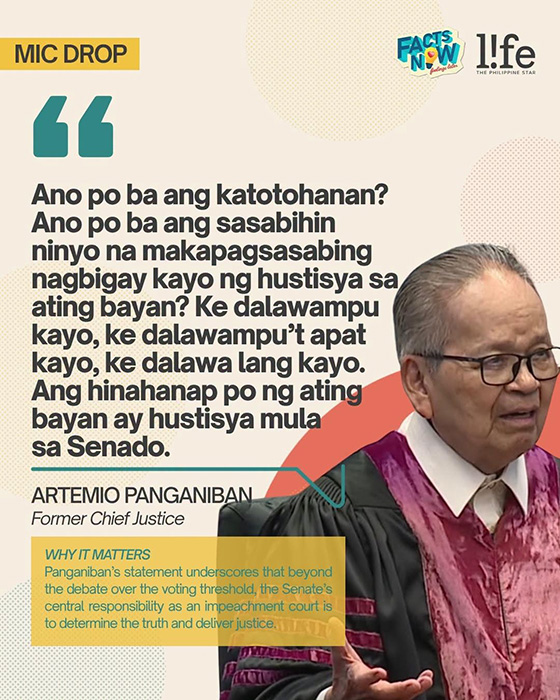
In his presentation, Panganiban asked if it was “fair to allow senators who enjoy tourist spots abroad or those hiding in the dark corners of the world to participate in the impeachment trial’s voting process, when others have allotted time in hearing arguments and examining evidence?”
“The standard of truth is called from facts extracted, one, from studying and verifying the documents and papers submitted by the parties, and two, from hearing witnesses and observing their demeanor on the stand in front of you,” he said.
Panganiban was the most senior of the retired magistrates present, serving as chief justice from 2005 to 2007. He studied law at the Far Eastern University and landed No. 6 in the 1960 bar.
“We have decisions of the Supreme Court which clearly decree that public officers facing criminal cases in court cannot, during the pendency of their cases, practice their profession nor hold office, elective or appointive, while in detention," said Davide in a written position read by the Clerk of Court Renato Bantug.
“Clearly then, the basis of computing the two thirds must be the number of senators who are qualified to vote, not the 24 in the present Senate,” he added.
Davide was the 20th chief justice, serving from Nov. 30, 1998 to Dec. 20, 2005. He was also a member of the 1986 Constitutional Commission.
Puno said the power to change the threshold emanated from the Constitution’s expressed grant to the Senate of the “sole power to try and decide all cases involving impeachment.”
“My respectful submission, Your Honors, is that the Senate, as an Impeachment Court, possesses the power to interpret the meaning and nuances of that sentence,” Puno said.
The framers of the 1987 Constitution, he said, vested the power to decide on an impeachment case in the Senate, not to the Supreme Court. Had they wished so, they could have given that to the high tribunal.
Puno served as the country’s 22nd chief justice, serving between 2006 and 2010. He was the prime author of the Freedom Constitution, which took effect after Corazon Aquino assumed the presidency until the 1987 Constitution was ratified in February 1987.
To be sure, the four magistrates, make no mistake, were invited for their views. They did not volunteer. And they don’t publicly represent any party for or against Duterte.
They enlightened and armed the trial with the necessary legal basis to exercise their power to decide an impeachment complaint.
But their presence likewise gave the senators a platform to raise some questions that were notably reflective of their own political issues.
Those perceived to favor a conviction sought a change in the threshold. Those who opposed it said otherwise.
Senator-judges Robin Padilla and Pia Cayetano managed to bring out what has long been a lingering suspicion over the past many months that the administration had been “weaponizing” the law to charge and detain its critics in the Senate to reduce the number of unfavorable votes against the conviction.
The retired justices emphasized a number of times in the hearing that for the trial to be credible, the senators should be free from partisan politics, and free from pressure, bias and prejudice.
Whether their opinion would influence the senators remains to be seen.
Day 26 was a great discussion of some legal issues about covering the impeachment. But for all their legal brilliance, the three amici curiae were ex-justices, not the justices of the Supreme Court.
If the court needs a judicial review, the 15-member Supreme Court will have to decide. That’s 15 different republics.
Which side is now facing a checkmate? The prosecution or the defense?
Whatever, the appearance of the retired justices, wittingly or unwittingly, has become part of the political side of the sui generis of the impeachment trial.

WATCH: LGBTQIA+ people with unlikely professions
June 28, 2026