

[ANALYSIS] Duterte impeachment trial Day 25: Who's telling the truth about Sara's SALN?
The impeachment trial of Vice President Sara Duterte has gone dry and dragging anew on the second day of Article II, which accuses her of having sinfully accumulated unexplained wealth.
The trial is losing steam, and the prosecution could only blame itself for its lackadaisical scheduling of witnesses who could not keep up with the bravado of its lawyers and spokesman.
Was Duterte honest in declaring her Statements of Assets and Liabilities and Net Worth in the past many years?
Tuesday's witness, lawyer Karen Batu—OIC of the Ombudsman’s Central Records Division—took the witness stand, authenticated, and discussed copies of Duterte's SALN spanning from 2007 to 2013, 2016 to 2022, and 2022 to 2025, when she was still a vice mayor and mayor in Davao City, up until she became the country’s VP, or until she became an impeachable official.
Batu confirmed and identified copies of Duterte's SALNs submitted by the Ombudsman to the House of Representatives in 2024.
On direct examination, Batu reported that Duterte's declared net worth grew from roughly P7.2 million in 2007 to over P98 million until 2025, or over a period of 18 years.
CONTINUE READING BELOW

No one among the senator-judges expressed shock that Duterte’s wealth, or the increase in her wealth, was unreasonable. After the prosecution finished the slide presentation, not one Duterte critic exclaimed: Oh lala!
The prosecution's 10-point offer of testimony aimed to trace changes in Duterte's declared cash positions, foreign currency deposits, business and financial interests, and compliance with divestment rules.
Prosecution lawyer James Bryan Ibrahim Alih tried to pound Duterte’s cash on hand or cash in bank amounting anywhere between P2 million in 2007 and P3.7 million in 2018.
The cash entry disappeared in her 2019 SALN until the 2025 SALN. Alih theorized Duterte could have lumped the cash entry with her tangible assets and this, he said, violated the SALN provisions.
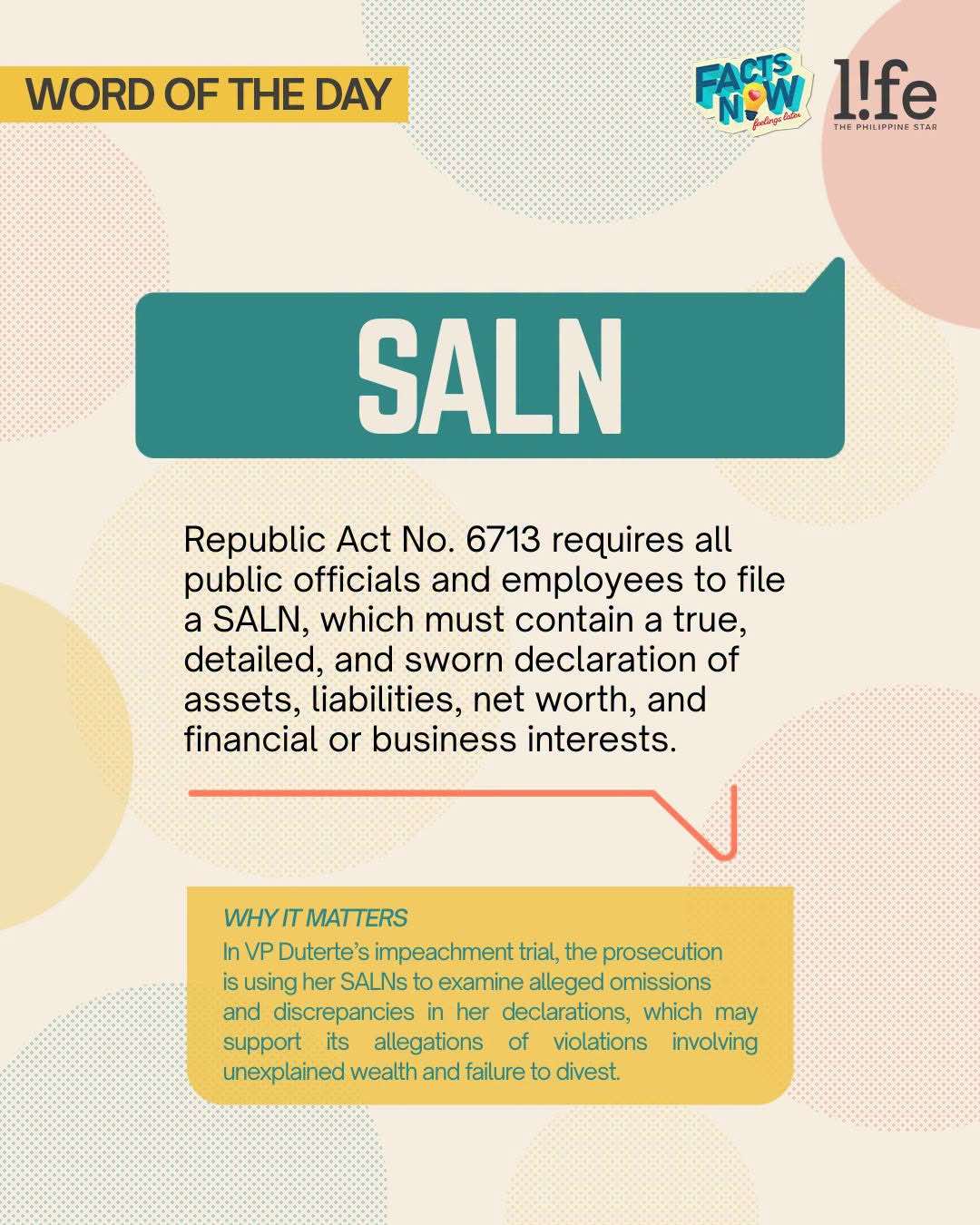
But while separating cash and tangible assets entries had been a common practice, the trial, on cross-examination of the witness by defense lawyer Justin Nicol Gular, showed that there was no explicit prohibition on lumping the two entries together.
The public was expecting Batu to pull the trigger, so to speak, on allegations that Duterte had sinfully accumulated wealth. But she didn’t.
Her role as a record keeper, she said so many times, only allowed her to testify on what was physically written in Duterte's SALNs. She made it clear: She had no personal knowledge or proof regarding whether the Vice President actually enriched herself or acquired unexplained wealth.
Perhaps, because for all the bravado of prosecution lawyers and spokesmen shown in the past many weeks, the public was expecting a bombshell.
Batu gamely answered questions, despite limitations. But then again, she couldn’t pull a trigger, perhaps because she didn’t have a smoking gun.
Perhaps all the prosecution’s claims against Duterte could be true, but it is not there yet. It has not presented enough to pin her down, as Day 25 tackled back-and-forth on laws and regulations on forms and filing covering SALNs.
The public has been wondering what’s holding the prosecution back.
Indeed, what highlighted the Day 25 hearing was a briefing on SALN, not unlike the academic discussion on graft and corruption by retired Sandiganbayan Presiding Justice Amparo Cabotaje-Tang on Day 24, with the senators-judges asking the most interesting questions seemingly for their personal enlightenment, as if they were no veteran SALN filers. Of course, with the usual “para maunawaan ng taong bayan.” Never mind that Batu didn’t sound as authoritative as Tang.
Perhaps the most striking question of the day was from senator-judge Lito Lapid, a known benchwarmer.
When he stood up to raise the question, Lapid said two of his colleagues had asked questions for “free legal consultation” on dollar accounts.
It was only the second time Lapid raised a question since the trial began. Even before he could speak, his colleagues showed surprise, prompting him to comment: "Oh ayan, papanoorin nyo naman ako."
Quoting a lawyer talking on a TV show, Lapid asked Batu: Do you believe that politicians are true and honest in filing their SALNs?
That question drew laughter among his colleagues, though Lapid said he was not joking. Indeed, some public lawyers believed that the SALN law had been the most frequently violated law.
Ironically, at the impeachment trial of Chief Justice Renato Corona in 2012, senator-judge Miriam Defensor-Santiago raised the same point. She called some of her colleagues in the Senate and the House "hypocrites," saying they were guilty of dishonesty in filing their own SALNs.
While delivering her "Not Guilty" verdict speech on Corona in May 2012, Santiago pointed out the logical flaw in convicting Corona solely based on omissions or misrepresentations in his SALN. She argued that if failing to properly declare wealth makes someone unfit for office, then virtually everyone judging him would also be guilty.
Former Senate President Jovito Salonga and former Sen. Rene Saguisag were the primary authors of the SALN law, or Republic Act 6713, passed in February 1989. The two were known for probity and statesmanship.
Also known as the Code of Conduct and Ethical Standards for Public Officials and Employees, R.A. 6713 was in compliance with Article XI, Section 17 of the 1987 Constitution.
Santiago highlighted the double standards of government officials with her sharp observations: Politicians who criticized Corona have frequently projected themselves as honest public servants while using legal loopholes, paper transfers, or distant relatives to hide millions or billions in ill-gotten wealth.
Like Santiago, Lapid was not joking. Perhaps the joke was on the public.
Disclaimer: The views expressed in this article are those of the author and do not reflect the opinions of PhilSTAR L!fe, its parent company and affiliates, or its staff.

WATCH: Can we talk about death and grief? (Generations Ep. 25)
October 14, 2026
WATCH: LGBTQIA+ people with unlikely professions
June 28, 2026