

The illusion of progress for women’s rights in the Philippines
April primarily signals the end of the academic year for grade school students in the Philippines.
The Spanish Educational Decree of 1863 allowed girls to go to primary school and then higher education, because of the American public school system established in 1901.
By the early 20th century, during the American period, those doors began to lead further inward into universities once reserved almost entirely for men.
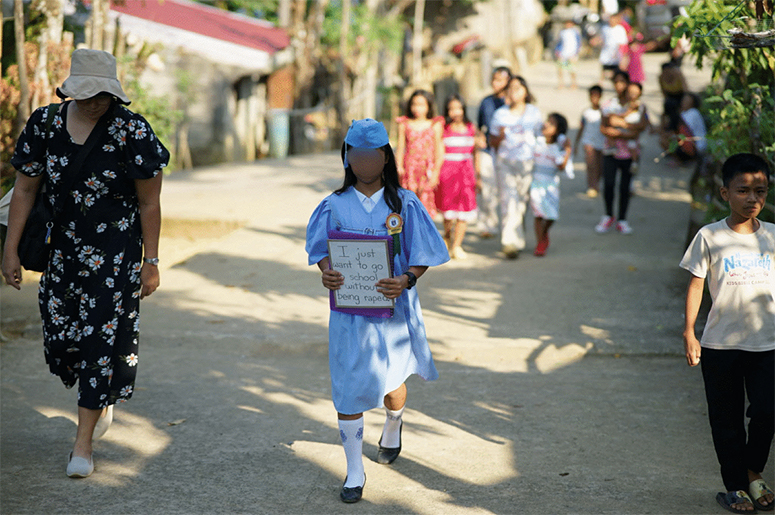
One hundred sixty-three years later, an 11-year-old girl from Tinambac, Camarines Sur, walked on her graduation day holding a sign that read, “I just want to go to school without being raped.” In a letter addressed to the President, the girl reported the alleged abuses of a barangay kagawad and his sons who raped girls in the community.
A total of 3,612 statutory rape cases were reported in the Philippines in 2024, amounting to an average of 10 cases reported per day.
CONTINUE READING BELOW

From classrooms to halls of power, sexual misconduct thrives, normalized by a system that repeatedly fails women and girls.
UNICEF has named the country a global epicenter for online sexual exploitation of children, with an estimated 500,000 Filipino children each year subjected to abuse for the production and livestreaming of sexual content for foreign predators.
April, while meant to celebrate passage and progress, is also Sexual Assault Awareness Month, which exposes how far we have to go in protecting women from a violence that turns everyday spaces into signs of threat.
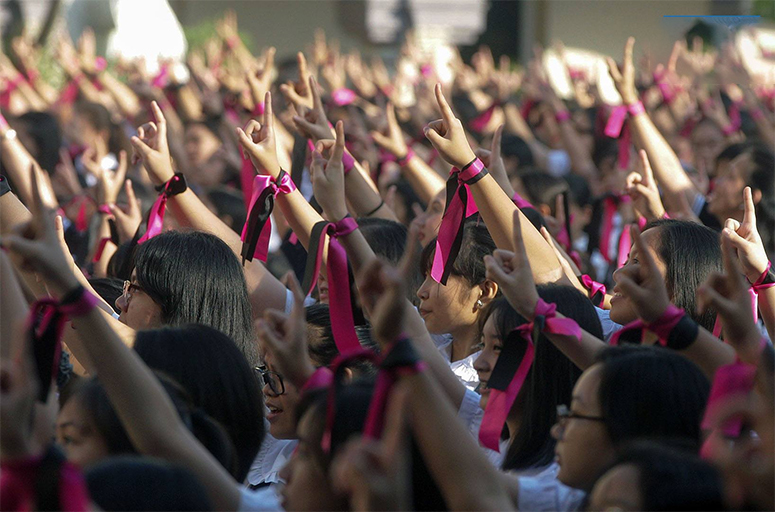
From classrooms to halls of power, sexual misconduct thrives, normalized by a system that repeatedly fails women and girls.
Earlier this year, during Women’s Month, a Quezon City district representative described feeling desire for a female celebrity on a House Committee on Justice session regarding the impeachment complaints against Vice President Sara Duterte. The celebrity was not present during the hearing, nor was she involved in the impeachment case.
The following day, he returned to his seat and told the woman he had talked about that “she should take it as a compliment.”
The month before, in a feature writing class, my professor was discussing an article he wrote about online sexual exploitation of minors. He told us how to successfully and respectfully interview victims and suspects, all before enumerating the sites where to find such content and teasing the class by asking if we knew more. Everyone laughed, inside one of the classrooms of the oldest Catholic university in Asia.
Today I found out that my favorite movies are older than women’s rights.
Pulp Fiction (1994) came out three years before marital rape became illegal in the Philippines.
Miss Congeniality (2000) is four years older than the Anti-Violence Against Women and their Children Act.
Ikaw ay Akin (1978) hit theaters seven years before women were allowed to get a credit card without a male co-signer.
Frankenstein (1910) premiered 27 years before women were legally allowed to vote.
And people, sometimes even women, still wonder why we need feminism.
Women globally hold only 64% of the rights men enjoy. Most tend to easily forget that the rights we have today are not birthrights, but inheritances wrested from a system designed to exclude us. To forget is a privilege; to remember is to understand that the system has not changed as much as we’d like to believe.
The struggle prevails because women have fought for centuries for rights that remain incomplete and fragile because of a politics that answers to a few and abandons the many.
To be able to say “I hate feminism” and advocate for a household vote, where one family is represented by a husband’s vote, is a product of feminism. Whether you choose to be a “traditional” woman or a working woman, the choice exists only because of generations of women who demanded it.
The existence of those who confuse gender equality with the freedom to punch a woman is why we need feminism. This necessity persists at a time when objectification is considered “admiration”; when young girls are stripped of their innocence, forced to march with signs and plead simply to attend school without fear; when children are exploited online for a few thousand pesos while society looks the other way.
These are not isolated incidents or unfortunate exceptions but patterns that persist today because they are still tolerated, excused, and are becoming more and more normalized. And yet many believe that gender inequality is simply normative wisdom in the contemporary world. This belief persists because these realities are filtered through distance, dismissed as irrelevant by those who feel untouched by them. This indifference is why we still need feminism.
A progress that opens doors means nothing if it does not stop the harm that follows women through them.

WATCH: Discovering Vietnam in three days
June 9, 2026