

“At the outset, Your Honors,” Atty. Joel Butuyan said on the projector screen, the recording 30 minutes delayed as it streamed from the International Criminal Court, “we communicate the very deep disappointment of the victims at the decision allowing Rodrigo Duterte not to be present in this stage of confirmation of charges.”
A chorus of “Boo!”, “Shame!”, and “Coward!” rose in the cold multifunction hall of a small migrant-run community center in the Hague. The few dozen demonstrators, bundled in puffer jackets, were watching the first part of the pre-trial over hot lugaw on a chilly February morning. The hall was barely packed, and not all the chairs set out in front of the projector were occupied. There were originally 70 demonstrators before, but a part of them had split from the group earlier in the morning to watch the pre-trial live in the first chamber of the ICC: they were coordinators of the European chapter of the Duterte Panagutin Campaign Network, security, and most importantly, the families of victims of the war on drugs. The former president may not have deigned to present himself to the court, but these people had come all the way here to see the justice that they had once thought was impossible.
Last February was my second time coming to the Hague from Amsterdam with the intention of seeing former president Duterte’s pre-trial, only to catch a disappearing act. In September 2025, his lawyer postponed the pre-trial, claiming that Duterte was unfit to stand for the proceedings. Despite this, I still attended Duterte Panagutin’s program of activities and demonstrations in the Hague on Sept. 20-21, the same days of Baha sa Luneta and the Trillion Peso March. On that weekend, across time zones, Filipinos were demanding the same thing: accountability.
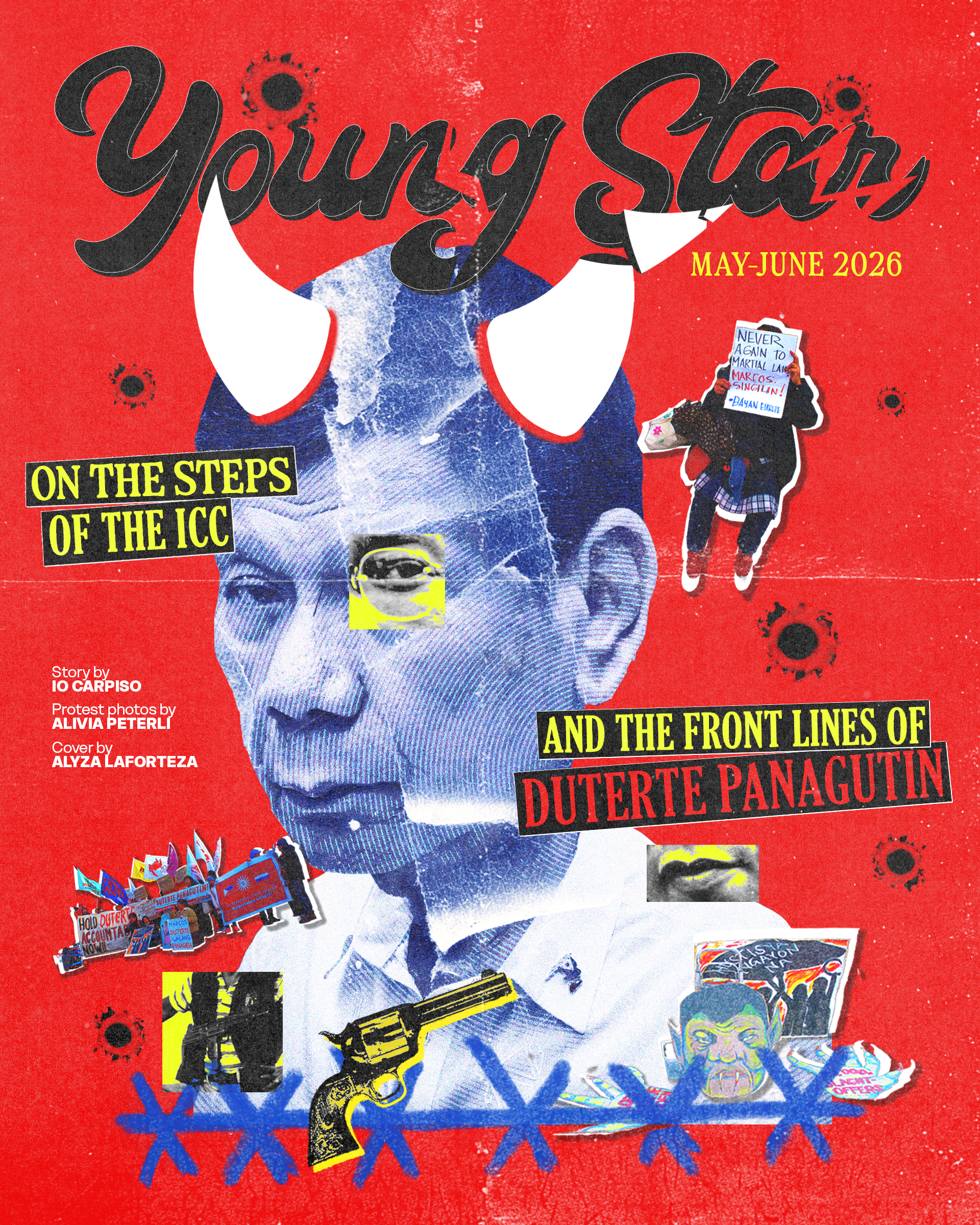
I hadn’t realized there was a campaign at all until I started looking around Instagram, searching for counterdemos to the Duterte supporter-led “Bring Him Home” campaign. As I followed the Duterte Panagutin Campaign Network, I soon found that Duterte Panagutin was made up of a constellation of groups coming from all across Europe. Duterte’s arrest solidified a sense of urgency to these organizations’ collaboration. This was an opportunity to educate people across the world about the horrors of Duterte’s war on drugs and the Davao Death Squad, platform survivors, and to let the record show that not all Filipinos supported an orchestrator of state-sanctioned slaughter.
At first, the news of Duterte’s arrest last year felt unreal. Enzo Camacho, a Germany-based organizer for ALPAS Pilipinas and Migrante Germany, woke up to the news and rushed to fact-check. “I thought it would have been entirely impossible for him to ever face a court in the Philippines,” he said, echoing a common sentiment throughout discussions about the pre-trial. The relief mixed with secondhand grief: an arrest will not bring back the alleged 30,000 lost, one of whom was a brother of a friend of Enzo’s.
CONTINUE READING BELOW

Icai Enriquez, a member of Pinay Sa Holland-GABRIELA, described the hours of anxiety that followed as members of what would become the network tracked Duterte’s travel path and waded through the wildfire of fake news surrounding his arrest. The last thing she wanted was for him to die in custody 一 his martyrdom would be explosive. As a development researcher and community organizer living in the Netherlands, she had seen how polarization had torn her community apart during Duterte’s presidency and the divisive 2022 general elections. This had calmed into unsteady tolerance under Bongbong Marcos’ presidency, but the hostility returned with Duterte’s arrest. The distrust and othering were new developments in the diaspora, a stark difference from the image of a strong community a Filipino could expect to find wherever they went, once upon a time.
When organizing events where they bring in families of the victims from the Philippines, Icai recalls it was the first time Pinay sa Holland-GABRIELA and another group, Migrante, had to consider coordinating a security team. Allegedly, Duterte supporters would hurt or harass victims’ family members during rallies or spit on journalists and reporters. In real time, the stereotype of the diaspora shifted in the eyes of foreigners, especially in the Netherlands. She said, “There was a time ‘pag sinabi mong Pilipino: masipag, mabait, masimba. ‘Yung positive traits natin… Pero now, ‘yung tingin nila sa’tin, ‘yung nagkakalat do’n sa labas ng ICC. It was a very big shift.”
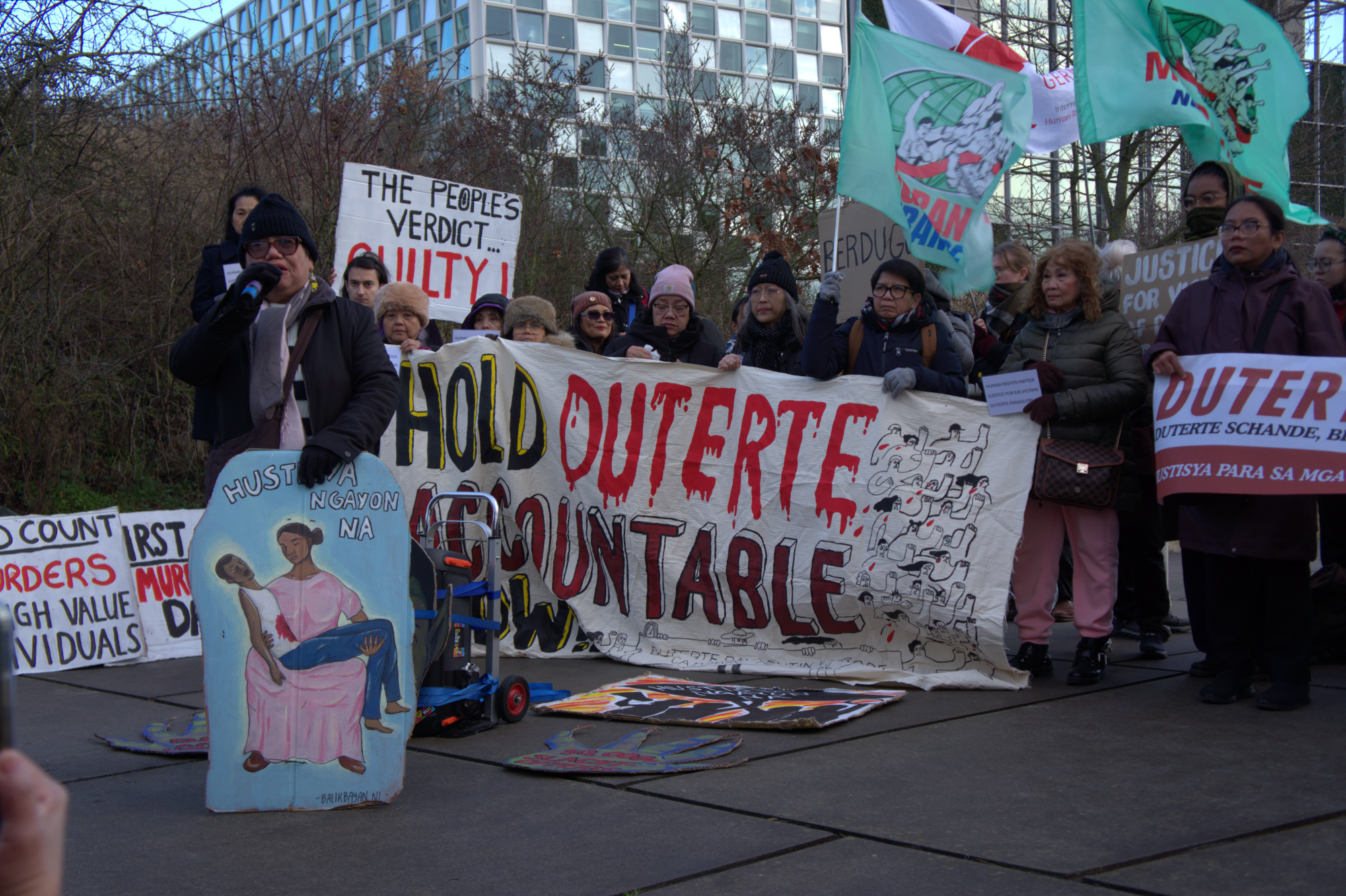
Despite these pains, she refuses to blame the Filipinos who support the likes of the Dutertes and President Bongbong Marcos. Her displeasure is firmly against privileged politicians who stir conflict for their benefit, because unlike them, migrants have no one else to count on but each other. Pinay sa Holland-GABRIELA works with vulnerable people like blue-collar workers, women in abusive relationships, undocumented migrants, children, and trans folk — all of whom are facing the intersectional crisis of being a person of color in Europe. And sometimes, they so happen to be in the Duterte faction. This leads to awkward conversations, but cutting Filipinos off from aid is not an option.
As I followed the Duterte Panagutin Campaign Network, I soon found that Duterte Panagutin was made up of a constellation of groups coming from all across Europe. Duterte’s arrest solidified a sense of urgency to these organizations’ collaboration.
Garry Martinez, the UK-based chairperson of Migrante Europe, lists exhaustive examples of the ironies the progressive groups face as they help their kababayan. Before rallies, it's groups like Migrante and Pinay sa Holland-GABRIELA that release social media statements reminding demonstrators of their rights and visa restrictions. When rowdy protestors get arrested, it's their social media pages that are pinged with pleas for legal advice. Tito Garry, as affectionately called by fellow organizers, had even had to deal with assisting hapless “Bring Him Home” demonstrators consider their travel options in coming to the Hague, where they would undoubtedly find Migrante members pushing for Duterte to answer for his crimes.
As a survivor of human trafficking, Tito Garry is empathetic to fellow OFWs. From his experience over the decades as a laborer, union organizer, and activist, he has found that the embassies and consulates 一 much less the leaders Duterte supporters idolize 一 do not protect their citizens abroad. Groups like the ones that comprise Duterte Panagutin are vital wherever there are OFWs, as they give legal, financial and social aid to the breadwinners of the nation that are sorely under-supported.
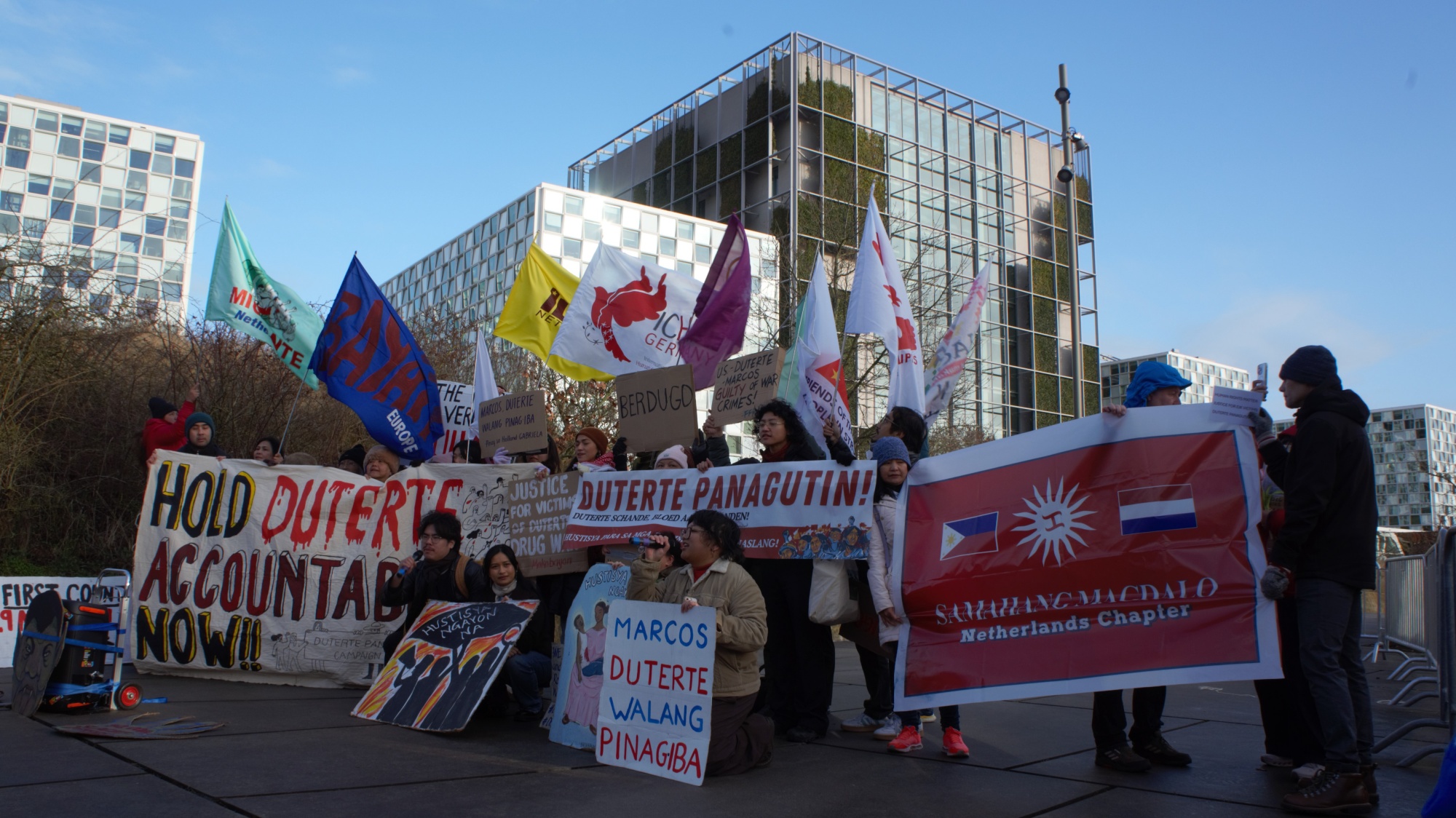
“They were also completely duped by (Duterte),” Fig, a coordinator of the pan-Asian youth group Balik/Bayan, said about Duterte supporters abroad. “Otherwise, why would they be working abroad to make a better life for their families? Why is there still poverty in the Philippines if Duterte was meant to fix that with his war on drugs?”
“Fig” is her action name 一 a nom de guerre many activists in the Netherlands don for privacy and safety when participating in rallies, squats, or community organizing 一 and she had invited me to interview her at a gallery she works at in Amsterdam-Zuidoost. There, she had been coordinating an exhibit on gendered labor and labor exploitation in Southeast Asia, and I watched as she spoke in Bahasa Indonesia and Dutch to artists and curators before switching to English and Filipino for the interview. Fig is a migrant twice over, having moved to Indonesia at a young age with her OFW parent and now working as an OFW herself. She is heavily critical of why her background is not so uncommon among Filipinos.
They were also completely duped by (Duterte). Otherwise, why would they be working abroad to make a better life for their families? Why is there still poverty in the Philippines if Duterte was meant to fix that with his war on drugs?
Her youth and background in the arts aren’t limitations to her work in Duterte Panagutin. Balik/Bayan and ALPAS Pilipinas serve as instigators among the younger generation of activists and diasporic Filipinos, holding youth-centered community events like karaoke fundraisers, movie nights, potlucks, and even Dungeons & Dragons sessions. For the first and second Duterte Panagutin campaigns, Balik/Bayan led workshops among younger demonstrators, creating accessible spaces of engagement, and shaking the narrative that diasporic Filipinos are detached from the struggle.
As it was, I met Filipinos from all around Europe in the thick of the campaign weeks. I met book reviewers, retired nurses, political refugees, students, engineers and radio hosts based in the United Kingdom, Switzerland, Germany, Spain and the Netherlands. I met people who had grown up in the Philippines and others who had only been there a handful of times.
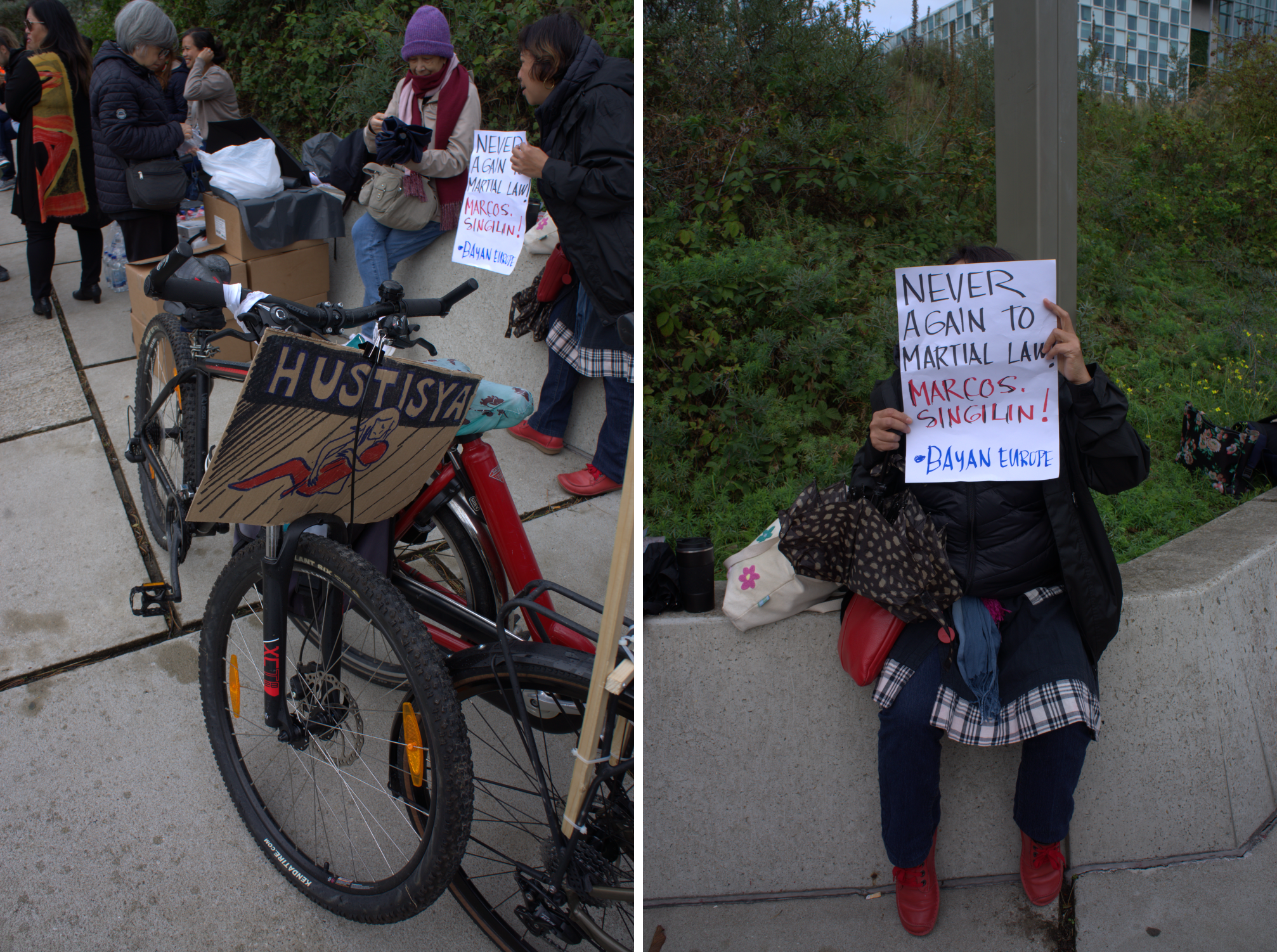
Many of the older demonstrators have lived in Europe far longer than they have in the Philippines, yet they felt so strongly about seeing one bloody-handed president get his due. During the pre-trial, a silver-haired woman from Switzerland loudly heckled Atty. Nicholas Kaufman’s statement beside a handful of grim-faced lolas who had flown in from London to support the proceedings. As I traveled back to Amsterdam, I spent the trip talking to a lolo who told me how he survived Ferdinand Marcos Sr.’s dictatorship as a student activist, and how he felt pleased that at least Duterte is being tried in his lifetime.
I felt unsettled. The ending of the trial is still up in the air. What does justice look like in a world where genocides and massacres are passively permitted? And even on the off-chance Duterte is found guilty, Filipinos around the world will still have to pick up the pieces of the damage he left behind.
As much as I have misgivings about what justice could mean, the family members of victims of the drug war say again and again during Duterte Panagutin rallies and in conversation that seeing him tried on a global stage is enough. His pre-trial is more than they could have imagined; it is a culmination of several decades’ worth of work on the sides of human rights organizations, whistleblowers, journalists, lawyers, activists, volunteers and more. It is a movement that is propelled by those who care.
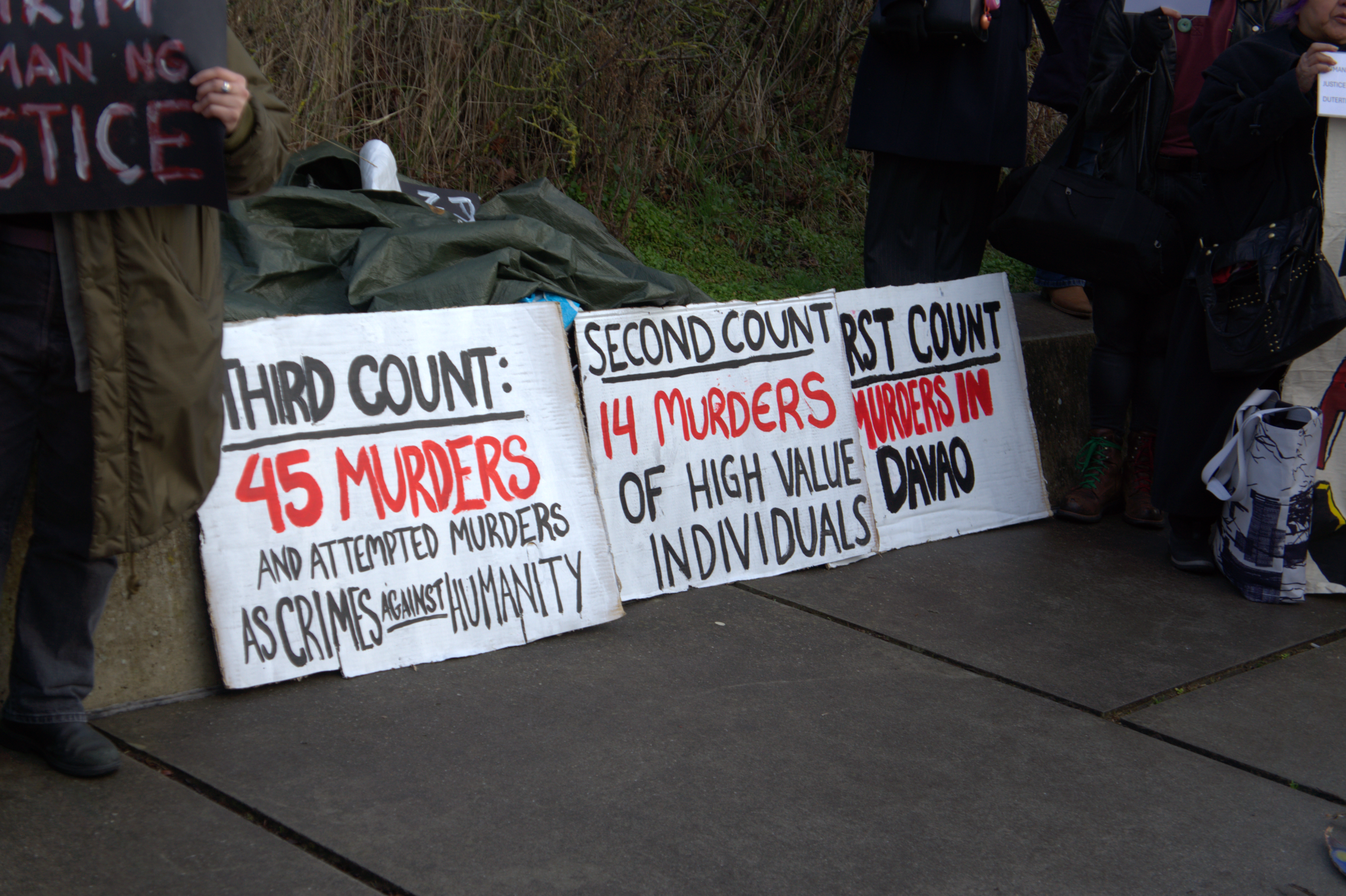
Furthermore, Duterte’s trial goes beyond the Philippines: it is the ICC’s first trial of an Asian head of state. There are criticisms that it isn’t Netanyahu, but still, eyes are on Duterte. An Indonesian anarchist visiting Amsterdam told me, unprompted, how his wife had unknowingly congratulated Duterte supporters at the news of his arrest, much to their outrage. When I first attended the Duterte Panagutin rally in September, I tried speaking Tagalog to a confused man I assumed was Filipino, whom I later found out was part of a Colombian organization that was demonstrating alongside the network. Balik/Bayan’s Indonesian members staunchly show up for demonstration after demonstration. Speckled throughout the event are young activists of a variety of nationalities and ethnicities sporting keffiyehs, scarves that show solidarity with the Palestinian struggle for liberation.
To have him tried at the ICC for his “work” in Davao and the Philippines is a beacon of hope for other countries, Icai argued, and shows the same justice could happen for any people, any country, someday.
Duterte’s second disappearing act in late February wasn’t just cowardice: it is akin to the wealthy taking a well-timed flight abroad during a typhoon, a refusal to own up to the consequences of his actions. But those in the Duterte Panagutin Campaign Network 一 and many others 一 await whatever comes next. In the meantime, they’ll continue touching on hot-button issues regarding OFWs and their kababayan, and their continued struggle under exploitation from foreigners and Filipinos alike. As long as the current world order remains, there will be struggle; but as long as there are people who care, the struggle for justice will persist. ¡El pueblo unido jamás será vencido!