

Cavetown is never far from home
It’s become a rite for touring musicians to dine at the Filipino restaurant Manam as soon as they land in Manila. The sisig, they might say to the crowd during their live show, was simply divine.
“I’m vegan, though,” English singer-songwriter Cavetown prefaces as he recounts having exercised his right to Manam the night before. “So it’s been hard to experience the real Filipino food.”
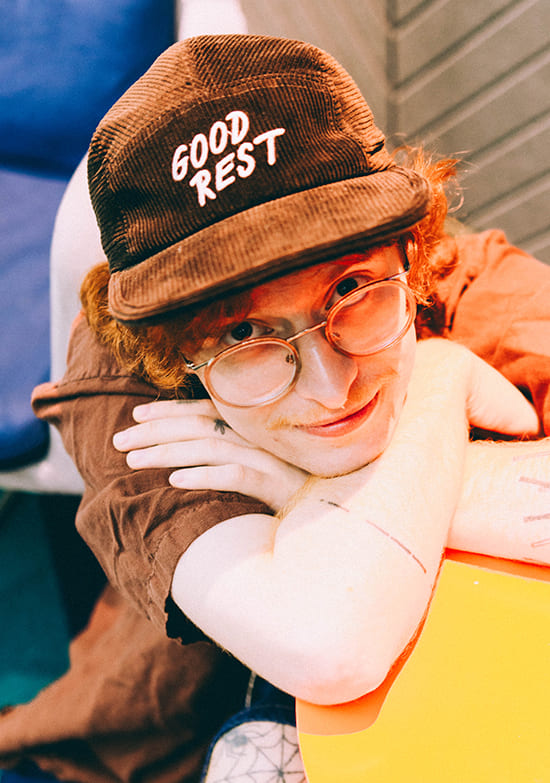
I let out a giggle at the story. Certainly a trivial detail, but it seemed so on par for the artist, real name Robin Skinner—the irony of getting to travel the world because of your music but not getting to eat at a vegan restaurant, of making it but still not quite fitting in.
It’s not to his detriment, of course. This is precisely the strength of his work. It’s what earns the loyalty of his millions of listeners, myself included. Since his early days on YouTube and Bandcamp in 2015, his music often resurfaces on social media; my favorites are young people lip-syncing to his older songs with the caption, “Trying to beat the weird kid allegations but then someone plays this song.” (They know all the words, obviously.) What is youth, after all, if not feeling weird and out of place all the time? Robin was the same, except he knew how to write good, oft-viral anthems about it.
CONTINUE READING BELOW

Right now, he is touring his sixth album, Running With Scissors, with stops in Europe, North America, Australia, and, for the first time, Asia. This new record has hyperpop and pop punk influences, flaunting an edgier, more self-assured sound. It’s a departure from the ukulele-accompanied bedroom pop Cavetown is most known for—but it’s a homecoming for Robin, who grew up listening to bands like Pierce the Veil and Bring Me the Horizon. “I would listen to their music and imagine that it was me rocking out on stage, but I never felt like I had the confidence for it,” he reveals.
He had been on the edge of this “more abrasive” sound for a while: Pierce the Veil frontman Vic Fuentes is featured on his 2022 album Worm Food, and Robin opened for the band on their last tour.
But it was meeting his girlfriend of four years that ultimately threw Robin “back into that version of myself”: “(We got together) around the time I started writing some of these songs. We connected over being into the same music as teenagers before we even met, especially Pierce the Veil.” While loneliness and frustration are major themes on the rest of the tracklist, the album’s first two singles, Rainbow Gal and Baby Spoon, are upbeat love songs. “She's really given me a lot of confidence and made me feel like I can do whatever I want.”
Running With Scissors also marks Robin’s first time working with co-producers after self-producing his first five albums. Among them were hyperpop artist Underscores, rock producer David Pramik, and frequent Aurora collaborator Couros. “I convinced myself I wasn't very easy to collaborate with. I feel like I'm pretty stubborn about my sound, and production is my favorite part of the process,” the singer says.
“(We did) it slightly differently, where I could still be in control of the production but just have another brain with new ideas next to me. Having someone there to push me forward in places where I would usually get frustrated or stuck on my own was really helpful. I was able to learn from them, and I was surprised that they could learn from me, too.”
Perhaps this album was less of a departure and more of an evolution, or at least a growing-up. For most of his decade-long career, Robin faced the unique dilemma of instantly striking gold. His first official single, 2015’s This is Home, is still one of his most popular songs and people’s introduction to Cavetown. It was a song he wrote at 15 and released at 17, and in the minds of many, he appear to stay that way: a teenage boy suspended in time, encased in glass with a ukulele and a mustard yellow knit hat.
I think back to that younger Robin, writing about isolation, broken homes, and gender identity; how his music meant the world to so many young people like me. But it must be strange to be 27, as Robin is now, and still be known for who you were 10 years ago. How do you grow—as an artist and as a human, when growth is marked by transformation—while still honoring the work that continues to matter greatly to other people?
“I definitely feel a bit of cringe towards my old music, especially just having to play it so long after I've passed that point in my life,” he begins. “But the messages in the music can be translated into something I'm (going) through now. Whenever I listen back to my old music, they’re just timestamps of all the different people I've been. That 15-year-old kid who wrote This is Home is still in me somewhere.”
A lot of the things that I've written songs about are things that I felt very alone in experiencing. So to know that there have always been people literally on the other side of the world who know exactly how I feel is really comforting.
“And it's also been cool to grow alongside my audience. I've seen a lot of people who have returned after years and years; I've gotten to see them grow up, see their style emerge, and hear about the work they got into as they left school. I think it's cool to be able to grow with them, not just as a person, but with my music. Because even if I'm growing out of the stuff that I'm writing, they're probably also growing past that stuff, too.”
Running With Scissors, while sonically more exploratory, retains the thematic tensions that have long defined Cavetown. The title itself is a volley between growing up and not feeling good enough for it. Micah, a track about wanting to be a good older brother, is two songs away from First Time, which retells Robin’s first time getting pulled over on a highway.
“That old stuff still exists, and it still represents a part of my life. So I can be grateful for that, even if I feel weird about how my voice sounds or the production or whatever,” he continues. “I'm mostly just appreciative of the people it's managed to reach, the connections I've made, and how it's made me feel more part of my community.”
Talking to Robin, I notice all the little ways in which he’s older: longer hair, more tattoos. But of course I got older, too. We’re only two years apart; in front of me is the boy who, for most of my teenage years, I looked to for how to live. I realize now that he couldn’t have known. I feel fortunate, still, to have someone who doesn’t have the answers but with whom I can contend the questions, whose work I find respite in, both at 15 and 25. I’m reminded of the final line of This is Home: “Time is slowly tracing his face, but strangely he feels at home in this place.”
***
I spoke with Robin the day before his scheduled show in Manila. We didn’t know yet that it would be cancelled an hour before doors, reportedly due to unforeseen venue issues, when the line of fans already snaked around Skydome. Many had skipped school. Despite the cancellation, many of them remained, singing the songs I’m sure they all grew up with, too.
At the end of our conversation, I asked Robin what it means to him to always find his people, even when he’s the furthest he’s been from home. “A lot of the things that I've written songs about are things that I felt very alone in experiencing. So to know that there have always been people literally on the other side of the world who know exactly how I feel is really comforting and amazing,” he said.
“I hope that I can provide the same feeling for my audience over here. To be like, ‘Oh, someone on the other side of the world is writing music (about what I feel).’’’
I won’t say it didn’t matter that Robin didn’t get to perform, because it did. But the music has always been here, and so have the people who understood. May the chorus of fans that evening always remind us that they are much closer than we expect, and we are never as alone as we feel.
***
Running With Scissors is out now on all major music streaming platforms. Follow Cavetown at @lemon.socks.

WATCH: How to experience Bangkok and Kanchanaburi in one trip
October 21, 2026