

Every morning before dawn
"Migs, have you ever seen newspaper carriers?"
It was a question asked during one of our meetings. For someone who was once a campus journalist and now works in the print media industry, it felt embarrassing to admit that I hadn't. But that was the truth.
I grew up seeing people around me reading newspapers. Yet newspaper carriers were figures I had encountered only in fiction or heard about through other people's stories.
After all, I'm part of Generation Z, whose news consumption has largely been shaped by rapid technological and digital developments.
While my knowledge may have been limited, one thing was clear: Newspaper carriers serve as an essential link between the newsroom and its readers.
They deliver more than newspapers: They deliver journalism, connecting communities with reliable information every single day. Then and now, their early morning rounds continue to place the day's news into the hands of people who read, reflect, and decide for themselves.

Curious to learn more, I set out to meet the people behind these daily deliveries.
A story of dedication
While the moon still hangs over the quiet streets before dawn, newspaper carriers are already on the road.
Among them is James Alegria, who has been in the trade for the past 20 years.

Riding his motorcycle, he delivers newspapers around Forbes Park and Dasmariñas Village in Makati City. He usually begins his route between five and six in the morning and finishes between seven and seven-thirty, although some days stretch until eight or even nine.
As a part-time newspaper carrier, he heads to his other job after completing his deliveries.
Rain or shine, Alegria carries the responsibility of bringing newspapers to his clients.
That unwavering commitment is what makes newspaper carriers remarkable. Amid the scorching heat, flooded streets, and dangerous storms, their dedication to delivering reliable news remains steadfast.
Alegria recalled one particularly difficult morning when he had no choice but to continue despite torrential rains: "Tumatakbo 'yung motor mo. Bagsakan na 'yung mga puno. 'Yung mga puno sa Forbes pati sa Dasmariñas, makita mo, nakakalat na. Ang lakas ng hangin. Continuous ka pa ring nagde-deliver ng diyaryo."
In moments like these, fellow carriers and village security guards often lend a helping hand.
"Nagiging friendly naman tayo sa mga security guard sa mga subdivision o village. So naaawa sila. Ilang beses nang nangyari sa akin 'yun. Naging kumpare ko pa. Sabi sa akin, 'Sige, pre. Ito 'yung motor ko. Hiramin mo muna para matapos mo 'yan.'"
They deliver more than newspapers: They deliver journalism, connecting communities with reliable information every single day.
Two decades on the job have also broadened Alegria's perspective. Through daily conversations, he has met people from all walks of life. "Iba't ibang tao 'yung nakakausap mo at nakakukuwentuhan mo kung anong ginagawa nila, mula sa hardinero, driver, katulong, mayordoma," he said.
"Kahit mababa lang pala ako, pantay-pantay kayo sa mga usapin. Pare-parehas kayong may mga problema. Iba-iba nga lang."
His work has also helped support his family's finances. Thanks in part to his earnings as a newspaper carrier, two of his three children became scholars at a well-known public university in Manila.
From the streets
Beyond gated villages, newspaper vendors continue to serve communities from sidewalks, market corners, and neighborhood stalls.
Among them are Michelle Villanueva, who sells newspapers in Quezon City, and Helen Mariano, who has been serving readers in Marikina City since 1998.
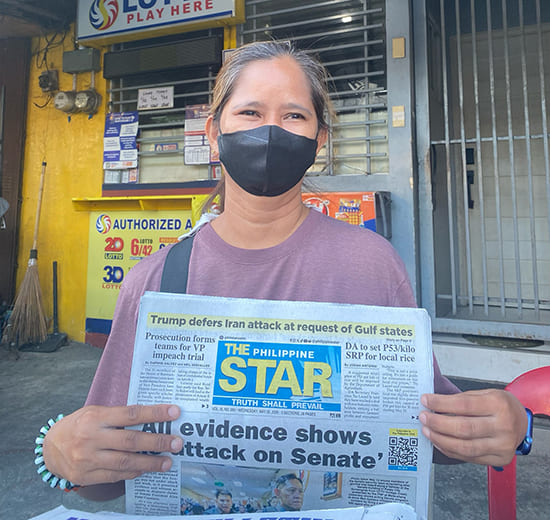
For Villanueva, newspaper vending is a family tradition. She inherited the livelihood from her father, who himself followed in the footsteps of his own parents. She began selling newspapers as a child and has spent so many years in the trade that she can no longer recall exactly when she started.
Mariano, meanwhile, entered the business after a friend introduced her to it nearly three decades ago.
Like newspaper carriers, vendors begin their days before most people wake up. Aside from tending their stalls, they also make deliveries. Mariano, for instance, goes around nearby subdivisions and the local market to bring newspapers directly to her loyal customers.
Newspapers are newspapers. Internet is internet. Iba pa rin 'yung aktuwal.
The trade has allowed both women to raise their families and send their children to school. It has been their livelihood through the years, and it continues to sustain them today.
Despite decades in the business, neither has considered walking away. Villanueva continues because she cares deeply for her suki, especially senior citizens who still rely on newspapers as part of their daily routine.

Mariano, meanwhile, says she cannot simply retire. Aside from selling newspapers herself, she also serves as a sub-dealer, supporting other vendors who depend on her. "Kaya hindi ako pwedeng tumigil. Gawa nila. Kasi umaasa rin sila d'yan."
An indelible mark
Listening to the stories of Alegria, Villanueva, and Mariano left one realization firmly in mind: Print is alive.
Reliable journalism continues to find its way into homes and communities every day. It’s also found in convenience stores, hotel lobbies, and local markets, waiting for its pages to be discovered by seekers of truth.
Newspapers invite readers to slow down, think critically, and engage with issues beyond the noise of endless online feeds. They foster informed conversations grounded in verified reporting.
Through newspapers, truth, at its highest level, is still within people’s grasp. As Alegria simply puts it: "Newspapers are newspapers. Internet is internet. Iba pa rin 'yung aktuwal."
Like millions of hardworking Filipinos, Alegria, Villanueva, and Mariano continue pursuing better lives for their families. Whatever the hardships, they press on: one delivery, one customer, and one day at a time.
Yet their role extends beyond earning a living. They are the indispensable link between the newsroom and the communities it serves.
They may not always realize it, but they help sustain a culture where credible journalism remains accessible, even as technology continues to reshape how people consume information.
As long as people read, as long as communities gather and conversations matter, newspaper carriers and vendors will continue doing what they have always done.
As long as people seek the truth, print will endure.

WATCH: Is OPM still as good as it used to be? (Generations Ep. 20)
September 9, 2026
WATCH: Pixar Summer Fest adventure at Hong Kong Disneyland
August 10, 2026