

The languages I will never learn
Part 3 of 4
You know those quizzes that ask what superpower you would want? Mine would always have something to do with learning or becoming fluent in all languages. I sometimes wonder how many stories, perspectives and entire worlds I am missing out on simply because I cannot speak the languages in which they are expressed. There are jokes I will never understand, songs whose lyrics will remain beautiful but incomprehensible, poems that lose something in translation, and conversations whose nuances I will never quite grasp. Every language carries more than a vocabulary. It carries a way of seeing, remembering, teasing, grieving and describing things that may not even have an equivalent in my own.
I could spend the rest of my life learning languages and still barely scratch the surface of what humanity has found ways to say. I know this because even within the languages I already speak, there are words and expressions that resist translation. There are things that can be said in Tagalog that cannot be fully expressed or replicated in English. Not because English necessarily lacks the words, but because their meaning is inseparable from the culture, history and shared experiences that gave them life.

This is partly why I have such a nerdy fascination with etymology and the history of words. I love tracing where words came from, how their meanings evolved and the circumstances in which they first came to be used. It makes me wonder about ancient manuscripts and religious texts, for instance, and how much meaning might have shifted as they passed from one language to another. The Bible, originally written primarily in Hebrew, Aramaic and Greek, is a particularly fascinating example. How many nuances, cultural references and shades of meaning have been lost, altered or simply understood differently along the way?
Translation, after all, is never entirely neutral. Every translator brings a degree of interpretation, shaped by their own time, culture and understanding. Even a translation that is faithful to the original is still an attempt to make sense of it through another language.
CONTINUE READING BELOW

I was reminded of this recently by Christopher Nolan's film adaptation of The Odyssey, which made me think about how differently the same story can be told and understood. None of these interpretations is necessarily wrong, but neither can any one of them claim to be the definitive version. They are all attempts to make sense of an original idea, a text or, in this case, a story.
There is also the rather uncomfortable possibility that we sometimes think we understand more than we actually do. Eep. We read a translated novel, watch a subtitled film or listen to someone explain a foreign expression, and come away feeling reasonably informed. But how much have we really understood? Subtitles, after all, are little acts of compressed translation. Someone has to decide which words matter, which jokes can be sacrificed and which cultural references need explaining.
When a language disappears, we don’t simply lose another way of saying hello. We lose a particular way of describing the world, and once that goes, there may be no exact substitute for it.
A two-line subtitle cannot always carry the weight of a particular turn of phrase. We get the gist, perhaps, but the gist is not necessarily the whole story. It is the difference between being invited into a room and being given a description of what happened inside it.
When I think of this, my mind always goes to two of my favorite Tagalog words: gigil and kilig. Gigil is often roughly translated as “cute aggression,” which, to my ear, is still not quite the same. Then there's tampo, for which the closest equivalent I can think of is “sulking.” But even that doesn't quite capture it.
I have occasionally found myself in conversations where everyone is laughing and I am smiling along, hoping nobody suddenly asks me what I found so funny. There is a particular vulnerability in not understanding the language being spoken around you.

You become dependent on facial expressions, gestures and the occasional familiar word to work out what is happening. You can usually tell whether the conversation is serious, amusing or mildly scandalous, but the details remain a mystery. And you realize that communication is so much more than exchanging words. It is also about belonging to a conversation without having to ask for a translation every five minutes.
I wonder, too, whether we are quite the same people in every language we speak. Some languages seem to lend themselves to affection, others to argument, humor or formality. We might be articulate and confident in one, but suddenly reduced to a collection of hand gestures and questionable pronunciation in another.
There are expressions of affection that feel perfectly natural in one language but embarrassingly theatrical when translated into another. Perhaps our personalities are not entirely separate from the languages through which we express them. Perhaps there are versions of ourselves that only emerge when we have the right words available. I find that rather fascinating, and a little unfair to those of us who have only a limited vocabulary to work with.
For example, when discussing something, I tend to stay in English. But if I am really angry, there is absolutely nothing quite as delectable as cussing in Tagalog, Bisaya or Ilokano. When the French comes in, it means I need to get myself home.
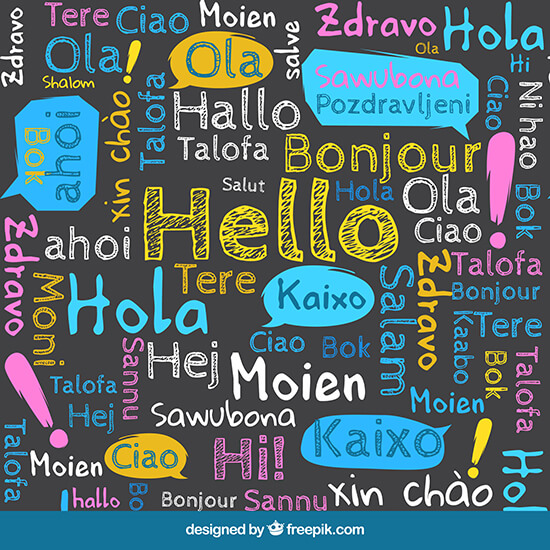
Living in a country with so many languages and regional variations makes this question particularly interesting. We can travel a few hours and encounter expressions, pronunciations and entire vocabularies that are unfamiliar to us. And then there are languages spoken by smaller communities that are slowly disappearing, sometimes because younger generations no longer use them at home.
It makes me wonder how many stories, jokes, recipes, folk wisdom and family histories are carried in words that may eventually fall out of use. When a language disappears, we don't simply lose another way of saying hello. We lose a particular way of describing the world, and once that goes, there may be no exact substitute for it.
Of course, there is also the business of actually attempting to learn another language, which is considerably less romantic than imagining it. There are verb conjugations, unfamiliar sounds, grammatical rules that seem designed to humble perfectly intelligent adults, and the inevitable moment when you confidently say something entirely different from what you intended. Still, I think there is something generous about making the effort. Even a badly pronounced greeting can make someone smile. Asking how to say something in another person's language is a small acknowledgement that their words, and the world they come from, are worth the trouble. Fluency may be a distant ambition, but curiosity is considerably easier to achieve.

Perhaps the point isn't to become fluent in every language, or collect them like stamps (although that would make for quite an impressive party trick). Perhaps it is simply to recognize that our own language is not the measure of all that can be thought, felt or understood. There are stories I will never hear in their original words, jokes I will never quite get, and ideas that will remain just beyond my reach. But I can still listen. I can learn a greeting, ask someone to teach me a word or linger over a phrase that refuses to translate neatly. Every new word is a little window into someone else's world.
I will never learn them all, and I've made peace with that. There are only so many hours in a day, and I suspect my brain has already reached its language acquisition quota. But isn't it wonderful to know that there will always be another word, another expression, another way of describing the world that I haven't encountered? I'd rather remain curious about what I don't know than assume that the languages I speak have somehow covered all the bases. They haven't. Not even close. And what a lovely thing that is.