

Under the Marrakech sun
In Marrakech, color is difficult to ignore. It catches the eye on ochre walls, glows in the souks, and intensifies beneath the North African sun.
After years of severe drought, Morocco has seen some relief, though the landscape around Marrakech still bears the marks of prolonged aridity. Yet inside the Jardin Majorelle, I was captivated by the audacious magenta of bougainvillea against walls painted in a blue so saturated it seemed to have escaped from a painter’s imagination. The magenta bracts spilled over the blue in extravagant profusion. I lingered over the contrast, thinking about how beauty can emerge under difficult conditions, and about Yves Saint Laurent, whose relentless pursuit of perfection coexisted with periods of profound personal distress.
Bougainvillea is said to bloom more profusely under stress, though abundant sunlight and soil allowed to dry between waterings generally encourage flowering. Still, as I walked through the paths, I wondered whether beauty might be coaxed out by hardship. I thought of Saint Laurent, whose own life seemed to balance on that same precarious ledge, his brilliant body of work produced through discipline alongside a private suffering no amount of applause could ever soothe.
“Before Marrakech, everything was black. This city taught me color,” Saint Laurent once said.

The remark has the satisfying simplicity of a revelation, but the relationship between a place and an artist is rarely so easily explained. Marrakech did not invent his eye for color. It gave him a new palette and a landscape that would become inseparable from his imagination.
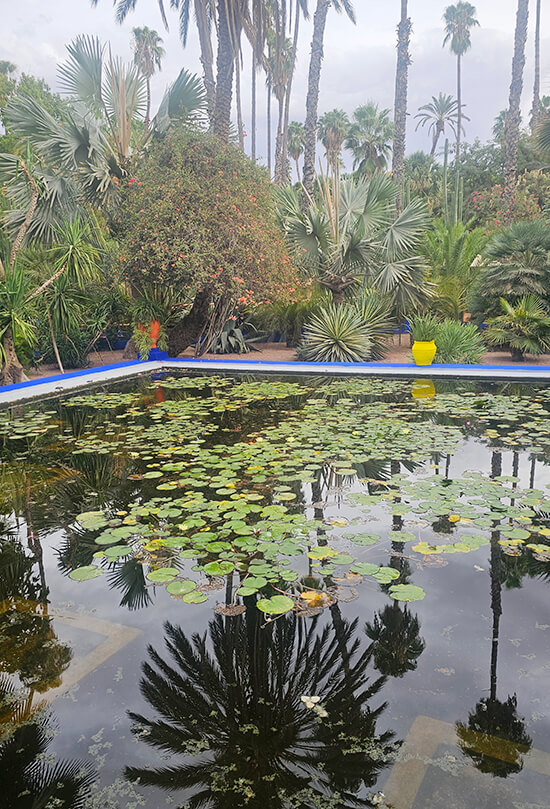
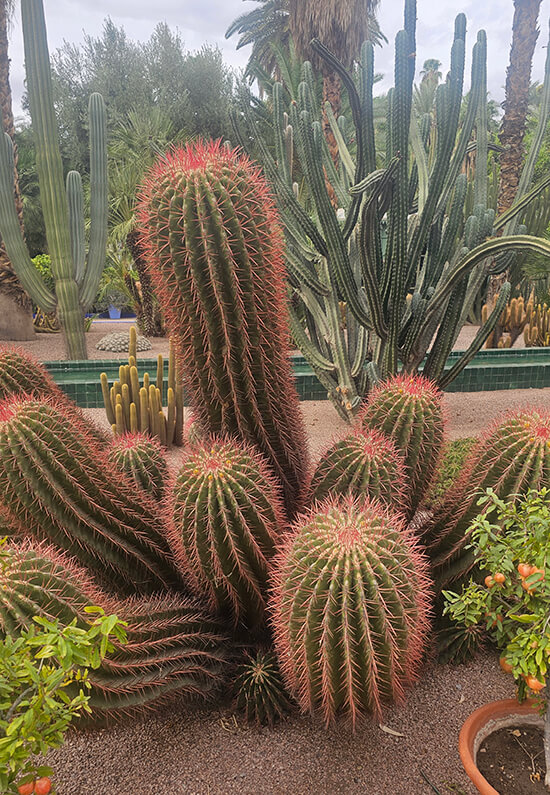
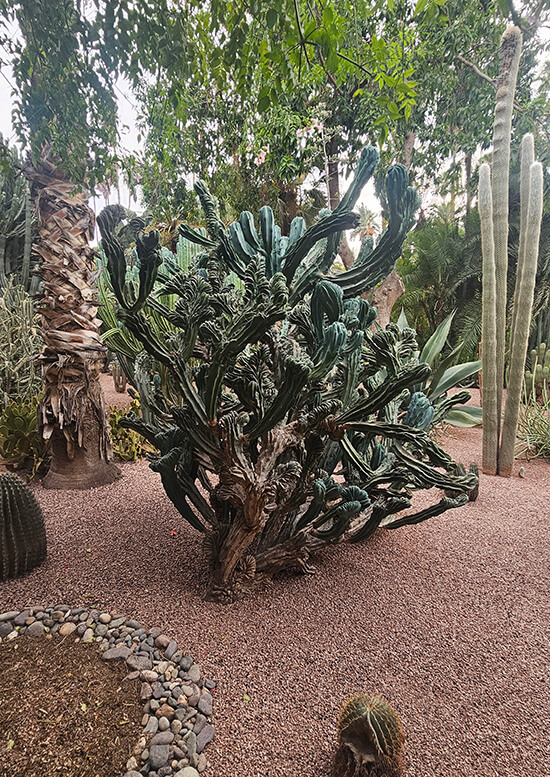
The garden operates as a living laboratory. Jacques Majorelle, the French artist who began developing it in the 1920s, gathered rare specimens from across five continents. Sculptural cacti rise beside sword-shaped yuccas, while palms and banana trees bring tropical abundance. Dense bamboo screens frame shifting fragments of light, and water lilies float across pools reflecting the sky.
My eye kept leaping from cobalt to emerald to magenta, but scent gave me a reason to slow down. Jasmine perfumes the air, while the fountains stir the coolness around the pools. The fragrance turns an enclosed space into something vast, engaging more than just sight.
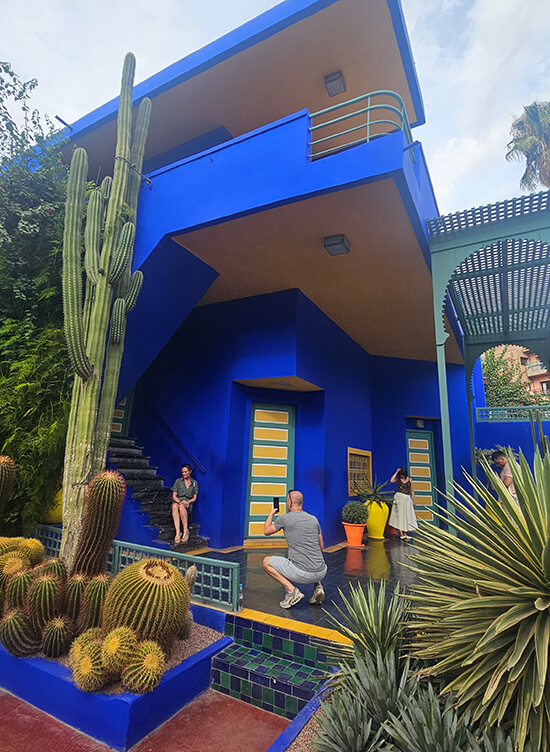
Majorelle blue is the anchor of the whole place. Its founder applied this heavy ultramarine to the walls and buildings in 1937, a decision that makes the surrounding green leaves feel almost electric. Moorish arches, painted pots and pools contribute to a character unlike that of any other garden.
Watching the plants converse with the architecture through shape, texture and hue, I recognized Saint Laurent’s own mastery of contrast. His clothes could be severe in silhouette yet audacious in color, disciplined in construction yet liberated in effect. In 1966, the same year he and Pierre Bergé first set foot in Marrakech, Saint Laurent introduced Le Smoking, reshaping women’s relationship with clothing. Beyond bringing bright colors together, he possessed a rare gift for harmonizing radical contrasts, making them seem made for each other.
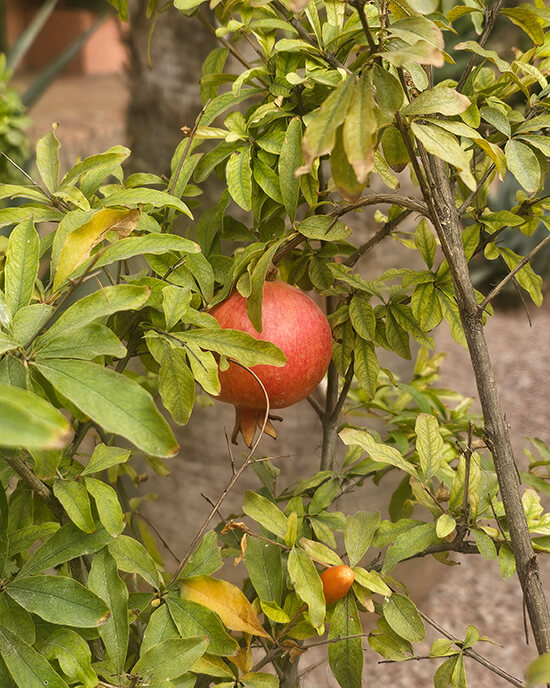
Saint Laurent and Bergé returned to Marrakech often, finding refuge from the demands of Paris. In 1980, they purchased the Jardin Majorelle to save it from real estate developers who planned to replace it with a hotel complex. The property had fallen into neglect following Majorelle’s death in 1962. Saint Laurent and Bergé restored the grounds alongside landscape designer Madison Cox, preserving the painter’s vision while allowing the flora to evolve. They renamed Majorelle’s former residence Villa Oasis, creating a haven away from the demands of public life.
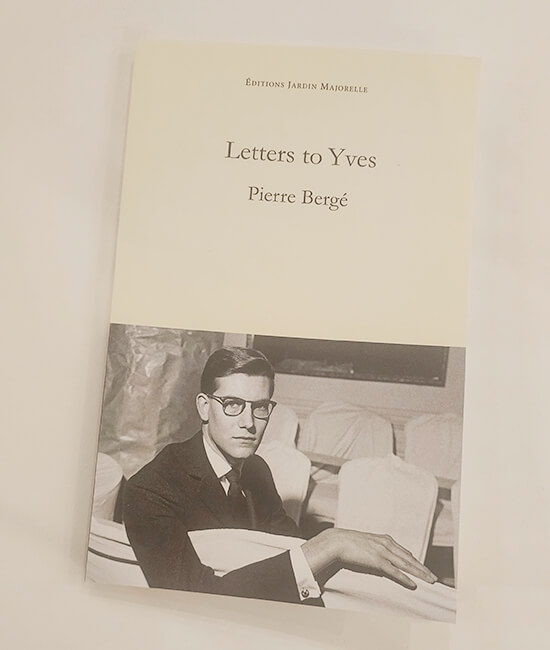
At the Majorelle bookshop, I bought a copy of Pierre Bergé’s Letters to Yves, which I read in one sitting. Addressing his late partner, Bergé captured the haunting duality of the estate when he wrote, “So many memories, the good and the bad, run up against one another.”
Saving the garden became an essential chapter in Saint Laurent’s story. They protected a work of art made by another man, a living composition that could easily have disappeared beneath concrete. Bergé wrote, “Your body of work will be a source of inspiration for years to come. And a French designer, as you couldn’t be anything else.
As French as a poem by Ronsard, a garden by Le Nôtre, a composition by Ravel, a painting by Matisse.”
Yet Saint Laurent’s life cannot be understood through beauty alone. Barely 21 when Christian Dior died in 1957, Saint Laurent succeeded him at the helm of the House of Dior, inheriting extraordinary expectations. While he went on to transform modern fashion, he also endured periods of profound psychological torment.
It is tempting to turn such suffering into artistic mythology and imagine that darkness supplied the brilliance. I find that explanation both too easy and too cruel. Talent does not require suffering, and depression is not a prerequisite for creative achievement. Saint Laurent’s accomplishments sprang from rare ability, discipline, and an exacting eye. His personal struggles belonged to the human being behind the famous label.
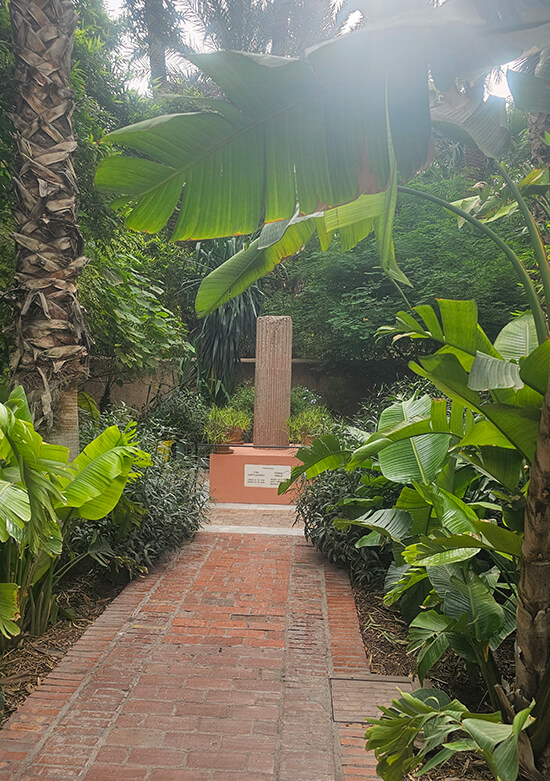
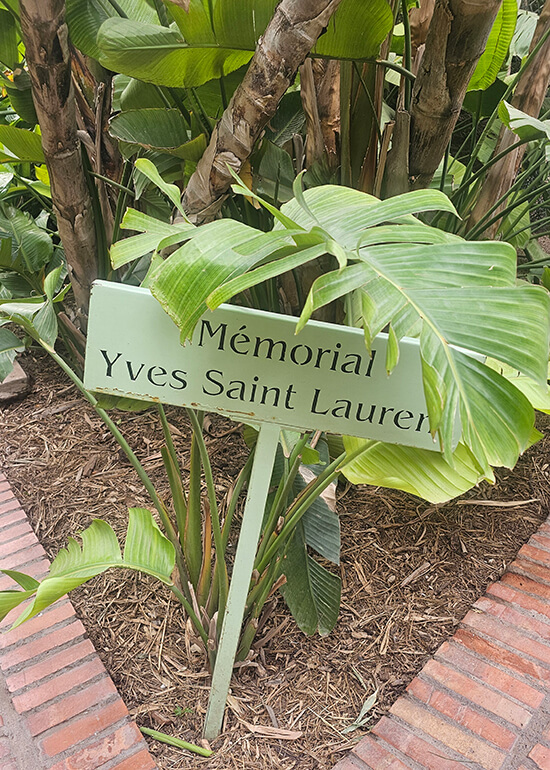
When Saint Laurent died on June 1, 2008, his ashes were scattered in the rose garden of Villa Oasis, where a memorial now stands. In a letter dated May 2, 2009, Bergé wrote, “I’m in Marrakesh, how can I not think of you? Memories of you are everywhere, refusing to leave the city that was so important to you and your work. Marrakesh is where, you would say, you discovered color and your palette. The clothing worn by the local women dazzled you; you were carried away by the hint of a saffron-colored lining underneath a green caftan, by headscarves with borders of jet-black fringes, but also by the jacaranda and blue melia trees, the red hibiscuses, the orange cliveas, the pearly white water lilies. I’m sure that’s where you were happiest. Where we were happiest.”
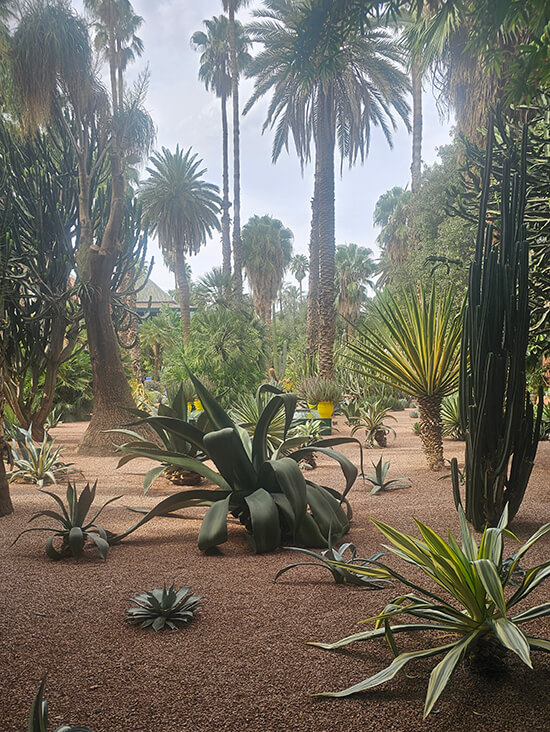
Knowing that Saint Laurent’s ashes were scattered here changed the way I saw the garden. The bougainvillea, palms and intensely blue walls belonged to a living sanctuary, yet they also formed part of the private geography of a man whose public persona often eclipsed his private self.
I returned to the bougainvillea in my mind, its brilliant bracts set against Majorelle blue. Saint Laurent was not a plant, and his life cannot be reduced to a botanical lesson. Yet the garden offers a way to consider vulnerability and creative force without confusing pain with purpose.
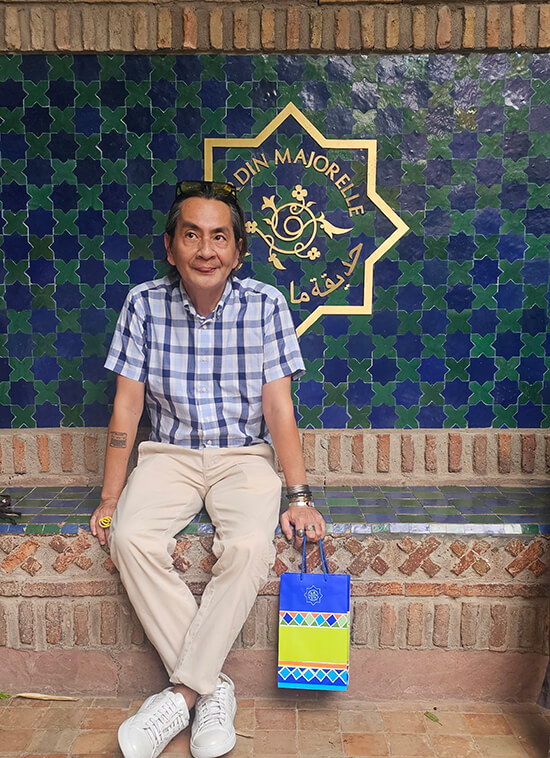
Marrakech expanded Saint Laurent’s visual world. In saving the Jardin Majorelle, he and Bergé preserved a sanctuary that outlived them both. Beauty here is the product of many elements, including a painter’s vision, a gardener’s labor, the plant’s own nature, and the care that allows the composition to thrive.
Bougainvillea can flourish under demanding conditions, but hardship does not deserve credit for its color. The same distinction applies to Saint Laurent. His genius need not be explained by his suffering. What remains in his clothes is the extraordinary work he produced, and what remains in the garden is the beauty he and Bergé helped preserve for others.

WATCH: Save for retirement or enjoy life now? (Generations Ep. 21)
September 16, 2026