

Christina Dy draws the dance of the untraceable
Where does the body end and the drawing begin, as the dance snakes in between?
In the art of Christina Dy, the demarcations are not easy to point out.
Let’s start with a hospital X-ray, which seems an unlikely place for an exhibition to begin. But for Christina Dy, the image of her own spine offered something stranger than diagnosis. “A hospital trip x-ray revealed that I had bone spurs growing out of my spine,” she recalls. “Of course, I exaggerate it in my head and think… oh, maybe my bones can grow into more bones?”
The thought led her to another body she had recently manipulated: a cactus. A few years earlier, Dy had experimented with grafting the plants, cutting one organism and joining it to another so that two separate structures might continue growing as one. Bone spurs and botanical grafts suddenly appeared related. “Bones growing outward, cacti being cut then put together,” she says. “I saw both of them as creating new things out of old limbs, like collage.”
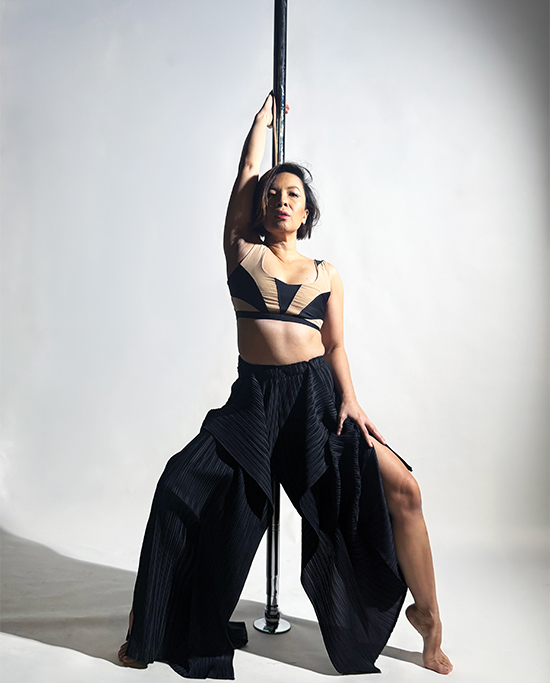
This is the creature at the center of “Chimera: New Drawings,” which is currently on view at The Crucible Gallery in SM Megamall. Not quite the fire-breathing hybrid of Greek mythology, but an organism assembled from what was already there. Anatomy, botany, memory and drawing are joined at their joints. More specifically, Dy says, “I am splicing new ideas about my aging body.”

For an artist who has spent more than two decades drawing bodies, the admission is deceptively simple. Dy’s practice has traveled from monumental charcoal drawings of hair, bodies, oceans and skies into folded paper, dance, performance and, through the collaborative project Somatosonic, technological systems that translate physical movement into image and sound. “Chimera,” however, brings her back to paper.
“It’s still me, drawing bodies with charcoal, after more than two decades,” she says. What has changed is the tense in which she is working. “Before, I would draw to capture certain moments, certain feelings, but now it’s more forward-looking, more what-if questions.”
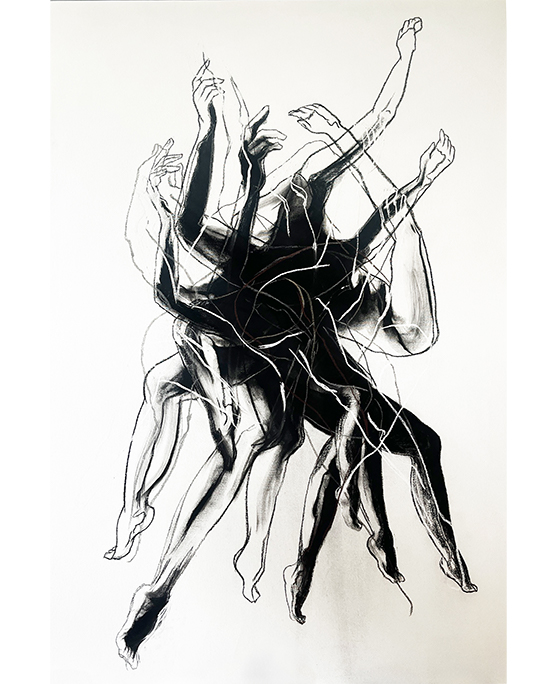
The drawings are also smaller. There is no grand conceptual explanation for this shift. “Not deliberately,” Dy says, with characteristic practicality, “but as a result of a smaller workspace, and also to fit the gallery space.”
Scale may have contracted, but the body occupying the work has become more complicated.
For years, Dy seemed to maintain several parallel identities. There was the visual artist, and there was the dancer. There was drawing, and there was pole. There were studio disciplines and bodily ones. At one point, she remarked that pole dancing “took the sex out” of her art, as if physical and sexual energies that might otherwise have entered the drawings had found somewhere else to go.
That separation no longer interests her.
“What I like now is that I don’t feel the need to separate all my interests and careers or whatnot,” she says. “They’re all now one thing. (I am a chimera!)”
The chimera is not simply what Dy draws. It describes her method. Painter, draftswoman, dancer, performer and collaborator no longer need discrete territories. One practice grows into another.
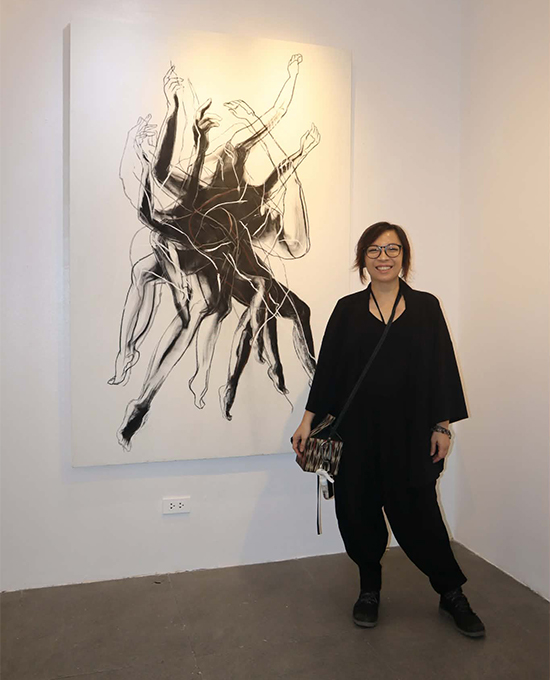
Asked what her dancer’s body has taught her drawing hand that art school could not, Dy replies: “Rhythm. Feelings. Also, that arthritis will come for you (laughs).”
Aging in “Chimera” is neither metaphor nor a distant possibility. It is material. Hands tire. Backs hurt. Bones change shape. Making an artwork means negotiating with a body whose capacities are not fixed.
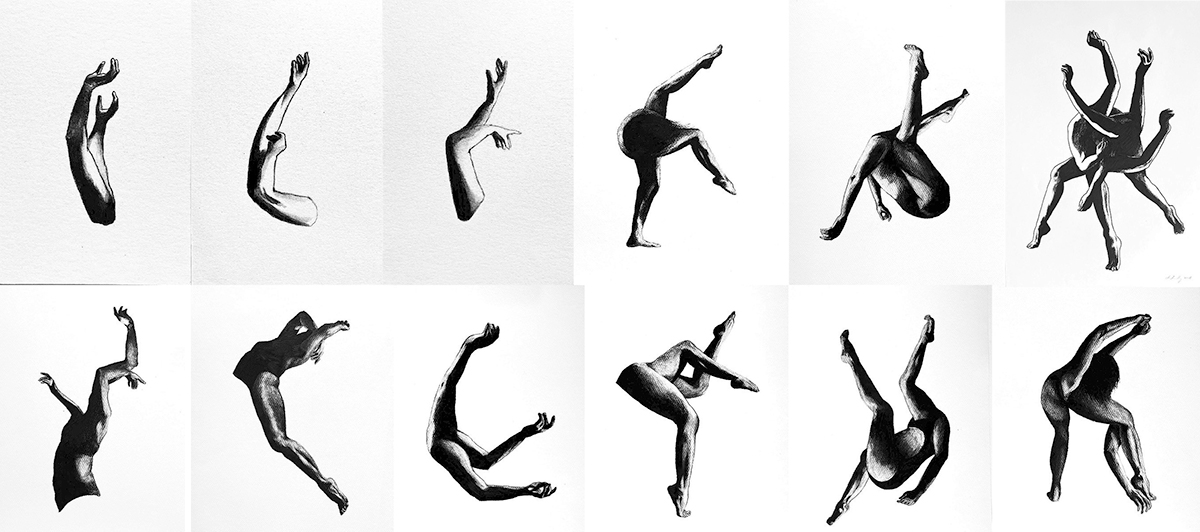
This physical awareness has sharpened rather than diminished Dy’s attachment to drawing. In “Chimera,” she returns to what she calls “my love, which is drawing on paper.” Her visual reference is deliberately old-fashioned: scientific illustration. “Black and white drawings on clean paper.”
Scientific illustration promises clarity, taxonomy and the possibility of making a specimen intelligible. Dy introduces instability into that tradition. Her bodies do not stay within their assigned categories. Parts meet parts that did not originally belong together. Plant grafting provides the operative logic.
She says she “did not think about hiding seams,” being “more interested in showing them, showing how things are put together.”
There is even a rule: “Join at the joints.”
Like grafting cacti, she explains, the cut cannot simply happen anywhere. “There are certain points where you have to make the cut.”
The seam becomes evidence of construction rather than a flaw to be disguised. These are invented bodies that insist on revealing how invention occurs.
This emphasis on assembly connects “Chimera” to Dy’s work in dance more directly than its traditional materials might suggest. Drawing and choreography, for her, have become nearly interchangeable acts.
“Drawing, dancing, it’s all the same to me,” she says.
When constructing drawings from several bodily fragments, she describes herself as “choreographing the images on the paper.” The questions she asks resemble those of arranging bodies across a stage: “What story do I want to tell? How will I arrange the different elements together? I think about rhythm, about texture.”
Even hanging the exhibition participates in this expanded choreography. “Arranging the works on the gallery walls, it’s choreography.”
Dy is not pretending the body is inexhaustible. The body has already contradicted that fantasy. It produces bone spurs. It develops arthritis. It becomes tired. The point is precisely that she continues to use it.
“So many things happening now, but I can’t give up.”
This insistence might invite the temptation to read “Chimera” as an allegory for the present: a world of technological acceleration, political fragmentation and environmental instability, its incompatible parts badly grafted together. Dy resists allowing the exhibition to become quite so universal.
“This show is a portrait of myself now,” she says. “I think every show is a portrait of the artist at that specific time in her life.”
But she immediately complicates the apparent inwardness of that statement. A portrait of an individual cannot be detached from the conditions producing her. It is “also the result of the conditions the artist is living in.”
Dy keeps some of those conditions at a deliberate distance. “I don’t watch the news, it gives me anxiety,” she admits. “If something is important enough, I find that I will find out about it, one way or another.”
Still, when the conversation turns towards the Philippines, grafting becomes political.
“I hope we are successful at our grafting of different branches together,” Dy says. “Some grafts don’t take, and that’s fine, but hopefully everything merges into one sturdy and beautiful organism.”
It is an unusually hopeful image for the chimera. Mythology tends to treat hybrids with suspicion. They are aberrations, monsters assembled from incompatible parts. Dy’s version makes incompatibility productive. Some joins fail. Others heal. The seam remains visible.
Perhaps this is why the scientific appearance of the new drawings matters. Their clean paper and black charcoal propose observation, while the creatures themselves refuse stable classification. They document a body becoming other than it was.
Dy has spent much of her career tracing movement: charcoal dragged over paper, a dancer moving through space, a machine recording gesture, one medium passing information into another. In “Chimera,” movement becomes anatomical. The body itself is changing.
Yet beneath all these transformations sits one remarkably persistent action.
“It’s still me,” Dy says, “drawing bodies with charcoal.”
New startling gestures from aging yet defiant limbs.
* * *
Christina Dy’s “Chimera: New Drawings” is currently on view until Sept. 27 at The Crucible Gallery, fourth floor of SM Megamall A, Mandaluyong City. For information, visit The Crucible Gallery on social media.

WATCH: Can you still trust someone who betrayed you? (Generations Ep. 22)
September 23, 2026
WATCH: Can we talk about death and grief? (Generations Ep. 25)
October 14, 2026
WATCH: LGBTQIA+ people with unlikely professions
June 28, 2026