

Subversion and abuse get a human face for the new generation
Violence and abuse in a society’s political system and culture have a way of trickling down to affect the family and the individual in many profound ways. In our history, this is most evident in how martial law, declared 54 years ago on Sept. 21, continues to reveal its aftershocks. Just look at how the impeachment proceedings and corruption scandals are bringing to light all the ills that have continued to plague the nation since then.
This makes Subversive Lives, presented at Areté Ateneo, very timely. It’s particularly resonant because it dramatizes how military rule impacted the lives of the Quimpos with their 10 children, seven of whom were active in the resistance against the government—all recounted in the book of the same title written by Susan Quimpo and Nathan Quimpo, with contributions from their siblings.
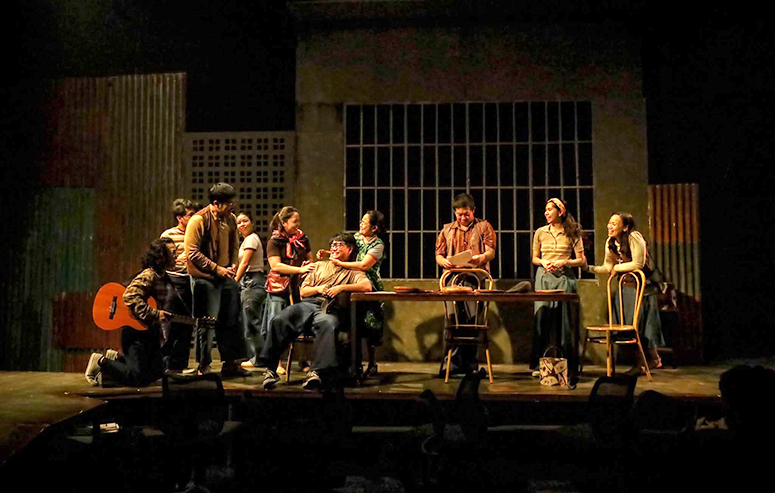
Susan (Rigel Hechanova), the youngest who joined a militant theater group, narrates their family’s beginnings in Iloilo until they moved to Manila for the polio treatment of Ryan (Timothy Castillo), who escaped to France and built networks for the resistance. Flashbacks to idyllic family days contrast to make scenes of military abuse more wrenching. With five of their children imprisoned and four of them brutally tortured, you feel the anguish of parents Ishmael Sr. (Gino Ramirez) and Esperanza (Neomi Gonzales) as their sons Jan (Joshua Tayco) and Nathan (Jerom Canlas) go missing at street protests and join the underground CPP. The most harrowing is when Jun (Jerome Dawis), who joined the NPA, is reported dead and sister Emilie (Chic Agustin-De Guzman) discovers that his death was not as a hero in battle but as a victim of treachery.
Under the direction of Delphine Buencamino, the play employs a devised theater approach where the cast and creative team read the book and consult with the surviving siblings to come up with the script. Actors contribute to the writing of their own lines while librettist and dramaturg Sabrina Basilio refines the text, resulting in richer material as each actor internalizes their character and processes the events, making it more personal and updated for today’s generation. The basic historical facts are integrated, but what hits you hardest is the emotional truth, thanks to the sensitivity of the actors, making each story so real and the plight of the family so affecting.
CONTINUE READING BELOW

The drama is made even more gripping and immersive with D Cortezano’s set design of ramps surrounding the audience who are given swivel chairs to view the action. Buencamino makes the narrative easy to follow even as tableaus shift from one side to the other. Jethro Nibaten’s lighting design establishes a scene’s setting and mood which is further enhanced by Arvy Dimaculangan’s sound design and Jose Buencamino’s music to take you back to that era. John Carlo Pagunaling’s costumes fit right in with an indigo and earth-tone palette recalling the ’70s wardrobe of student activists.
Although the family was disillusioned after the treacherous death of Jun, moving away from the underground that lost steam, they redirected their political energies into academic, civil advocacy, and historical preservation work. Their story makes for an important study to enlighten us on how to move forward as we stay vigilant to new forms of authoritarianism, injustice, and corruption that threaten our human rights and democracy.
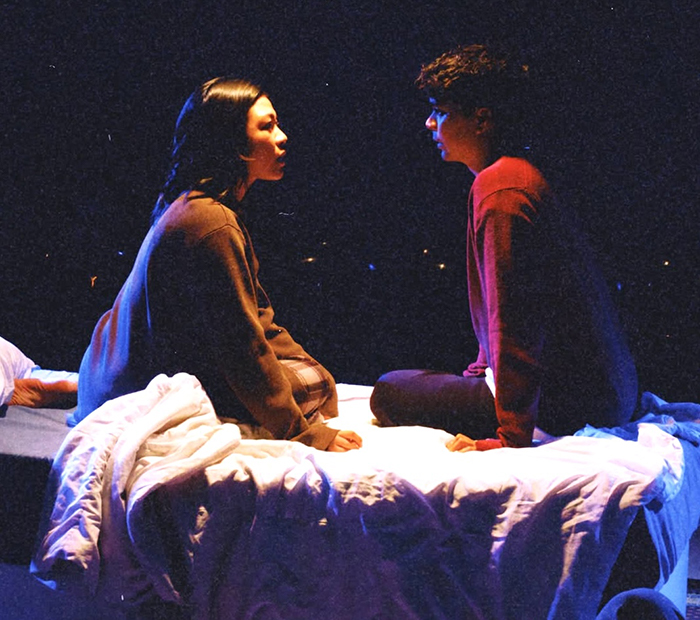
In Jonah, a play by Rachel Bonds presented by Spike Theatre, there is another form of abuse and just like martial law’s authoritarian rule, it is symptomatic of the patriarchal system of male domination. Ana (Chelsea Nikole Apolto) relives memories of relationships with different men, told in an intriguing, non-linear manner like pieces of a puzzle. In her college dorm room, she encounters Jonah (Riel Geli), a boy-next-door type with whom she shares her sexual fantasies and gets intimate enough until flashing lights erase him and reveal another man named Danny (Johnny B. Maglinao), who turns out to be her stepbrother; then we segue to a later date at a writer’s retreat where Steven (Edward Solon) tries to get close to Ana after admiring her book.
It turns out that Ana’s trust and intimacy issues originate from a violent household where Danny is physically abused by his father. Danny plays the protector who helps Ana escape from their toxic home, but he is also severely damaged, overly possessive, and inflicting his own kind of abuse. Steven, with his Mormon background, has his own hang-ups about intimacy. Apolto effectively channels the troubled character’s psychological dilemma as she navigates her trauma through these relationships. Maglinao is masterfully manipulative enough to cause her distress, while Geli has the wholesome sweetness and fragility to calm her. Solon is a natural in his character’s dorky, tentative manner in trying to gain her trust. Under the direction of Edith Garcia, they have an easy synergy as the drama unfolds. It’s curious that the title is Jonah when Ana is the protagonist, but then the biblical story comes to mind, so you realize she is in the dark belly of a whale from which she has to emerge and Jonah is an idealized romance and fantasy that can jumpstart a process of healing where she becomes one again in body and soul.
