

Is Jesus Christ still a superstar in 2026?
Jesus Christ Superstar was a big deal in 1970 when no producer would gamble on a biblical rock musical, prompting composers Andrew Lloyd Webber and Tim Rice to create a concept album instead which was such a hit that it made its Broadway debut in 1971 and became a global phenomenon, reaching our shores the same year when a production starring Boy Camara was presented at CCP followed by many other iterations thereafter including the one in 2000 featuring Basti Artadi and Wolfgang.
Now, 55 years after its conception, the landmark musical is back, opening recently at the Theatre at Solaire where it was presented by GMG Productions. Will it have the same drawing power, or more importantly, the relevance it once had?
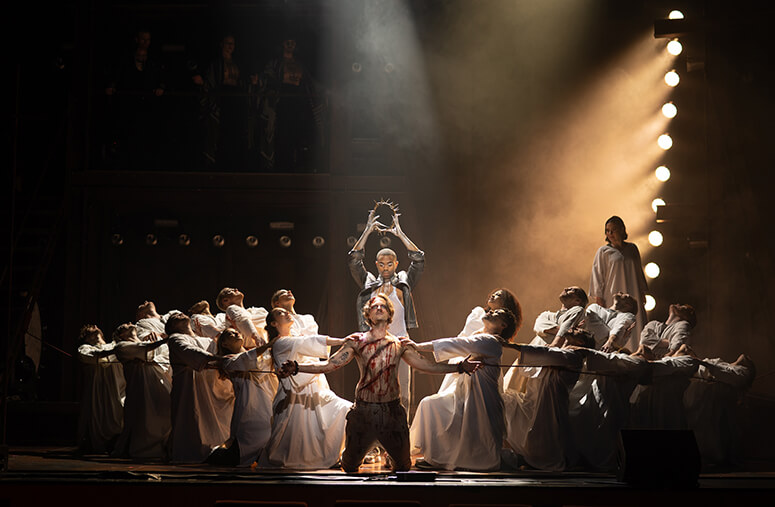
With the way the world has deteriorated, do people still care to see a musical about Jesus Christ, whose teachings seem to fall on deaf ears when you see how things have devolved with so much greed and immorality, epitomized by all the shameless corruption and lack of accountability happening in our very midst?
The audience reaction at the gala seemed to indicate the affirmative. For those preconditioned to watch a traditional musical show, you will probably be disappointed, but if you open yourself to a contemporary rock-concert experience, you will be rewarded.
Winning the 2017 Olivier for Best Musical Revival as directed by Timothy Sheader at Regent’s Park Open-Air Theater in London, this version was reimagined as a gig-theater piece which blends theatrical storytelling with the atmosphere and energy of a live concert. Featuring actors from the UK, North America and Australia, the special appearance of Philippine theater star Gab Pangilinan as Mary Magdalene upped the stakes further at the box office.
CONTINUE READING BELOW

Andrew Lloyd Weber’s fusion of rock, soul, gospel and symphonic elements that subverted the musical genre then has stood the test of time with its complex but catchy score incorporating electric guitars, pounding drums and string and choral arrangements. This 2026 arrangement by Tom Deering, however, incorporates more modern, varied instrumentation to allow for unique interpretations of songs like Gethsemane. The whole show is still sung-through, with every song advancing the storytelling and revealing the characters’ inner lives.
Sheader’s direction focuses on the characters’ humanity to make them more relatable, bringing the narrative to the present day. They connect with intimate emotional moments and even play instruments for a more informal “one of us” appeal, the way Jesus Christ (Joshua Bess) strums a guitar like your everyday subway busker. Bess, the understudy of Luke Street who was still scheduled to arrive within the week, has a boy-next-door appeal underneath the post-apocalypse makeup, with a high tenor and gentility that could be a selling point for a quiet revolution but for confronting Javon King’s commanding Judas when he has to, the latter may appear to be the dominant one. King delivers the energy and precision of Heaven on their Minds, the emotional pain of The Betrayal and the swagger and control of Superstar.
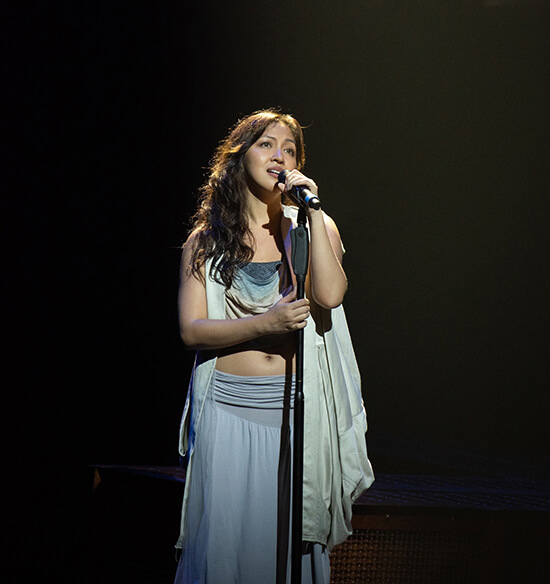
Gab Pangilinan brings her strong, versatile soprano for Everything’s Alright which is appropriately soothing for the weary Jesus but in I Don’t Know How to Love Him she shows a lot of tenderness and not enough bewilderment. She has the perfect duet with Peter (Thomas McFerran) for Could We Start Again, Please? with their voices suited for harmonizing together.
Among the authorities, Ethan Hardy Benson has strong, nuanced vocals for Pilate’s conflicted episodes while Grant Hodges and Kodiak Thompson make a great team, with the former embodying the corrupt and manipulative nature of the high priest Caiaphas with his deep bass and the latter essaying both fierceness and charisma as the calculating Annas, the enabler behind the plot to stop Jesus.
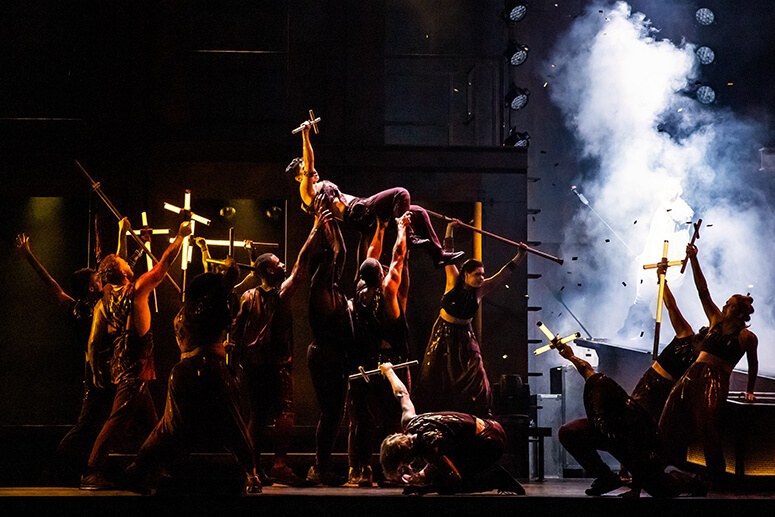
To complement the rock opera genre, Tom Scutt, Tony winner for his scenic design for Cabaret, created an industrial, dystopian world of multilevel, metal girder scaffoldings and ladders for his raw, “fallen cross” aesthetic epitomized by a diagonal cross-shaped ramp dominating the stage. In lieu of shifting scenic pieces, the sets work in tandem with the lighting design of Lee Curran who creates dramatic moods with chiaroscuro and silhouettes. The design encourages high-energy movement of performers who can be positioned all throughout the set to provide the concert-like experience while making it visually interesting.
Drew McOnie’s choreography is frenetic and raw to reflect the physical and emotional strains of the story, blending sharp, street-dance elements with powerful gestures of hands reaching up in religious devotion, simulating a “rave” or modern, ritualistic gathering with dancers moving in unison to create a tribal, cult-like atmosphere among the disciples.
Scutt’s costumes follow through, with its 1970s rock feel mixed with contemporary streetwear, jeans and activewear for the ensemble, contrasted by the Sanhedrin’s capes and breastplates. King Herod was in another world altogether in full, glittery brocaded camp befitting his decadence.
Ultimately, what resonates is how the show centers on Jesus as a social and political rebel during turbulent times which could very well be our own. The parallels with modern cult-like celebrity worship is also so close to home, showing how movements can lose their meaning when too much is focused on the “superstar” rather than the message, illustrating the tension between blind devotion and questioning motives the way Judas does. The finale is quite haunting and provocatively open-ended, challenging us to reflect on our own views of power, loyalty and faith.
* * *
Jesus Christ Superstar runs until May 31 at The Theatre at Solaire.

WATCH: Can you still trust someone who betrayed you? (Generations Ep. 22)
September 23, 2026
WATCH: Is Philippine cinema still thriving? (Generations Ep. 19)
September 2, 2026
WATCH: LGBTQIA+ people with unlikely professions
June 28, 2026