Assembling fascinating fissures
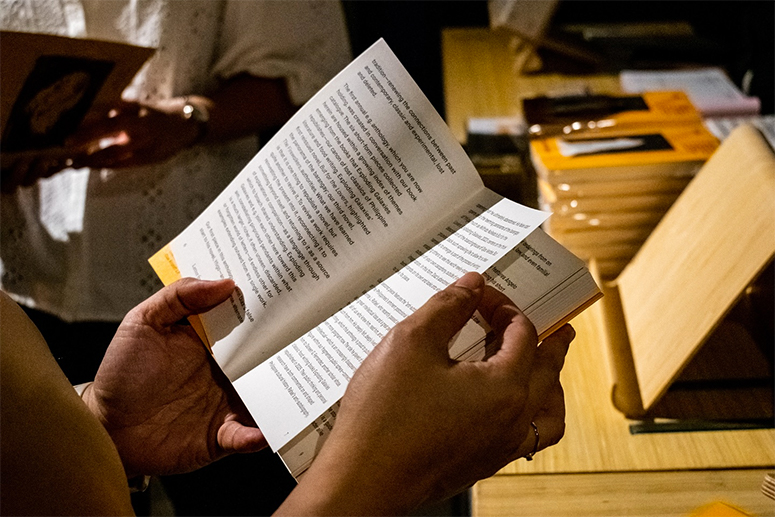
For a small book of 168 pages, e.g. Anthology 1, published as an imprint of Exploding Galaxies, promises much, proceeding from the precious idea of assembling seven authors who contribute “Short-form explorations, offcuts, and miscellany.”
Editor Nicole CuUnjieng Aboitiz expands on that: “The short-form imprint e.g. cuts a home from the dustbin—our canvas of abandoned explorations. … We created e.g. to encourage new wanderings in the varied world of Philippine letters, to widen the field in which we discuss out lost classics, and to reinvest contemporary meanings into our long literary tradition—renewing the connections between past and contemporary, classic and experimental, lost and deleted.”
It comes across, superlatively, and should serve as a strong call for annual reprise, going by the wealth of outlier creativity comprising a wealth of genres: fiction, anti-autobiography, essays, CNF, filmscript, translation, and poetry.
The seven samurai of shared similitude are authors Glenn Diaz, Vicente L. Rafael, Lisandro E. Claudio, Angelo R. Lacuesta, Alvin Yapan, Christian Benitez, and Charlie S. Veric—all notable as literary prizewinners, scholars, academic superstars.
Given our limited space, we cannot dwell in specific detail on our admiration for this collection, so the next best thing is to quote from the components, from the explanations for the contributor’s choice, the actual excerpt, or the post-interview.
The exceptional novelist and scholar Diaz gets the ball rolling with his original draft that started his second novel, Yñiga. Calling it a “false start,” he replaces it to abide by academic requirements for the completion of a novella. His PhD supervisor suggested fewer characters in proportion to the world-building. So he “sent in a new first chapter, brisker and less profuse, hyper-focused but less cacophonous.” Years later, he is “comforted by the (Borgesian) idea that the published version, finite as it is, contains all the ghosts and specters of the unfinished ones, itself a provisional form toward which the other invisible false starts accumulated …”
“And even if little from them survived, the false starts still meant, at the very least, time spent in the world of the would-be book. Nothing, in writing as is life, is wasted.”
It’s necessary to add that the false start he shares a sample of here, characteristic of his fiction, already hovers over the edges of excellence.
Rafael, who sadly left us only recently, contributed “Inventories and Interventions”—part of an attempt at an anti-autobiography “(i.e., one that does not conform to actual life, but to a wished-for existence).”
It is “an archive of quotations,” etcetera, “overheard conservations, notes from podcasts, and random observations of resistant cultural artifacts I’ve stumbled on in … cities (like) Seattle and Manila.”
In an interview, Rafael stressed: “The random, disparate nature of these texts suggests the impossibility (but not necessarily the desire) of integrating these different selves. What comes across is not one life, but several, each slipping away from the others.”
A pity that “Vince” did not complete his “Inventories.” But then again, maybe they were meant to stay richly disparate.
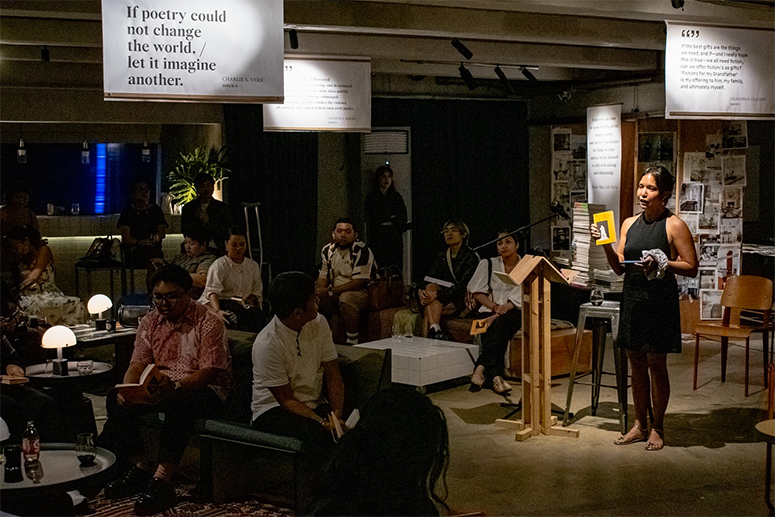
“Fictions for My Grandfather” by Claudio “involves the clashing of two voices: the academic historian and the memoirist.”
“The historian is the voice that tells the inconvenient truth. The memoirist is the voice grappling with how painful that truth is.
“… These voices are emotionally distinct. But they are both attached to fiction/s. The historian needs the art of fiction if only to make the reader turn the page. The memoirist, confronting the historian’s discoveries, needs fiction as a balm. And imagination allows him to come up with a plausible happy ending.” Indeed, straight facts and the curves of fiction are woven into enhanced completion by way of invaluable imagination.
Lacuesta’s “Exit Libris, Enter Rex” is a triple treat for someone who has watched the film An Errand, the filmscript of which adds a mythic character not present in his short story.
“So here were two very interesting translations at work.” Translations, because the evolved process involved two art forms, related in certain ways. But “the movie was never going to be the endgame of the written story … (T)he text must be its own endgame.”
Yapan’s “Mga Alamat sa Bayan ng Sagrada” is translated into “Legends of Sagrada” by Benitez. The original text in Filipino was actually a short story that developed into Yapan’s historical novel, “Ang Sandali ng mga Mata.” Set in Bicol, “this story led me to a synecdochic technique, using parts of the body as emotive links between characters across generations and worlds.”
Yapan credits Benitez for first noticing this recurrent narrative technique in his fiction. “I use these (bodily parts) as metonymic links between my characters and the ideas I want to convey.”
Veric’s “Notes from Exile” are poems intended for a sixth book of poetry, which he wrote in Siquijor and Dumaguete in 2004 upon returning from a fellowship in South Africa. “Mundane tasks took over.” The 13 fragments he wrote while on vacation in our south have been placed in the back burner since—“perhaps to let it simmer until the urge to write claims me once more.”
Here are his opening lines: “What paradise was, I had glimpses of. / The distant islands. Cloud on shining water. / Seagrasses. Starfish in the clearing, leaving / a trail of movement. Then I came unannounced. / Trudging on soft flats at low tide, I heard / the crustaceans, their tiny shells breaking / underneath my heavy sandals.”
From false starts to random interventions, then, family memories to mythic cowboys, interspersed translations of narrative genres to body parts in another language, and finally to islands of inherited enchantment—the fragments in our stories are made richly whole through the viability of a people’s imagination.
From this anthology that’s available at the Exploding Galaxies website, young writers may thankfully assume that a fascinating world of competing fissures can offer progressively asserted concepts on fresher ways to tell a story. Including disruption. And meta diversions.