What does a haunted object want?
In the notes for Martha Atienza’s “The Coconut Methodology” at Silverlens Manila, Stephanie Bailey speaks of the “spectral” materiality of the fallen coconut trees that Atienza foregrounds as medium and subject in the exhibition.
There is a haunting solemnity to the way she describes Atienza’s work: she speaks of concrete as tomb-like, the “monumental silence” of fallen coconut trees, and the “spectral shadows” of discarded fishing nets. With footage and various materials gathered from the ecologically endangered site of Bantayan Island, what the artist constructs is a landscape of “haunted objects” coming back to tell the viewer of storied tensions along the coastline. The curious spectrality of the site begs such a question: What is it that haunts this space between land and sea?
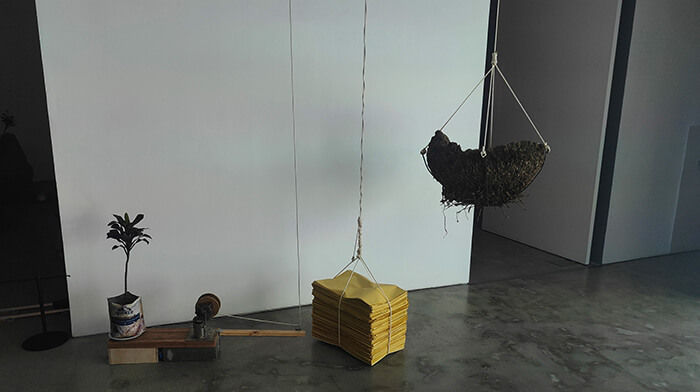
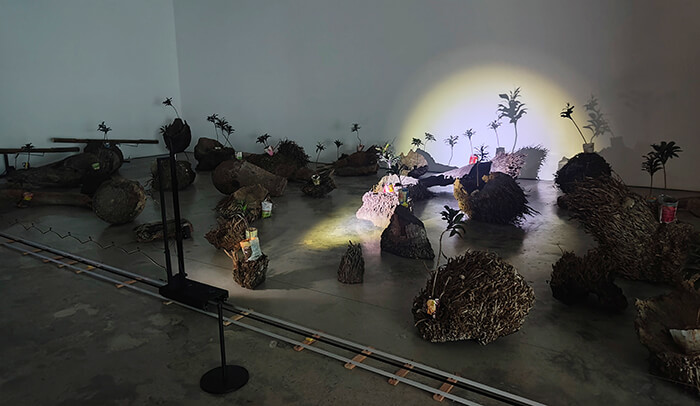
“The Coconut Methodology” draws from Atienza’s continuing social engagements with her community in Bantayan Island. It is also part of a larger project that has long preoccupied Atienza’s artistic practice, aiming to document and interrogate environmental and political tensions that have wrought her home.
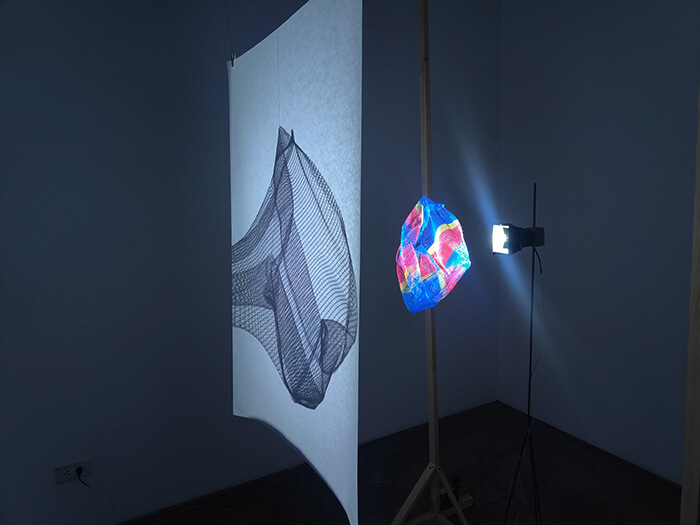
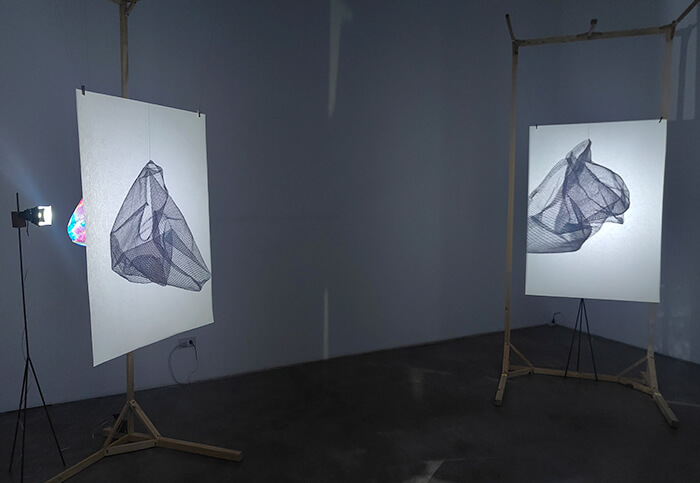
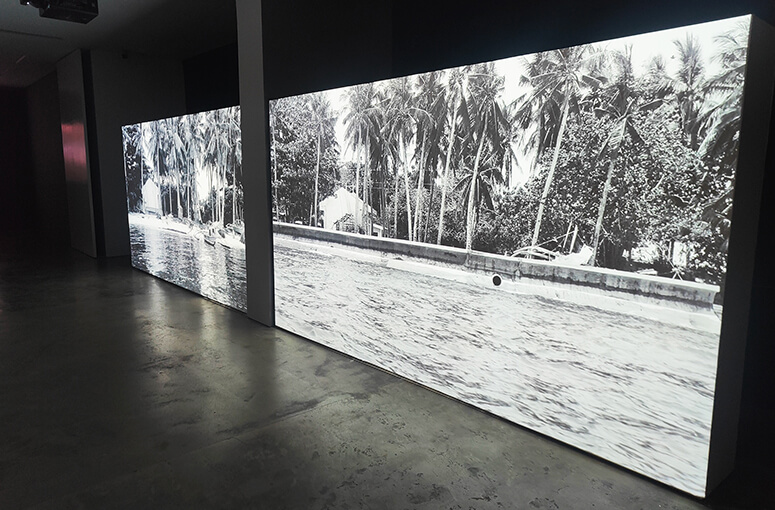
Said tensions become immediately palpable in the two-channel video work “Malbago,” which shows a panoramic shot of the site’s changing coastline from 2019 and 2026. The second channel clearly shows a concrete “seawall” erected as a measure against rising tides that have drastically eroded the coastline and caused the trees along it to be uprooted, yet also indicates the encroachment of private entities into this site that, through developmental projects, have displaced both natural and human lives. The salient image of the fallen coconut tree adrift on the shore becomes a testament to all these phenomena: Atienza frames them as witness to and evidence of tensions between topography, natural phenomena, politics, livelihood and power that have led to such environmental changes in Bantayan. In “Malbago,” the haunted materialities Bailey speaks of are immediately made visible to the viewer—that of concrete and fallen coconut trees, here entangled within a larger picture that solemnly clues us in to what lives, what struggles, and what dies in this coastal land.
The panoramic panning shot in “Malbago” finds reminiscence in the way “The Coconut Methodology No. 1” is composed, where Atienza constructs a mechanism out of plants, the found wood of coconut trees, bamboo, and a slider light machine. As the light pans like a beacon across an assembly of plants and coconut tree carcasses that scatter the gallery space like islands, a silhouette is conjured: the moving shadows cast on the wall create the illusion of moving adrift on the waters during nighttime, perhaps not unlike a fisherman’s excursion late at sea or that of the wooden carcass of fallen trees.
The second work in the “Coconut Methodology” series is a pulley mechanism held down by the weight of concrete and wood, heaving manila paper and coconut root mid-air. Caught in a perpetual balancing act, the movement of the coconut root as it is heaved up and down, becomes akin to either an uprooting from land or a drifting across an uncertain sea.
Recalling the play of shadows in “The Coconut Methodology No. 1,” the third work in the series conjures a spectral image—this time that of suspended fishing nets that cast a fine mesh-like silhouette that hauntingly entrances the viewer as it floats ruminatively.
Scoring these installations is a bamboo sound machine whose mechanism is driven by another balancing act: the flow of water and batad shells within the mechanism whisper like tranquil shores as the bamboo sways like a boat being rocked along the waves.
The precarity of the coastline shown in “Malbago” becomes solemnly palpable in these installations as they evoke a ghostly feeling of drifting through a play of cruising shadows, balancing mechanisms trapped in uncertainty, and the wispy murmurs of water. Perhaps, it is this very precarity that haunts the site. By evoking the materiality of “haunted objects” such as the tomb-like concrete, coconut tree carcasses, and the skeletal mesh of fishing nets, the landscape seems to speak in whispers: what do these “haunted objects” want?
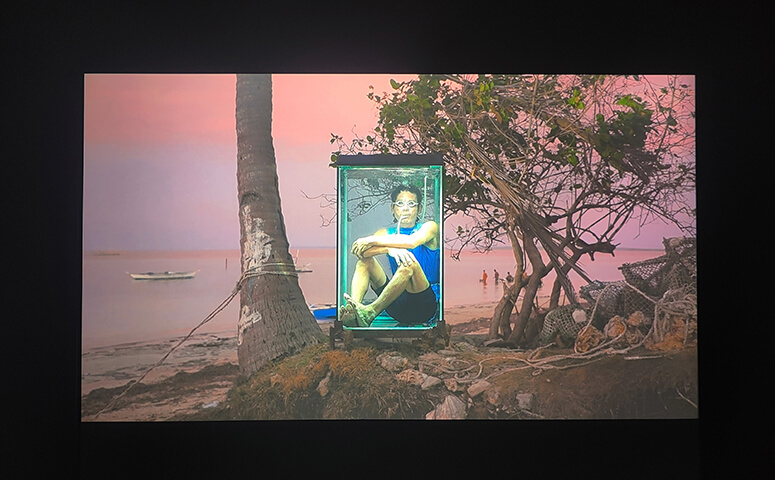
Taken as a methodology, the landscape Atienza constructs perhaps urges us to investigate, as though in a seance, what these “haunted objects” have witnessed. In the single-channel video work “Batang No. 1,” one finds an arresting image of persistence that clues us in to what we may uncover in such a task: the enduring stories of displacement and survival that have taken place here between land and sea—and how we, too, might see our place in this very struggle.