

Facebook faces the music
Like a movie monster returning to the screen years later in a reboot, Mark Zuckerberg resurfaces after 2010’s The Social Network in Aaron Sorkin’s sequel, The Social Reckoning. And as with all horror reboots, things have changed, while somehow remaining the same.
The rot hinted at in The Social Network, where Jessie Eisenberg’s palpable, nervous-tic acting embodied the socially challenged Harvard nerd who launched Facebook as a negging and bro-whistling website to rate his female classmates’ looks, have been overtaken by decades of actionable evil under Zuckerberg’s company in the name of profits.
The main evil? Facebook’s algorithm prioritizing Meaningful Social Interactions—really a Trojan Horse that keeps delivering users content that will “spark conversations and debate,” while tending to increase polarization and anger at the same time.
The film opens on a dark roadside where a distraught white woman (Portia Doubleday from Mr. Robot) is gazing at her phone. Her car hood is open; police stop to offer assistance. She turns a simple overheated vehicle into a racial meltdown on camera, uploading it live to Facebook. Later, FB data engineer Frances Haugen (Mikey Madison), upset at seeing her former liberal friend radicalized by her company’s algorithms and turned into a raging Online Karen from Hell, decides it’s time to tell the world that Zuckerberg is allowing the company to turn users into hate machines.

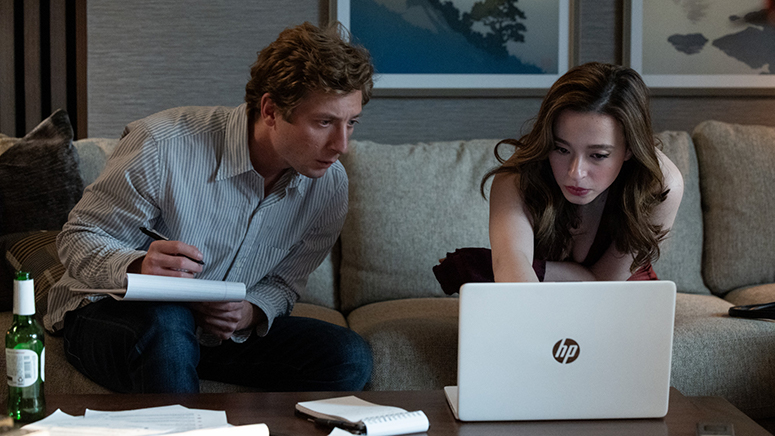
Frances reaches out to Wall Street Journal non-tech writer Jeff Horwitz (Jeremy Allen White), who pleads with Frances to give him insider files as proof that Facebook knows its algorithms are toxic.
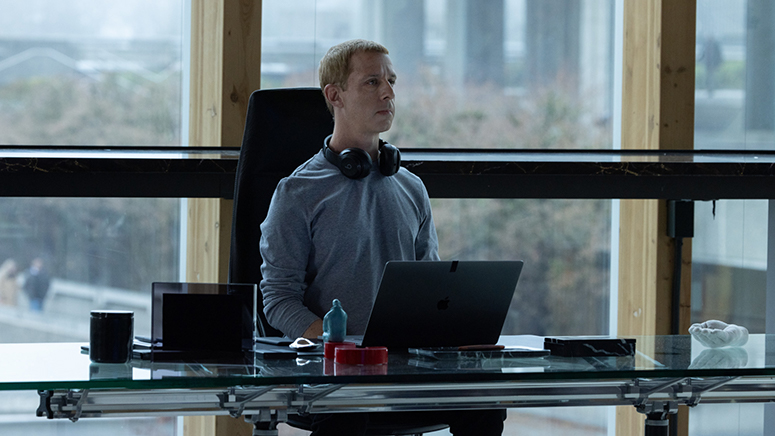
Enter Zuckerberg. We see him first in 2022, being coached on how to act more “likable” before a US congressional hearing. Eisenberg’s yapping younger CEO has now been replaced by… Kendall from Succession (Jeremy Strong), a robotic calculator in human skin who unblinkingly insists on keeping the divisive, hate-driving algorithm in place because dropping it would cause a loss of, er, one percent of Facebook’s profits. Whatta guy.
Strong brings his own palpable, icy edge to a role that Eisenberg reportedly turned down for this sequel, telling Sorkin he no longer likes being “conflated” with the tech CEO. (Hmm… Wonder why?)
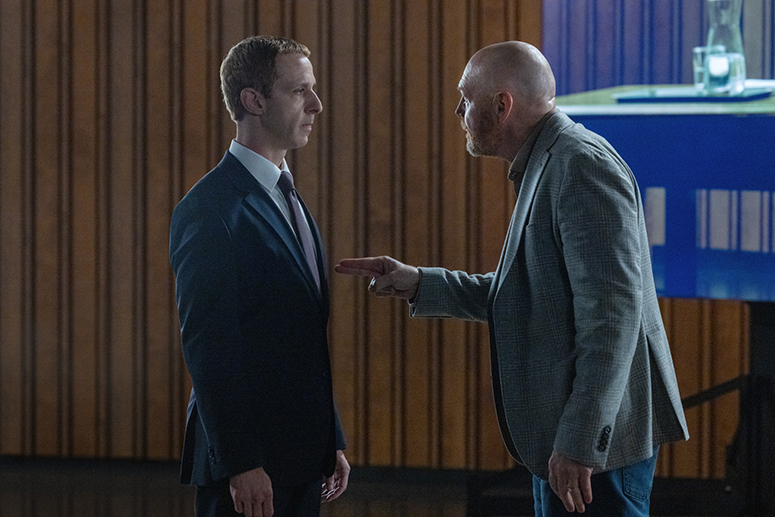
Yet, with his eerie Caesar haircut and hollowed eyes, Strong’s presence here amounts to a looming background cameo. He’s mostly a stiff, though he does have spicy exchanges with former roommate Charlie (Bill Burr), with Zuckerberg using his stance as a “free speech absolutist” as an excuse for not censoring Facebook content.
Another player who took a pass for this sequel is director David Fincher. The absence of his sleek direction is felt in Sorkin’s wordy, slower pace and lack of dramatic flourish. Which is odd, because since The Social Network came out, things have just gotten weirder with Facebook and Zuckerberg, what with a worldwide pandemic, and a certain US president denying he lost an election, then using social media to spin up a bunch of followers into violently attacking the US Capitol on Jan. 6, 2021.
That event forms the dramatic core of Sorkin’s script, such as it is. Yet a reenactment of that day onscreen feels like yesterday’s news. After Jan. 6, Zuckerberg briefly dropped Trump from Facebook, then reinstated him once the 2024 election rolled around. Facebook was renamed Meta, and it made nice with the newly re-elected president, offering him big donations.
“The Facebook Files” came out as a series in the Wall Street Journal. It led to congressional hearings and a class-action suit against Meta, filed by 48 US states, charging the company with knowingly using algorithms that are not only addictive but mentally harmful to children using Instagram and its other social media apps. That case was recently settled in a courtroom, forcing the company to pay out $18 billion over 10 years to complainants and set usage limits for kids.
Somehow, the payout seems like small potatoes. Zuckerberg, like other tech bros, still probably feels invincible after greasing the Trump administration. (One of his FB minions in the movie brags that the company is now “post-government.”)
The big problem with The Social Reckoning is it lacks the roller-coaster twists and turns of its predecessor. It also misses Fincher’s pin-sharp direction, not to mention the pulsating Nine Inch Nails soundtrack. Instead, it’s just immensely wordy, laced with tech details that quickly blur. Despite the events, there’s little dramatic core here: the congressional showdown with Zuckerberg hinted at early on never even materializes. The film just kind of…ends.
What really saves this from being a dry-as-a-martini CSPAN feed is the fact-digging journey involving Madison and White. Their patter is peppered with whip-smart, funny lines and a dash of social awkwardness.
White’s investigative reporter proves that no exposé is worth its salt without a Deep Throat helping in the background, and Madison takes her Oscar win (for Anora) to explore an even more conflicted character. They’re good together, but all that effort barely seems to jump-start a story bogged down in technical asides.
At his best, Sorkin brings a little of his patented Ben Hecht/His Girl Friday energy to the game. He seems to have a fondness for Frank Capra, too, but unlike that director’s happy endings in Washington and Bedford Falls, the Facebook story still seems mired in mid-game. And as monsters go, Strong’s Zuckerberg is kind of a stiff.
