

Boyet Fajardo talks about his ‘blinded soul,’ new fashion collection and lessons learned
Angelino “Boyet” Fajardo’s story as a pret-a-porter designer illustrates redemption and renewal. For someone who started small in the fashion business in 1978, he made it big. So big that he did not only have swollen bank accounts but also a bloated ego.
In my interview with Boyet almost 10 years ago, he humbly admitted that “success blinded my soul.” In 2009, he hogged the limelight after he asked a Duty Free salesman to kneel before him after the latter asked for an extra valid ID, a requirement for Boyet’s credit card transaction.
After that, his fashion business, which carried plus-size apparel, crashed. He was cancelled. Most of his shops in the malls closed. His billboards were defaced. He was called a monster.
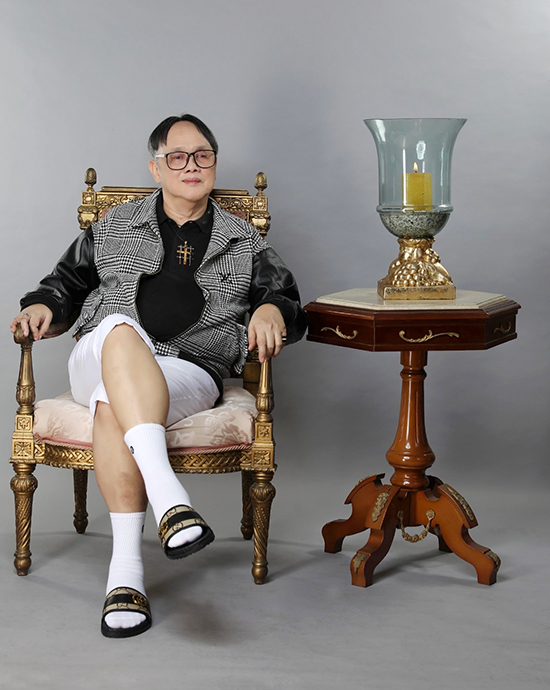
When he realized he was wrong, Boyet apologized to the man. He made amends. He atoned for his sins—“for as long as I am alive, I will support him.” He honored his word. He was forgiven. He also forgave himself.
Part of his restitution is to always check himself of conceit and prejudice. In time, he gained back the trust of the market.
Remaining relevant
Having been in the business of RTW for 48 years now, he has experienced the ebbs and flows of life. What makes Boyet relevant to this day?
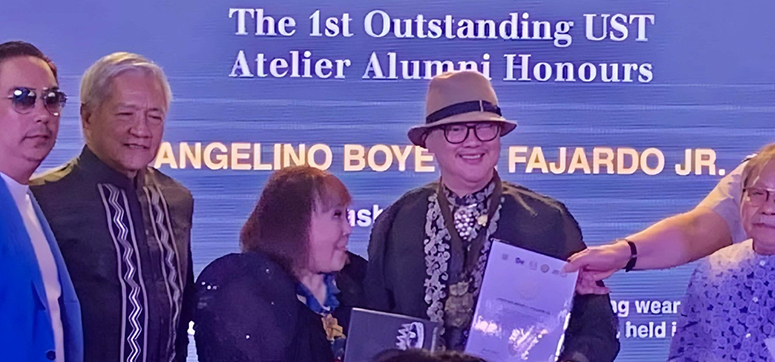

“I’m relevant because I do not forget the lessons I learned from the past. And I don’t use the argument that I am just a human being that’s why I commit mistakes. A mistake is a mistake. It has to be corrected. I learned it the hard way. But there’s no other way to learn it,” says Boyet, who started as an assistant to designer Goullee Gorospe in the late ‘70s. He also trained under Ben Farrales and Aureo Alonzo as an illustrator. All these he did while he was a young Fine Arts student at the University of Santo Tomas. (Boyet received an outstanding alumnus award from UST in April 2023.)
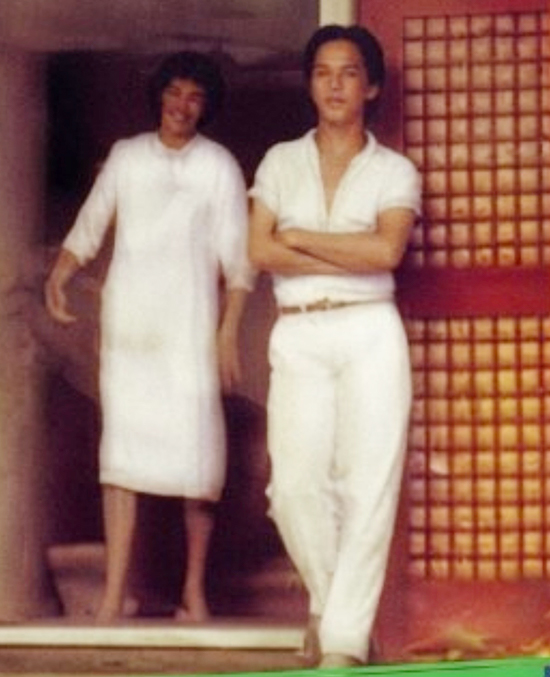
He takes pride in the fact that “on Sept. 1, 1980, I opened my own shop at the age of 18 in Banaue, Quezon City.” His ready-to-wear apparel is now called Boyet Fajardo Plus Size, Substance and Initials.
He adds, “I’m relevant because I know how to reinvent myself, my designs. My clothes, which are in major malls in Luzon, Visayas and Mindanao, cater to the baby boomers, Gen X, millennials, Gen Z. Yes, I cater also to the plus-sized Gen Z. I just don’t seat on my laurels. I need to understand also that the young set needs clothes from my collection.”
Boyet’s holiday collection

Two years shy of his golden anniversary in the industry, Boyet Fajardo is still forging ahead in full steam.
His latest collection of Asian-inspired silhouettes fill up his forthcoming holiday collection—with former beauty queen and supermodel Melanie Marquez as his muse. Boyet hopes that this collection, mostly in black and white, with a few splashes of vibrant color, will capture the interest of the RTW market.
“Japanese designs have always been part of my collections. They are timeless, geometric, linear and dramatic,” says the designer from Sta. Ana, Pampanga of his Japanese-inspired creations but with a distinctly Pinoy look.

“I feel excited about this collection. This collection highlights my 48 years in the fashion industry — through all the struggles.”
“These are limited edition pieces and all locally made. It’s a culmination of almost five decades of work. I want to be an inspiration, despite my shortcomings and physical infirmities (like my eyesight and right hand).
“I always want movement—constant movement—and never remain at a standstill, even during the global pandemic. I’ll do the things I’ve been dreaming to do all my life,” he adds.
Lessons learned
“Arrogance is not fashionable anytime of the day. That’s one of my biggest takeaways in life,” says Boyet, 64, who lost his father when he was 13. He was devasted when he lost his mother in 2012.
When he was called a “monster,” he reflected on his past and what contributed to unleashing the beast in him.
“It may be true that the world was cruel to me when I was young, when I was starting in the business, when people called me names, even accusing me of being a thief. Even if the accusation was proven to be untrue, they did not apologize. My designs were ridiculed. A sheriff even stopped me on the road and took my car. I told myself I would earn big, and I did and that changed me for the worse,” he said.
“Another lesson I learned is there will always be a time to change, to rectify mistakes, to believe in the mercy and kindness of God again,” Boyet says, adding he is comfortable talking about the monster phase of his life because “the more I talk about it, the more I learn my lessons.”
“I work to share my blessings with my staff, with others,” says Boyet. “I have visual issues; I’m legally blind now. I have a deformity in my right hand as a result of my being a menopausal baby. I’m okay with those physical conditions. God is good.”
Boyet is active at Inocencio Magtoto Memorial Foundation, a non-government organization for persons with disability. He also supports the Ephpheta Foundation for the Blind.
“I am not here to compete anymore. I only want to inspire,” he concludes.

WATCH: Save for retirement or enjoy life now? (Generations Ep. 21)
September 16, 2026