

Transforming rags into remarkable fashion
Turning rags into riches—that’s what ten Quezon City designers did, literally, at the recent “Retashow 2026” at SM Fairview. Rags, retasos and discarded clothing were transformed into remarkable fashion, instead of being added to the tons of clothes that end up in landfills every year.
Now in its third year, Retashow is a portmanteau of “retasos” and “show.” That’s the whole point, encouraging creatives to come up with inventive ways to turn trash into treasures, and rewarding them for it. This year’s winners, Niño Casiwan (Brgy. Nagkaisang Nayon), Ron Renigado (Brgy. Commonwealth) and Prince Charles Galang (Brgy. Novaliches Proper) each took home P70,000 for their eco-friendly and circular designs.

Quezon City Mayor Joy Belmonte opened “Retashow: Twinning Edition” with an anecdote about her own philosophy of dressing.
“May nagsabi sa akin dati na naawa sila sa akin,” she told the audience. “Mayor daw kasi ako pero rotating ang aking mga damit. Kulang nalang tanungin niya ako, ‘Mayor, mababa po ba ang sweldo niyo sa City Hall at wala kang pambili ng bagong damit?’

“Totoo naman mababa ang sweldo, pero marami naman murang damit ngayon na pwede bilhin so hindi yan ang dahilan,” she added. “This is a choice that I’m proud to make dahil pagdating sa sustainable fashion, isa sa pinaka malakas na mensahe ay ang paggamit ng mga damit na nasa aparador na natin. Patunay ito na hindi lang konsepto ang sustainability.”
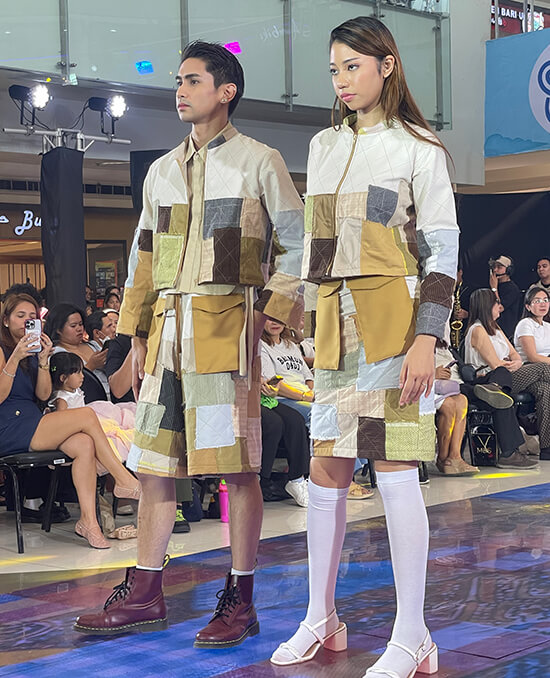
The mayor also shared the project Reporma, inviting the audience to continue donating their used office wear which will be given to graduating scholars to use for their first jobs. Donations are accepted at the city hall.
CONTINUE READING BELOW

This year’s theme of twinning had designers come up with two complimentary or paired designs. The first finalist, 22-year-old Jashmin Iballo used earth-colored scarves and cargo pants to create outfits inspired by the ever-changing forms of sand dunes, including a bag that converts into a jacket and a skirt that changes into a polo shirt.

The second finalist, Sophia Ysabelle Servando, created a mother-daughter dress set for “Kasama si Mama,” keeping memories alive by passing down traditions and garments, including the dasters that make us think of our grandmothers, and curtains and tablecloth. Sundresses used patchwork, ruffles and bows were incorporated for a flirty and youthful look.
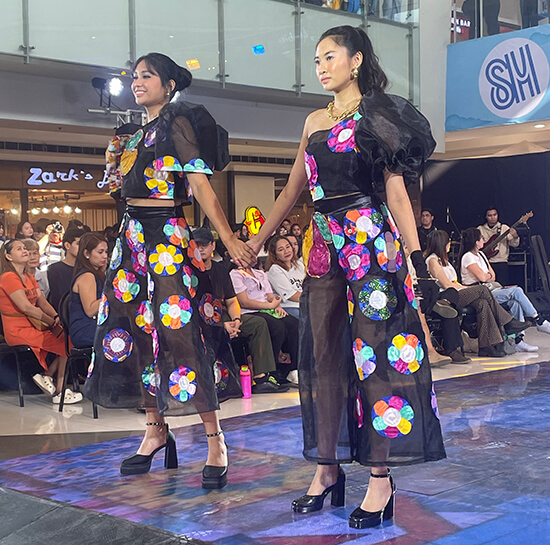
Finalist number three, 54-year-old Janeth Belchez, is a seamstress whose mother was a dressmaker, too. She plans to pass her sewing skills to her children to show that it can be both a hobby and a livelihood. Her “Pamana” design used basahang bilog, discarded satins and buttons. Colorful flowers bloomed on a bed of black organza.

Forty-one-year old Edel C. Santiago was finalist number four, a freelance pattern/cutter/designer whose “Kambal na Hibla” was literally A Mosaic of Retaso. He was inspired by the artistry of tile mosaics where broken pieces are assembled to create new visual harmony. His fabrics were gently colored using coconut, onion, mangosteen and other organic materials. His interpretation of the modern barong and Filipiniana was a dialogue between fragments and wholeness.
Twenty-four-year-old Ron Renigado, a UP fashion student, used scrap denim jeans and jackets, old and used zippers, and metal buttons. “Grow Beyond the Concrete” was inspired by the architectural strengths of the city, the interplay of light and shadow often seen across towering buildings. Floral appliques served as organic life flourishing within the urban environment. His sophisticated take made him one of the three winners.
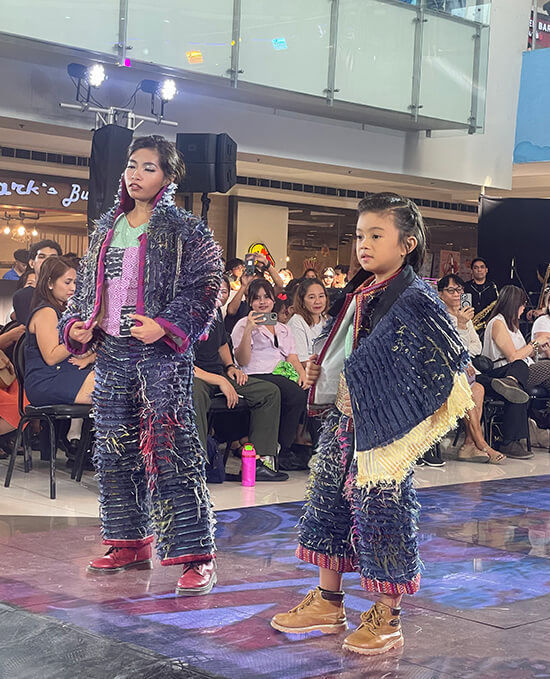
Finalist number six was 23-year-old Danryl G. Purisima, using old vests, dresses and notions for his theme “Yak-Bay” which celebrates romance, the sweetness of affection and the strength of enduring bonds. The patchwork, asymmetrical skirt and reimagined jorts forms a visual mosaic of shared struggles and triumphs.

The seventh finalist, 20-year-old Catrina Ann A. Lopez, used old fabrics and discarded jeans. Her theme was Gemeaux, showing the two sides of the twins Castor and Pollux of the constellation Gemini. The “outer persona” of Castor is bold and structured, while the “inner persona” of Pollux is intricate and detailed. With both she reveals the inner complexity of the spirit of Gemini in hip-looking street wear.
Finalist number eight, Prince Charles D. Galang, is a gown-rental boutique owner who used old denim pants, T-shirts and sweatshirts for an upcycled streetwear collection. The pants could be converted into shorts by unzipping at the knees, and then converted into a body bag or tote. He was one of the three winning designers.
The ninth finalist, Niño Casiwan is a Filipino wear designer who used old curtains, kitchen hand towels and fabric scraps to create an earth-toned palette to symbolize origin and foundation, and patchwork to represent growth and memory. For him, twinning is not sameness, but connection. He, too, was one of the three winning designers.

The last finalist, 54-year-old Evelyn T. Rocela, used discarded bathrobes and binakol fabrics for another parent-child pairing. Denim-like tops and pants had interesting textures because of the bathrobes, and made for sophisticated-looking streetwear.

The show ended with a collection by judge Avel Bacudio using his own Piñavel, a sustainable fabric made of pineapple. Summery dresses and menswear looked like they were floating down the runway, so light and white were they. The other judges for Retashow 2026 were Dr. Julius Leano Jr. of the DOST-PTRI and Prince Jimbel Ventura, a circular fashion consultant.

Apart from upcycling discarded fabrics and clothes in creative ways, many of the designers highlighted the modular aspect of their work where pieces could be converted into bags, jackets or shirts, or where pants could be turned into shorts and shorts could be lengthened into pants. Each designer had a unique point of view, a skillful way with adaptability and truth be told, they are all winners in the sustainable game of fashion.
