

On writers, artists and materials of complicity
Animosity peopled the air as calls for boycott of the Frankfurt Book Fair drove a wedge between local writers and publishers. The concluded fair, which received the Philippines as its “guest of honor” this year, has been criticized for its alignment with Israel. Still, a group of delegates, which included Nobel Peace Prize awardee Maria Ressa, literary royalty Butch Dalisay, and even battle rap mogul Anygma, flocked to Berlin to attend the fair, with trauma journalist Patricia Evangelista even delivering a speech condemning the murder of Palestinian journalists by Israeli forces.
The whole affair happened within the backdrop of the continuing exposé on the theft of public funds and the escalating protests all over the country. As more Filipinos are radicalized by this climate of dissent, it’s not hard to see why emotions are high against these supposed luminaries of culture and freedom who maintained their support for a fair that openly suppresses said values.
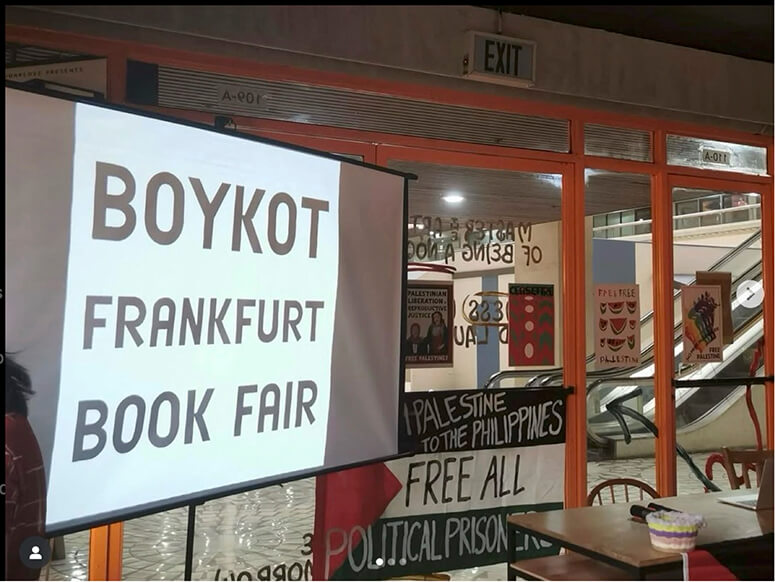
Issues of complicity among artists and how they relate to institutions have been the subject of many critical works over the years. The recent debates brought these discussions again to the fore. The Buchemesse delegates lament the invisibility of Philippine literature on the “global” stage, thus insisting on attendance for the opportunity to put the country on the map. Meanwhile, boycotting writers and publishers argue that the fair is “instrumental” to the sanitizing of the Palestinian genocide. In a statement, Gantala Press pointed out how “cultural institutions are utilized by Israel and its allies in the deliberate, persistent and violent erasure of Palestinian identity and history.” Even by framing boycott as a legitimate response, the boycotters have already shifted the conversation toward a more empowered and critical perspective, at a moment when participation in the fair seemed almost inevitable and non-participation professionally impossible.
However, fruitful discussions are often derailed when political issues are articulated in moral terms. The language of “individual complicity” and “purity” dangerously obscures the political nature of protest. On the one hand, fair attendees cry foul at critics who call them opportunistic, asserting that there are many forms of protest, boycott being only one of them (a valid statement, but not an argument). On the other hand, critics can also fall into the trap of moralistic “cancellations,” which can alienate potential allies rather than broaden the ranks through patient and rigorous political organizing.
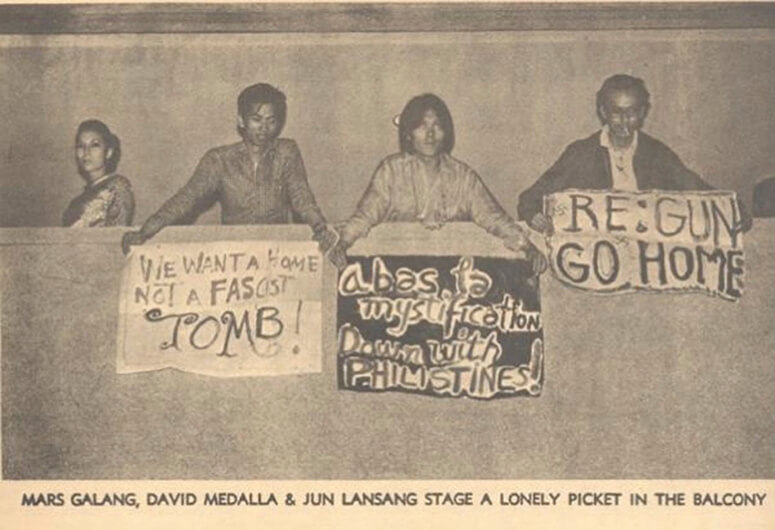
The transformation of politics into moralizing discourse also happens elsewhere. Take corruption, for example: it is fundamentally a moral term, typically applied to an individual’s ethical failings. In practice, it is most often used to describe public embezzlement in countries of the Global South or in so-called authoritarian states, and rarely invoked in wealthy nations. The term “corruption” narrows the broader dynamics of bureaucratic capitalism, where the state operates like a business, into the moral failings of a few supposedly “evil” individuals. In doing so, it depoliticizes what is fundamentally a political issue, transforming collective protest into a hunt for a handful of “rotten eggs” rather than a demand for systemic justice.
Moralizing assumes the existence of clean or “pure” political actors, and labels anyone who falls short as a hypocrite. But if market participation renders us all complicit, then everyone is a hypocrite, and true justice in this sense becomes unattainable. The rhetoric of “purity” reduces politics to a game of “gotcha,” where the focus is on catching individuals’ flaws rather than addressing systemic issues.
CONTINUE READING BELOW

However, protest, conveyed in a higher political register, goes beyond the language of individual complicity or non-complicity. Rather, it demands transcending the personal and directing the critique at the structural—the very conditions which rob the artist of the agency to completely opt out of something they do not wish to participate in. While the reduction of politics to morals frames choice as the analogous embodiment of one’s idealized moral Self, the political recognizes the Self as a site for conflict and contradiction. The defiant artist acts morally not because of, but despite their own personal predispositions.
Once we move beyond the reflex to reduce politics to moral accounting, previously nebulous things become more concrete. Aesthetic and thematic choices, artistic form, etc. cease to become idiosyncrasies, but reveal themselves to be part of a broader field. Meanwhile, seemingly non-personal acts, such as choosing to boycott a fair or not, become part and parcel of one’s cultural production. The most abstract and experimental works of art, for instance, become more decipherable once we weigh in the choices the artist made in order to materialize the work, seeing them as integral to the work itself. To do so is not moralizing, but being painstakingly political through and through.
Fortunately, little interpretation is needed to understand why artists cling to questionable markers of prestige. In responses to a magazine prompt about what the Philippines’ participation in the Buchmesse means to delegates, certain phrases recur: “global audience,” “promoting Filipino culture,” “expanding readership.” One might wonder whether they attended a book fair or a marketing convention. As Conchitina Cruz observes in “The Filipino Author as a Producer,” the Filipino desire for Western validation in the global sphere carries significant consequences: “Imaginings of national identity, while contributing more meaningfully to the struggle for representation, are nevertheless still embedded in the business of representation. This inevitably commodifies the struggle and converts it to cultural and economic capital, whose immediate beneficiary, for good or ill, is the writer herself.”
A similar dynamic can be observed in the art world. Examining the local art scene’s fixation on European biennales and international validation, Ryan Alcarde asks in “Behind the Curtain, Beyond the Stage” what Philippine participation in the Venice Biennale has actually yielded for local and regional curators, critics and art historians over the past decade. With platforms and opportunities for artists and writers limited and fiercely competitive, many are compelled to look abroad, which in turn reinforces the art world’s colonial deference to foreign trends and models. As a result, the full potential for the flourishing of Filipino culture remains largely untapped, even as it is constantly mined for novelty.
Participation is never neutral, but moralizing critiques and calls for purity, while understandable, risk obscuring these systemic forces, reducing complex political struggles to personal failings. Effective cultural and political resistance, by contrast, requires broad engagement against these structures. But of course, systems are not abstract: they do consist of individuals, flows, and concentrations of property and power. Beyond artistry, creation demands conscience. For Filipino artists navigating these terrains as both merchandiser and merchandise, the courage to draw the line, even amid imperfection, is the true measure of craft.
* * *
The essay’s title is after Amado Anthony G Mendoza III’s “Materyales sa Komplisidad” (2023)

WATCH: Is Gen Z too soft? (Generations Ep. 23)
September 30, 2026
WATCH: Why is it so hard to make friends? (Generations Ep. 26)
October 21, 2026