

Girlhood in a paper bag uniform
My best friend Terra and I went to the same high school, but we did not meet there. We met in college, several times, in fact. The first was an online Zoom orientation for a writing org I was pledging to join but ultimately deferred from. I exited the breakout room too early and was welcomed by her in the main room with a smile and a “Hi! Your hair is so pretty!” I didn’t get to reply as more people rushed back in. This was back when I had purple hair—Terra’s favorite color.
The second time was more of a chance encounter. We had the same Aerobics Dance class professor; I spotted her distinct blond hair in the crowd during our final dance marathon, when all the classes merged.
The third and last time was in a class required for both our programs. After seeing her in different literature classes time and time again, only exchanging a few “hellos” and polite smiles, we finally became seatmates.
We like to think our friendship was the one good thing we got from that class. We often mourn the time we could’ve had if we had met earlier. But then again, who knows if we would’ve been friends at all? I personally wouldn’t change our friendship now, even if it meant meeting her earlier.
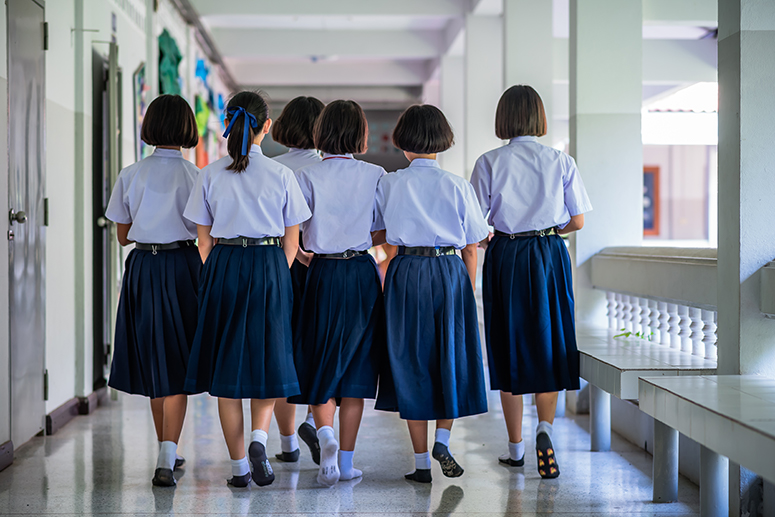
I transferred to that all-girls Catholic high school in 7th grade. Coming from a co-ed institution, the norms and culture of this space felt alien to me—in the best way possible. My old school was small and within walking distance from my childhood home. My boy classmates seemed like such a nuisance then: rowdy, sweaty, and loud. They basked in embarrassing the girls in our class and made a spectacle of our changing bodies. They “jokingly” peeped under our skirts, pulled on our bra straps through our uniforms, and teased us relentlessly for bleeding through our skirts.
On my first day as a transferee, a girl came up to me enthusiastically without introducing herself. She exclaimed, “OMG, hi! Na-stalk na kita!” It was such an absurd introduction that I decided then and there that she was going to be my first friend. Our surnames both started with “L,” so we sat right next to each other for the first quarter and were best friends for the majority of our high school years.

For a short while, I lived in a reality where it was neither a sin nor a mistake to like girls. It was a truth we all lived by.
My first few months included assimilating into my new environment, learning the ease and comfort embedded in each relationship and bond. Most of them have known each other since they were five, and yet they welcomed each new face with such warmth that you’d think they’d known you for just as long. We asked for sanitary pads in the same tone and volume as asking what our next class was. It was a matter of fact, devoid of the shame and weight people put on the reproductive make-up of girls. I began to embrace the innate sense of comfort in a room full of women, the unspoken understanding that we all bleed. How normal it is for us to shed—individually or sometimes at the same time.
***
“I’m not being an individual on my own.” — Clare Devlin, Derry Girls (2018)
While the nuns wanted us to be pristine and proper, we were quite the opposite. We laughed manically along hallways, pissing off the grouchy attendant working the desk at the accounting office. We sat legs wide, taking up space—skirts haphazardly covering our legs, elbows positioned on top of our knees. We scrunched up the long sleeves of our paper bag-colored uniforms and lost our belts often.
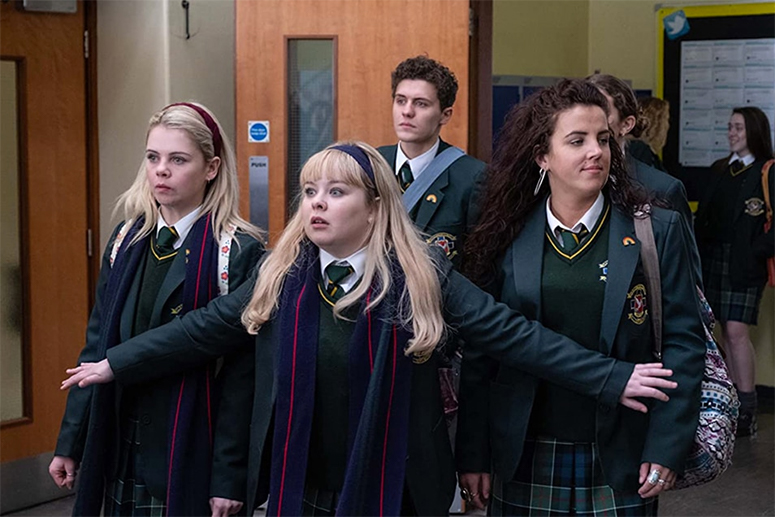
These were our tiny rebellions, breaking the rules forbidding us from displaying any semblance of individuality. We wore neon sport bras under our PE shirts, hoodies and jackets that covered up most of our uniforms, and buttons and enamel pins across our ID laces, bags and jackets. At times, I pushed my luck with nail polish or makeup, trying to see how red I could make my cheeks before I was forced to wash them off in the bathroom. On a random day in 11th grade, I got an additional pair of ear piercings—earning me an audience with our cluster leader. An earful of scoldings, a bleeding ear, and a written warning later, I exited the conference room with a grin, slowly putting all four of my earrings back in.
Schoolbook rules also prevented us from showing affection to one another—they feared it would somehow encourage homosexuality—but we did not care. We hugged longer than the five seconds the book allowed, kissed each other's cheeks, and held hands—all clean of malice, just plain girlhood. Celebrating each other’s birthdays felt like national holidays; the P.A. system announced each celebrant's name, encouraging everyone to greet one another. We set up surprises around the campus, serenaded one another, and bought balloons, bouquets and trinkets, all handcrafted and personalized to each person. I would go home with a mountain of gifts I could barely fit in my school bus. My cousin remarked that my friends spoiled me too much, but for us, this was normal. I learned that this was how you should be nurturing all your relationships, not just your romantic partners.
***
“Nearly everything I know about love, I've learnt from my long-term friendships with women.” —Dolly Alderton, Everything I Know About Love
Our canteen tables were often filled with endless laughter and stories. We exchanged secrets as easily as we shared our lunches. Sitting across from my girl friends felt like being in a confessional: no judgment, no divider, and no hiding—we confessed everything to one another, sparing no details even when we begged for a filter. No forgiveness nor repentance needed, just acceptance in its purest form.

Sitting across the table from Terra at a brewery in Cubao now, it didn’t feel any different. We’d sit down, glasses of beer in hand. We’d take a sip then reach across the table for the other’s glass, sampling each other’s drink like we were doing a choreographed dance. We’d share a box of pizza or an order of nachos; I’d get too stuffed, Terra would have to finish the rest, and we’d talk until the wee hours of the night. We made a pact early in our friendship that we’d always be honest. One too many friendships broken by the fear of being completely honest, or simply being ourselves. I guess it doesn’t really matter that Terra and I didn’t meet in high school. Just having her now brings me back home. Or as Terra would say, “If we trace anything or anyone far back enough, we’d always end up back at our high school!”
***
“Fun-fun lang.” — Rookie (2023)
Learning the vernacular of my school was fairly easy. First came the abbreviations for the places that became part of my daily routine. Second, the names we gave to teachers we didn’t like or those we favored. Third, the nicknames of people in the batch, because there could only be so many Julias and Sophias before we’d start confusing each other. Last, codenames for people we liked. I only found out in 7th grade how many crushes a person could truly have. There was a wide array of choices: from classroom crushes, happy crushes, even conditional ones like “if-ever” crushes, and of course, our long-term, unattainable upper-batch crushes.
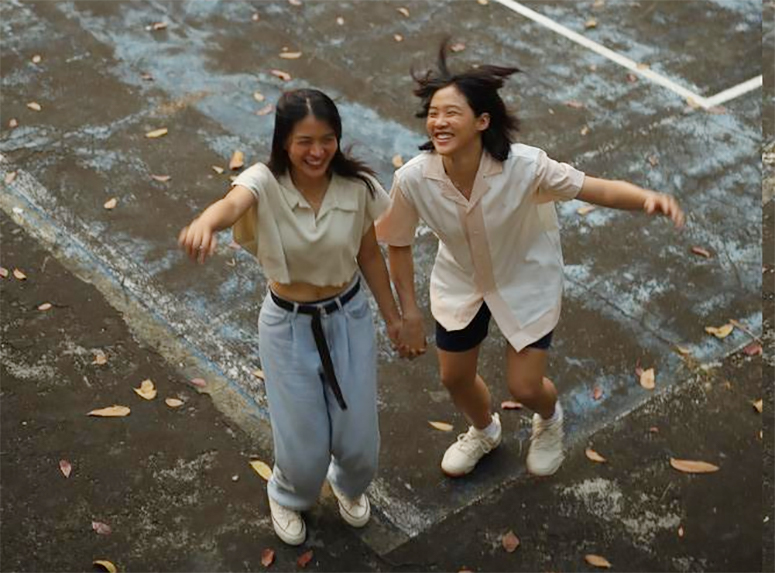
The annual intramurals only furthered our ever-growing delusions. One of the events was cheering (not to be confused with cheerdance), which involved synchronized chanting and choreographed movements. People joined because, yes, it was one of the major events, but also because it was accompanied by a team drummer from the graduating batch. It was normal for everyone to have “ICs” or intramural crushes; the drummer of our team that year was my first IC, and the first girl I had a crush on. I didn’t have a profound moment of reflection or a “coming out.” Perhaps I didn’t feel the need to; when the words “crush ko ‘yung drummer natin” came out of my mouth, my teammate’s response was instantaneous: “Ako rin! Tara, spot natin siya!” No fuss, no questions—just two girls crushing on their senior.
The closest thing to a coming out I had was in 7th grade. My friend Niesha and I were watching a movie in my room when my Papa dropped in to say a quick hello. He offered to make us grilled cheese sandwiches and his favorite mango milkshake. I didn't know this at the time, but Niesha was lactose intolerant. She chugged the whole thing down anyway without complaint. After she left, my Papa looked at me with a smile. “Girlfriend mo?” he asked.
I chuckled, “No! Iba girlfriend no’n.” He never asked again, but I know this was his way of letting me know he loved me no matter what. No confirmation needed.
***
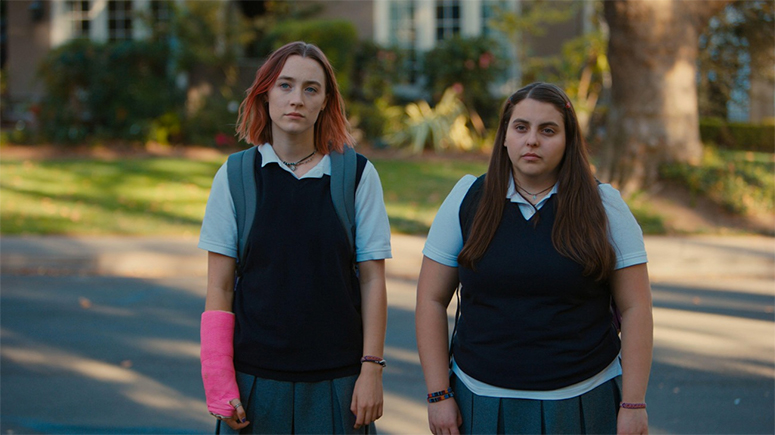
“But do you like me?” — Lady Bird (2017)
Unlike Lady Bird, who went to an all-girls high school and gushed over a guy from their all-boys counterpart, most of us didn't have crushes on boys. Rather, we fawned over one another. During Mass, we positioned ourselves beside our crushes in hopes of briefly holding their hand during Our Father and hugging them with a beso after exchanging “peace be with you.” Or, if you were in the choir like me, you’d try spotting them from afar and subtly dedicating a line or two. A Hail Mary that maybe they liked me back.
Loving someone of the same gender would have fit right into our ongoing habit of institutional defiance. But in our little corner of the world, it was the norm rather than a rebellion. We didn’t label or question each other’s sexuality or who we liked. Couples holding hands under canteen tables or kissing in the music room were a forbidden normalcy. We covered for one another, protecting each other from the piercing eyes of our teachers. We loved each other to the best of our understanding of what love was at 15.
I’m a sucker for the friends-to-lovers trope: most of my exes were my best friend at one point in time (unsurprisingly, most were members of the basketball team). Perhaps this was rooted in the idea that I was difficult to love as I am; that to love me, one must first endure the difficulty of knowing me. The beauty of starting out as friends, though, was that you could always go back to being friends, as did most of my failed relationships. And how lucky I was to be loved in different ways by the same person again and again at different points in my life.
***
“Sobrang ganda ng friendship, ‘di ba? Sobrang ganda no’n pero parang nagmumukha siyang consolation prize.” —Open Endings (2025)

The transition from liking only boys to liking girls as well was seamless for me—without judgment and doused in acceptance. Perhaps my coming-of-age was idealistic and not at all a standard for most. But for a short while, I lived in a reality where it was neither a sin nor a mistake to like girls. It was a truth we all lived by. I look back at that time of my life fondly. Despite the growing pains of teenage angst and loneliness, I was loved in a way that was all-consuming and devoid of judgment. If I could only take one thing from my short stay at my all-girls high school, I’d take the lesson of loving loudly and shamelessly. Or just Niesha, my best friend for more than a decade, partner of four years, and an ex-member of the varsity basketball team.
