Demanding a language for places
Poet-essayist Denver Ejem Torres is a risk management professional in Cebu who authored a 2018 poetry collection, Hate-Eating Birds, which I reviewed in this space.
Now he’s come up with his second book, To Travel like a Goat and Other Essays, published by Dual Story Brand Strategy Inc. of Mandaue, Cebu.
In her Introduction titled “The Fact, the Actual, and the Wish,” Dr. Christine F. Godinez Ortega writes:
“Denver’s discerning eye observing the lives of locals and significant sites during his travels and, fortunately, recording them from memory gives readers the kind of illusion that enriches their own experiences, as if they had been his travel companions themselves in Singapore, Bali, or in Macau.
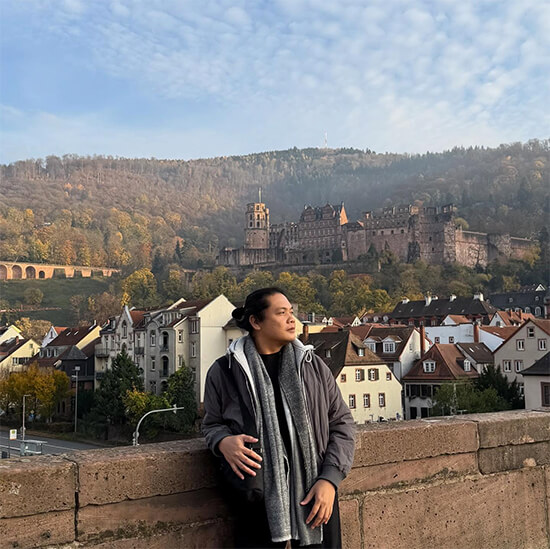
“These travel essays affirm that when visiting places, these places become a part of the traveler’s person. He can no longer say that he is the same after his travels, for his perspective widens and he becomes, to put it mildly, a better human.”
The book starts with two “Poems as Preface,” the second of which reads:
“Why I Write What I Write”: “because I am aware/ that the baby-named memory-stealer is on its way/ is always on its way,// And because no one else can.”
Here’s an excerpt from the first essay, “Busay and the Nature of Memory”:
“I was startled by a stirring in the trees. When I turned to look, I realized that my presence had startled a beautiful blue bird. I could not be sure if it was a Visayan blue fantail. All I gathered from that fleeting but blissful moment was that its sexy back was bluer than the Busay sky that morning.

“The bird and I, both of us, pressed on with our businesses. I was enjoying the view under the trees while the bird flew, I surmised, to someplace where it could not see me. I was sorry I had to take over its hangout place. Like that bird, I wanted a place in the midst of nature.
“… Before we climbed the slopes of Kahulogan, at the foot of the hill and by the brook, we rubbed crushed garlic on our skin as one would apply lotion. Auntie Conching, the Luminarias matriarch, taught me my first lesson in surviving the forest. She told me that the scent of garlic would ward off the snakes. Later in my life, this garlic took other forms and helped me survive other jungles, such as offices.”
Serving as the opposite bookend is the title essay that recalls a visit to the countryside off Ha Noi in Vietnam:
“In Ninh Bing, I was lucky to witness goats descending a steep slope of a karst near the gate of the Mua Caves. They were done with their business up the hill and they were on their way home.
“… Goats move from point A to B with so much poise. Goats are smart travelers. They are never in haste. They take their time. They enjoy the walk, sometimes they strut rather slowly, but they are always surefooted.
“… Goats travel to their feeding ground with poise and patience.
“… In other words, these mountain goats taught me how to be stylish. They taught me how to travel properly….”
From garlic to goats, then, Denver saunters and sometimes struts through myriad observations relating to nature. Ghosts supply another thematic motif. But irony is prevalent, especially since this traveler confesses as having been diagnosed to be flat-footed.
His locales often identify with his Bisaya/Mindanaoan origins, from his hometown of Cagayan de Oro to his relocation to Cebu City. He muses on recalled seascapes such as Macalajar Bay of childhood memories, before he eventually traverses Silot Bay by paddling a canoe (though he never learned to swim). He writes of “Commuting Cebu-Style”; “13C as the code for the Talamban-Colon route,” “The Queen City of Spits” where he brings up the “Diwata’s saliva.”
He mentions certain forbidding places, or those one must keep away from, because “This rumor tells us that the locals in these places will hex or poison your food so that you will fall sick.” But then, “Bus rides and nature are my pills for heartbreak.”
Then, too, in “Victims of Poor Translation,” Denver expectedly makes a case for the acknowledged bawdiness of “folksy language” in Cebu. Led off by radio programs, “the words and phrases we commonly use… are harsh, and to a certain extent foul. … (But they) are also something more. They are expressions of emphasis, to underscore the degree of concern, passion, care, or love of the speaker.”
This “naturally” leads to a typical Mindanaoan’s defense of Duterte’s language. “This is how a Bisaya speaks. To the uninformed outsiders, they could not see the tenderness, love, and passion in these words, in this language, because they could not get past the harshness of the tone, the half-speaking, half-shouting tone.
“… The key to unlocking the Bisayan tongue is to know that he is the type of speaker who cannot hide what he truly feels. … His language betrays this every time he opens his mouth.
“Binisaya is a demanding language. But there’s a shortcut, or a rule of thumb in translating the Binisaya: know that the Bisayans are a happy bunch and therefore, as a clue, read their utterances as a tease or a joke. They are probably pulling your leg when they speak in superlatives.”
In his meanderings, Denver Torres often unfolds ironies, as when he speaks of shortcuts, when he has also often disparaged his mobility that is beholden to two left feet. But then, it’s evidently not the conquest of physical space that’s essential to this writer. He travels, often surefooted, with his meditative, questioning mind.