

How Maynilad is strengthening water resilience amid El Niño
BrandedUp in partnership with
Building a more resilient water supply system does not begin when dam levels start to fall. It takes years of sustained investment to diversify water sources, expand production and storage capacity, improve network efficiency, and give water operators greater flexibility to respond as supply conditions change.
For Maynilad Water Services, Inc., the severe El Niño experienced in 2019 provides an important reference point. Since then, the company has continued investing in additional water sources, production facilities, storage, and distribution network improvements to strengthen its ability to manage future periods of constrained supply.
Recent rains have helped improve raw water conditions, but Maynilad continues to monitor developments closely and manage available supply prudently. The longer-term objective is to build a system that is progressively better equipped to cope with changing supply conditions—not only during El Niño, but amid increasingly variable weather patterns.
A key part of this strategy has been to diversify Maynilad’s water sources. While Angat Dam remains the main source of raw water for the West Zone, the company has expanded its use of other sources, particularly Laguna Lake.
The Putatan Water Treatment Plants 1 and 2 and the Poblacion Water Treatment Plant draw raw water from Laguna Lake and currently have a combined installed water production capacity of 470 MLD. These facilities provide an important alternative source of potable water and greater operational flexibility when supply from Angat becomes constrained.
The company’s total installed water production capacity now stands at 2,893 MLD, reflecting continued expansion since the 2019 El Niño.
CONTINUE READING BELOW

The company is also developing additional potable water sources through its NEW WATER program. NEW WATER involves further treating used water to produce potable water that meets the Philippine National Standards for Drinking Water (PNSDW) before it is introduced into Maynilad’s distribution system. NEW WATER facilities in Parañaque and Valenzuela are already operational, while the 12-MLD Pasay NEW WATER Facility is expected to begin operations this year.
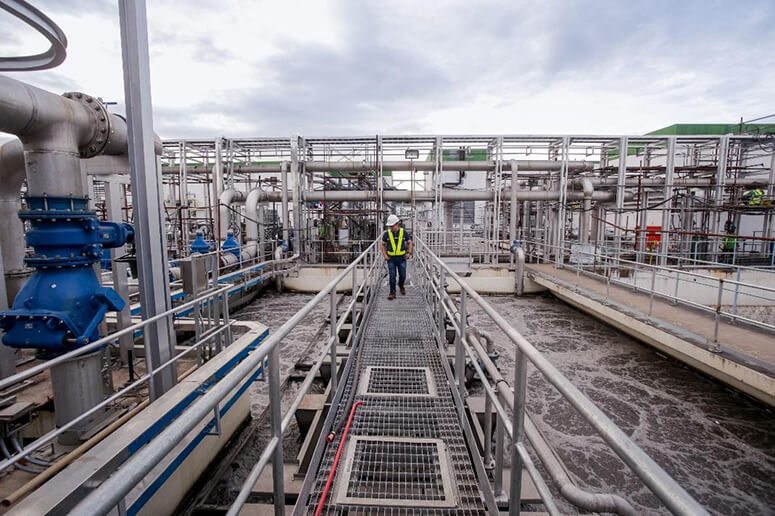
Storage capacity has also been expanded since 2019, providing additional operational buffer within the distribution system. Maynilad’s treated water storage capacity has increased from 692 million liters in 2019 to 780 million liters today. Ongoing reservoir projects, including those in Parada and La Mesa, are expected to further increase storage and improve the company’s ability to manage fluctuations in supply.
Alongside the development of additional sources and capacity, Maynilad has been working to make better use of the water already available to it by reducing losses across its distribution network.
Through sustained leak detection, pipe replacement, pressure management, network optimization, and the removal of illegal connections, Maynilad recovered 256 million liters per day (MLD) of potable water in 2025 that would otherwise have been lost.
The gains have continued in 2026. As of end-June, Maynilad’s non-revenue water (NRW) level had declined to 29.7% from 35.25% a year earlier, bringing period-end NRW below the 30% mark. Lower NRW means that a greater share of treated water reaches customers instead of being lost through leaks or unauthorized connections—an efficiency gain that becomes particularly important when raw water supply is constrained.
These improvements have also been accompanied by broader gains in water service. During the first half of 2026, Maynilad’s service coverage improved to 94.99%, while 24-hour water availability at the minimum pressure of 7 psi reached 92.1%.
Maynilad also invested P12.89 billion in capital expenditures during the first half of 2026, 18.9% higher than during the same period last year. These investments supported water and wastewater infrastructure, network efficiency and reliability, production facilities, and customer service improvement programs.
Taken together, these measures are intended to give Maynilad more options for managing changing supply conditions. Additional water sources broaden the company’s supply portfolio; greater production and storage capacity provide additional operating flexibility; and lower water losses enable more of the available supply to reach customers.
These improvements, however, do not eliminate the risks associated with a prolonged decline in raw water availability. Maynilad therefore continues to work closely with the Metropolitan Waterworks and Sewerage System, National Water Resources Board, PAGASA, Department of Environment and Natural Resources, National Irrigation Administration, and other government agencies to monitor conditions and implement appropriate operational measures as circumstances evolve.
Should supply conditions eventually require scheduled, area-specific service adjustments, Maynilad will issue advance advisories to affected customers and implement contingency measures to help minimize the impact.
Building water resilience is a continuing effort. Since the 2019 El Niño, each additional source, production facility, reservoir, network improvement, and reduction in water losses has helped strengthen Maynilad’s ability to manage available supply and sustain reliable water service—not only during El Niño, but over the long term.
***
Editor's Note: BrandedUp is designed to provide you with insightful, inspiring, and educational content created by The Philippine STAR in collaboration with brands like Maynilad Water Services, Inc.

WATCH: LGBTQIA+ people with unlikely professions
June 28, 2026
WATCH: How to experience Bangkok and Kanchanaburi in one trip
October 21, 2026