

Could researchers have found part of Amelia Earhart's plane, missing since 1937?
Researchers on remote Nikumaroro lagoon in the South Pacific may be on the right path to cracking the mystery of American aviator Amelia Earhart's 1937 disappearance.
On June 1, 1937, Earhart, accompanied by her navigator Fred Noonan, began their second attempt at circumnavigating the globe from Miami, Florida. Then, in July 1937, on the third-to-last leg of their attempt, the pair and their plane disappeared somewhere over the Pacific Ocean. Although numerous attempts to find them were carried out, Noonan was declared legally dead in absentia on June 20, 1938, and Earhart on Jan. 5, 1939.
Authorities have not found conclusive evidence to explain the mystery. That is, perhaps until researchers set up field operations on Nikumaroro Island a few days ago.
A 17-person team from the Archaeological Legacy Institute, Purdue Research Foundation, and Purdue University is investigating whether an object, called the Taraia Object, is part of the wreckage of Earhart's plane. The object was detected by satellite imagery in 2020 on the uninhabited island of Nikumaroro and was visible in 1938 aerial photos showing the lagoon.
Satellite images show the object, resembling a white stick with two spokes on either side, submerged in the water near a sandbar on Nikumaroro Island, according to information from Purdue University.
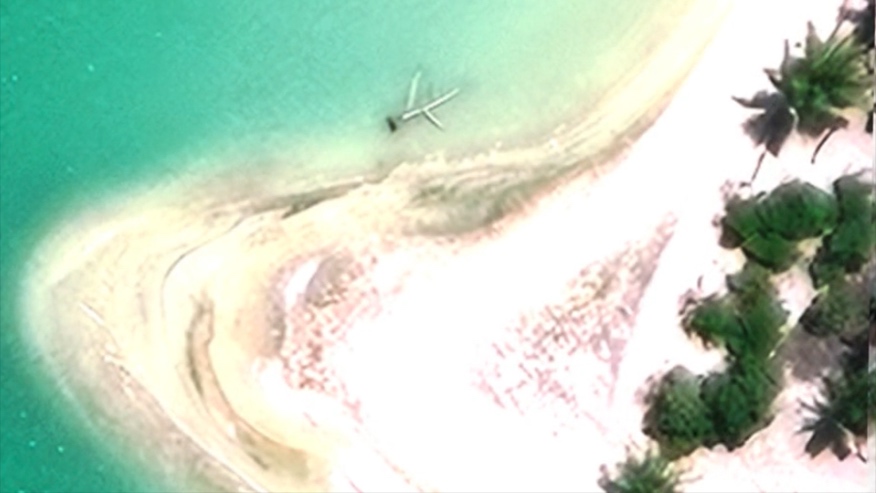

The Purdue investigation revolves around the theory that Earhart and Noonan may have crashed on Nikumaroro.
"We're day two on Nikumaroro... It's a pretty exciting day because we'll have the tech system set up and running so we'll be able to monitor the Tri Object. Today will be the day where we hopefully get a sense of what the Tri Object is," said Sirisha Bandla, Purdue alumna and technology specialist, in a video uploaded by Purdue University on Facebook on Oct. 14.
"It's a little nerve-racking, but really exciting, as well," she added.
While the investigation is in its early days, the researchers are optimistic that whatever they find will add to the collective information available on Earhart and Noonan's disappearance.
"No matter what the outcome, we're gonna find out what it is that was seen on that satellite imagery," said Steve Schultz, Purdue general counsel and field assistant.
The team has set up a tech system that measures tides and the weather, among others, which allows them to gather "more data on Nikumaroro than anybody in the world ever has gathered, and have it on real-time basis," added Schultz.
Although the investigation is only on its third day, much has been done. The maritime archaeology team has begun assessing the lagoon with a magnetometer and side-scan sonar technology.
The tool is designed to detect metals containing iron, including steel cabling and other metal parts from Earhart's twin-engine plane. Sonar technology will be used to find objects buried under sediment on the lagoon floor.
According to Rick Pettigrew, executive director of the Archaeological Legacy Institute, the team has a method in place.
"We're following our game plan. It's too early to reach conclusions as we've got a lot of science left to apply," he said.
Other tools the team has in its solar-powered tech system are a remote camera and water level transducer, both of which provide information on real-time weather and tidal flows.

WATCH: Do you still believe in marriage? (Generations Ep. 17)
August 19, 2026