

‘Moryon’: When war challenges faith
The Japanese occupation of the Philippines and the Moriones festival in Marinduque are the unlikeliest bedfellows but Moryon, a play written and directed by Dudz Teraña for the FEU Theater Guild, proves they can work together for a spellbinding piece about a mother’s grief and quest for justice as a community holds on to its religious beliefs. Lovingly crafted with utmost realism by student thespians and creatives, this production demonstrates that some of the most courageous and astonishing offerings in theater can be found in universities.
Teraña has taken “La Mère Sauvage,” the short story by Guy de Maupassant, and expanded its themes by transposing it to Mogpog, Marinduque, during Maundy Thursday, 1943, in the seaside house of Caridad (Maria Ysabel delos Reyes) who lives alone.
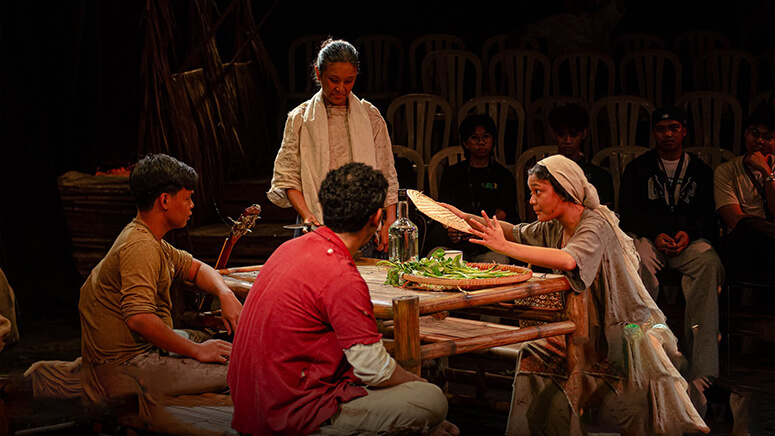
The painstaking attention to detail begins upon entering the theater where 1940s wartime tunes can be heard and you feel the gritty soil on the floor of the FEU Center of the Arts Studio that has been transformed by set designer Althea Sibulo into Caridad’s world, drawing you in as it indulges all the senses: the splash of water from a well, the aroma from a stewing pot in the kitchen, the clinking of enameled plates on a bamboo table, the flickering candles on an altar of santos and a cross fashioned from twigs, strips of nipa lining sleeping quarters, and Caridad herself, grating buko while straddling her kudkuran or kabayo, beside a log where she had earlier chopped the coconut in half with a bolo.
Neighbors come in, one by one, speaking in Marinduqueño, an archaic Tagalog which the actors have mastered to add to the authenticity and ease in inhabiting their characters, aided by period costumes meticulously researched by Justin Abalos and Margarita Barrameda and designed to look weathered by wind and sea. Even their skin is bronzed and hair made briny from their labors under the sun. Their chemistry is evident as the banter progresses organically in a superbly orchestrated tableau, much like an opera, from solos to a duet, a trio, a quartet—until you realize that they are all talking at the same time in a sonorous cacophony that camaraderie in a tightly-knit community brings.
CONTINUE READING BELOW

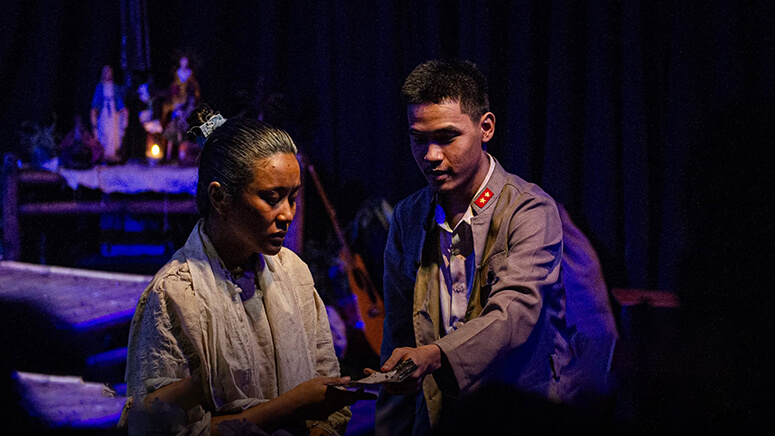
It’s so joyous that when the interpreter Esteban (Dave Bambang) arrives with Japanese soldiers who wish to spend the night at Caridad’s, you, together with the cast, are jolted into the brutality of war and colonial intrusion, which are manifested both visually and aurally: Clad in fascist militaire, an affront to the relaxed island wear, speaking in yet another foreign tongue just when Filipinos were getting used to the English of the preceding colonizer. Just like with Marinduqueño, the actors were coached to develop an amazing facility for Nihongo, which further enhances the verisimilitude.
With no supertitles, you empathize with the alienation. For Caridad, it’s even more personal, because the visitors are the very reason why her son, Joaquin (Aldin V. Covarrubias), left to join the guerrilla resistance, and she has no qualms in expressing disgust at their presence, which Esteban filters through his altered translations.
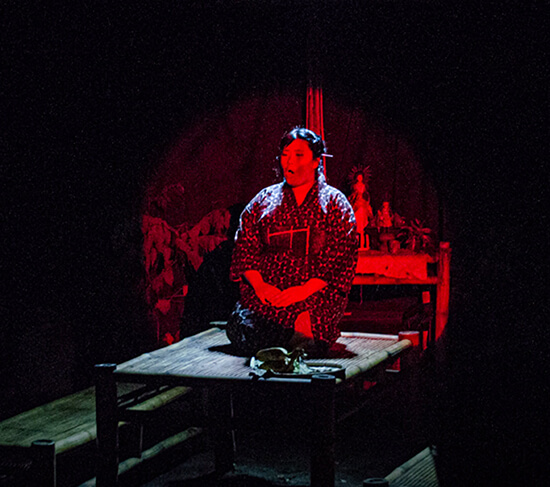
As past events in Caridad’s life resurface (Spoilers follow!), you realize the traumas she has gone through with a verbally abusive husband who leaves her, a daughter dying, and the separation from her son, all presented in Teraña’s meticulously composed mise-en-scenes that appear like unsettling flashes in her mind through sound triggers and abrupt changes in the lighting design of Sophia San Diego.
While they may justify her enmity, all these are juxtaposed against the Japanese soldiers showing kindness and gratitude for her hospitality — making her interaction with them not as simple as victim vs. villain. Even Esteban, portrayed by Bambang with more complexity than just an opportunistic collaborator, becomes sympathetic.
Delos Reyes captures the essence of Caridad, a survivor hardened by grief. She maintains a stoicism all throughout, but when it is revealed that her son, on suspicion of being a spy, has been murdered by the Japanese in the most heinous fashion, she loses it and her faith is put to the test as she contemplates revenge. Would it be justified as an act of war?
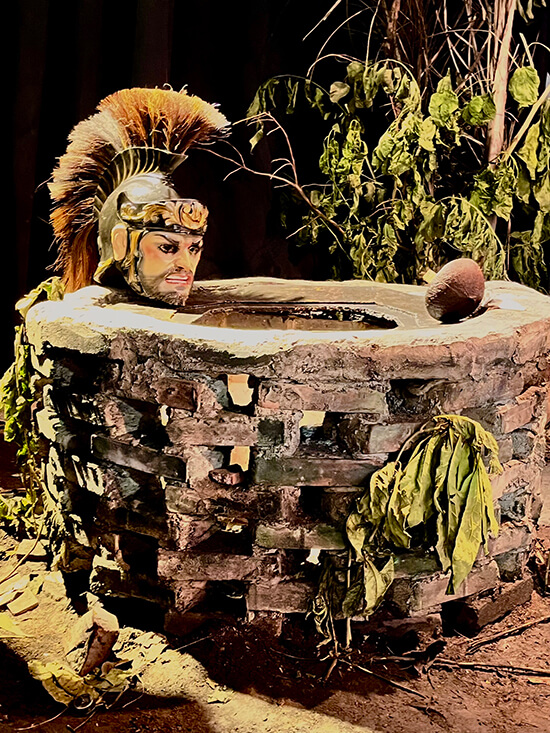
Teraña develops the tension with a calibrated pacing and the final scenes are some of the most poetic, if earth-shattering. You see the raison d’etre for the aesthetic choices in the production that pull everything together. The well, the source of life, can be the site of abuse as well as catharsis and healing. Ergo, for the kitchen, from whence Caridad nurtures, can also be her weapon in the call for justice. The altar that has sustained her suddenly gives no answers. For the community, as they wear the Moriones masks in a procession, religion hopes to shield them from the ravages of war and perhaps, like Longinus, the Roman centurion at the center of the festival, they may find enlightenment amidst all the violence.
Moryon runs at the FEU Center for the Arts Studio until Nov. 28. Follow @fareasternuniversitytheaterguild

WATCH: Can you still trust someone who betrayed you? (Generations Ep. 22)
September 23, 2026
WATCH: Good parent ka ba? (Generations Ep. 28)
November 4, 2026