

Political cartooning still holds, and will forever hold, a place in journalism
Political memes are everywhere in the digital space. While they make us laugh, they have also become a powerful tool in delivering messages to the masses and in promoting societal awareness.
But long before they occupied the online world, editorial cartoons graced the pages of the newspaper. Unfortunately, traditional print newspapers are facing unprecedented challenges and, as a result, editorial cartoons are struggling to find their footing in this print medium.
The first impression people have of me as a political cartoonist is that I was probably an art major. Actually, I am pursuing a career in science. As someone currently doing a PhD in Physics, I am often asked why I continue to dedicate my late nights and (digital) ink to political cartooning despite its current state.
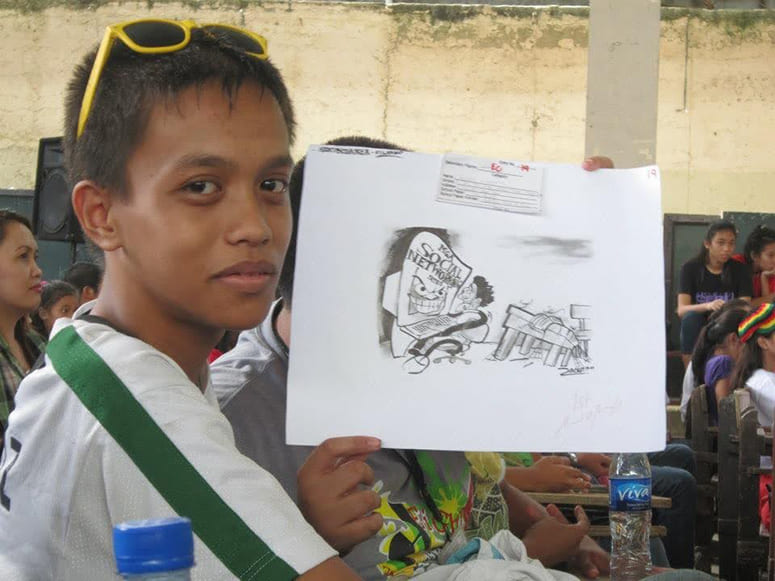
The answer tracks back to my high school days at the Philippine Science High School-Central Visayas Campus. Nestled in the middle of the hills of Argao, Cebu, my school felt worlds away from the bustling urban areas. Even though our school prioritizes science, math, and technology, we still had a chance to compete in DepEd-organized campus journalism contests, with Dr. Riza Reyna Calma as our school paper adviser for Ang Tugatog. For an aspiring campus journalist competing in the editorial cartooning category in DepEd-organized press conferences, finding reliable resources and mentorship was a constant struggle.
But our school had a saving grace: a subscription to The Philippine STAR.
Our librarian, Ms. Ligaya Geslaga, used to meticulously clip and compile the editorial cartoons from the paper. It was through those clipped pages that I first encountered the genius of the late Rene Aranda. I never met him in person, but his sharp lines, biting wit, and profound commentary leaped off the newsprint and reached me across the miles, right there in the hills of Cebu.
CONTINUE READING BELOW

It didn't matter that I went on to study BS Applied Physics and MS Physics. I spent years as the long-time illustrator for Today’s Carolinian, but it was the isolation of the pandemic that finally pushed me to build on my online public persona, “Cartoonist Zach.”
As the digital landscape grew more crowded, it became clear that individual cartoonists needed a collective sanctuary. That realization led me, alongside fellow artist Isang Tasang Kape, to co-found Pitik Bulag. When traditional spaces for aspiring cartoonists began to dry up, we wanted to build a digital platform where new voices could be amplified. We organized online contests, did collaborations, joined campaigns like #FactsFirstPH to combat disinformation, and sought to keep the tradition of visual resistance alive.
Our most memorable milestone came from a place of grief and gratitude: When Rene Aranda was hospitalized, Pitik Bulag called for caricature entries to honor him. Witnessing artists from all over the country pay tribute to the master who had indirectly raised us proved that our community’s heartbeat remains strong.
Now, as The Philippine STAR celebrates its 40th anniversary under the banner WHERE TRUTH SHINES, the media landscape and political cartoonists face a new elephant in the room: artificial intelligence.
Many fear that AI will render the human artist obsolete. I disagree. I am not afraid of AI for the same reason I am not worried about memes replacing fine art. Editorial cartoons are deeply, stubbornly contextual. Satire requires an intimate understanding of nuances that an algorithm, no matter how advanced, simply cannot synthesize.
We see this shift happening in music already. As AI-generated tracks flood streaming platforms, people are actively seeking out live concerts. Why? Because we crave the human side of creation. We want to see the sweat, the imperfection, and the raw emotion of a live performance. The same might be true for political art. When a reader looks at an editorial cartoon, they are looking for a human soul wrestling with the truth of our society.
Memes will continue to flash across our feeds and vanish into the digital ether by tomorrow. AI will continue to churn out mathematically perfect, soulless imagery. But the editorial cartoon, sketched by a human hand and fueled by a human heart, will always endure. For as long as there is power to be checked and truth to be told, we will keep drawing the line.
I don't draw for the likes. I still, and will forever, draw because it's who I am.

WATCH: Pixar Summer Fest adventure at Hong Kong Disneyland
August 10, 2026