

A millennial's pilgrimage to see Carlo Acutis, the saint in sweats and Nike sneakers
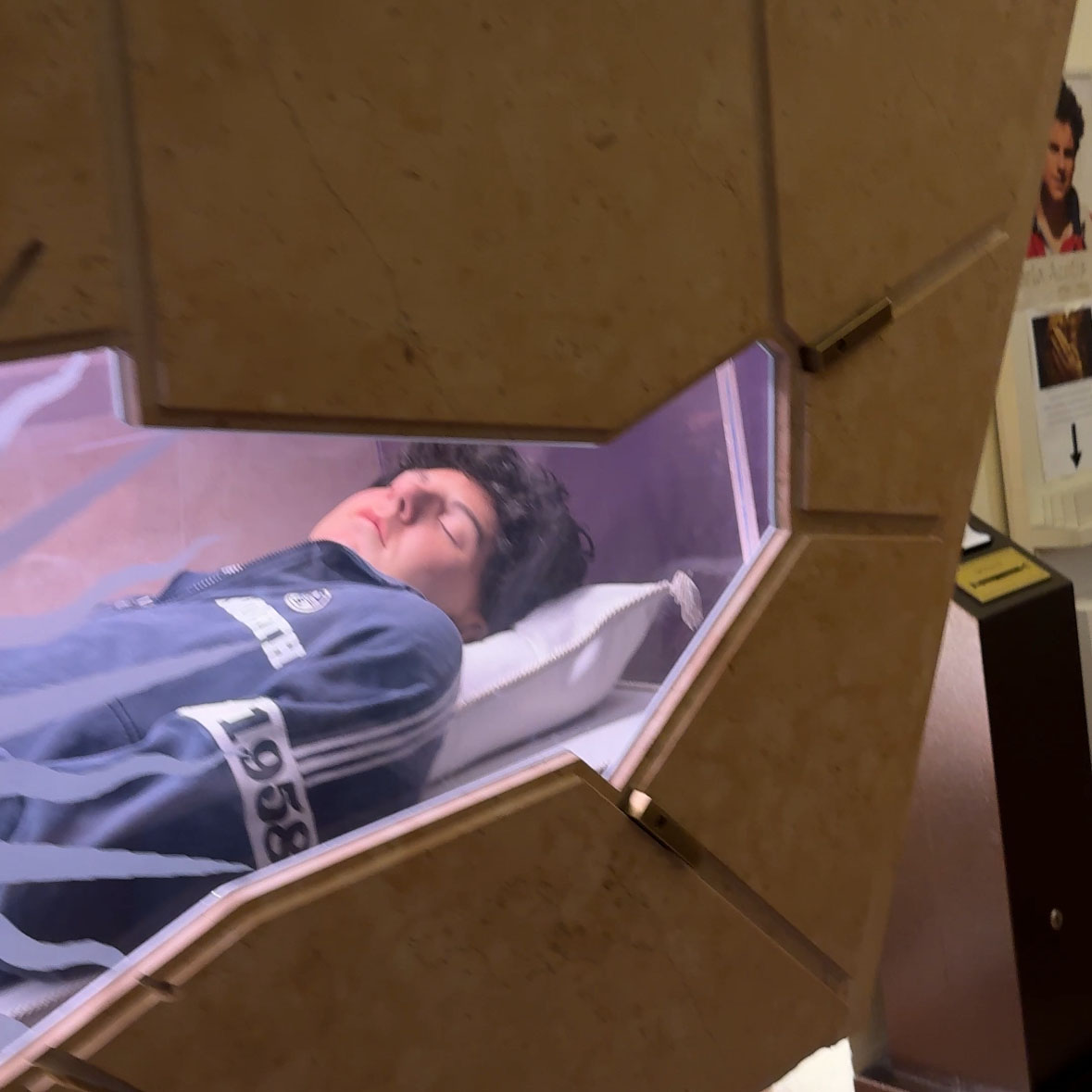
He lies in a glass sarcophagus, his face and hands remarkably preserved, wearing blue jeans, an athletic zip-up jacket, and Nike sneakers. Here is a saint named Carlo Acutis, a millennial who died in 2006, displayed as he lived: A boy who loved computers, video games, and probably knew the feeling of getting a new Walkman for Christmas.
I lined up alongside the other onlookers inside the hallowed walls of the Church of St. Mary Major in Assisi, Italy, to personally see someone dubbed “God’s influencer” and the “first millennial saint.” The air was thick with reverence and also curiosity. What kind of message is the Church sending with a saint in sweats?
As a Catholic millennial who came of age with the robotic hum of dial-up internet, I was brought up with the idea that holiness was an ancient relic, the likes of San Lorenzo Ruiz and Francis of Assisi. Eighty-seven-year-old Mother Teresa of Calcutta is the most memorable saint when I was in high school.
And as a digital native, I am used to seeing institutions try to stay relevant. What I see now feels like a whole new strategy.
For centuries, the faith communicated through stained glass, Latin prayers, and grand—often intimidating—rituals. However, it was a young crowd that gathered in St. Peter’s Square on Sept. 7, 2021, when Pope Leo XIV proclaimed Acutis and Pier Giorgio Frassati as saints.

“Sts. Pier Giorgio Frassati and Carlo Acutis are an invitation to all of us, especially young people, not to squander our lives but to direct them upwards and make them masterpieces.” Pope Leo XIV said in his homily. The canonizations were the first of his pontificate, making the Church’s message all the more obvious.
The saint in sweats represents a significant shift in the Church’s communication strategy. Acutis’ path to sainthood, just over two decades from his death, is one of the fastest in modern history. It reflects the Church’s urgent push for relevance to meet a generation that is increasingly disengaging from religion.
While the Philippines remains a deeply Catholic country, studies show a growing trend among millennials who believe that salvation is possible without consistent church attendance. This presents a challenge for the Church, which is now leveraging digital evangelization as a key strategy.
One of the Filipino digital evangelists I know is Fr. Fiel Pareja, who now has 3.6 million followers on TikTok with his popular phrase, “Wait, don’t skip,” and then leads a prayer in digestible vertical videos for his viewers.
However, the Church’s message to its young flock is a mixed bag for the Philippines, where a persistent digital divide persists. Around 25% percent of Filipinos are still offline, according to reports from Data Reportal 2025. Many people in geographically isolated and disadvantaged areas still lack access to reliable, affordable, and secure internet.
For this reason, the Church’s strategy cannot be solely digital. In many dioceses, bishops and priests continue to rely on traditional media, such as local radio, community television broadcasts, and personal visits to barangays, to spread the faith. The digital evangelization represented by figures like Acutis is a powerful new tool. Still, it must work in tandem with long-standing, tangible forms of outreach to truly bridge the gap and reach every member of its flock.
Acutis lived in a space between two worlds. As a product of the late ’90s and early 2000s, he grew up as the digital frontier was still being mapped. He became a self-taught coder and built a website to document Eucharistic miracles. This project has since been translated into dozens of languages and traveled the world as a museum exhibit. Now, here he lies inside a church, where people line up and take a few minutes to view his remarkably preserved body as part of the Church’s larger exhibit.
Acutis chose to be buried in Assisi because he was a fan of Saint Francis, the very same saint after whom the late Pope Francis took his name. Making a millennial a saint is a significant part of Pope Francis’ legacy, a pontiff who holds a special place in the hearts of Filipinos.

Pope Francis is the first to use social media so thoroughly as a tool for evangelization, where he built a strong presence on platforms such as Instagram and X to connect with a global audience. The move feels like a direct continuation of that same spirit, a desire to connect with the flock wherever they may be, even if it’s online.
On a side note, there is a new generation of so-called “nepo babies” who use their platforms to flaunt a lavish lifestyle, while the country is drowning in debt and severe flooding. This makes the life of Acutis all the more relevant. Acutis was born into a wealthy Italian family and had similar access to privilege and resources. Yet, he chose a dramatically different path, creating a website and learning to code as he went. His life demonstrates that influence is a tool for something greater than oneself, but a way to build communities and share what is good, true, and purposeful.
The casual clothes of Acutis convey a clear and deliberate message from the Church to the modern world, a strategic gamble. While it may seem like a PR move, it’s also possible that the Church is subtly telling its flock that there are newer ways of professing one’s faith. Defying the old image of a saint in a gilded robe, Carlo Acutis’ story proves that modern-day holiness can be found in a teen wearing everyday clothes.

WATCH: Is OPM still as good as it used to be? (Generations Ep. 20)
September 9, 2026