

UK-based Esther Carodan: Filipiniana as a metaphor for feminism in art
While there are currently ongoing exhibits in Manila of great art inspiring Filipiniana, with designers constructing, deconstructing and reinterpreting the terno, the balintawak and the kimono to rousing success, halfway across the globe a young Filipina artist is using the Filipina costume as a poignant metaphor in her art.
Manila-born and UK-based Esther Carodan aims to address the lack of women in the roster of National Artists. Feminism is at the heart of her work which is characterized by evocative figurative paintings and modern iconography, serving as both a celebration and critical examination of Filipino culture and the broader post-colonial experience in Southeast Asia and those formerly under Spanish rule. She delves into themes of identity and memory, employing a fusion of traditional and contemporary techniques in oil and acrylic painting. Blocks of wood and resin evoke the inevitable glitches of recollections and collective consciousness, as do distortions and fragmentation.
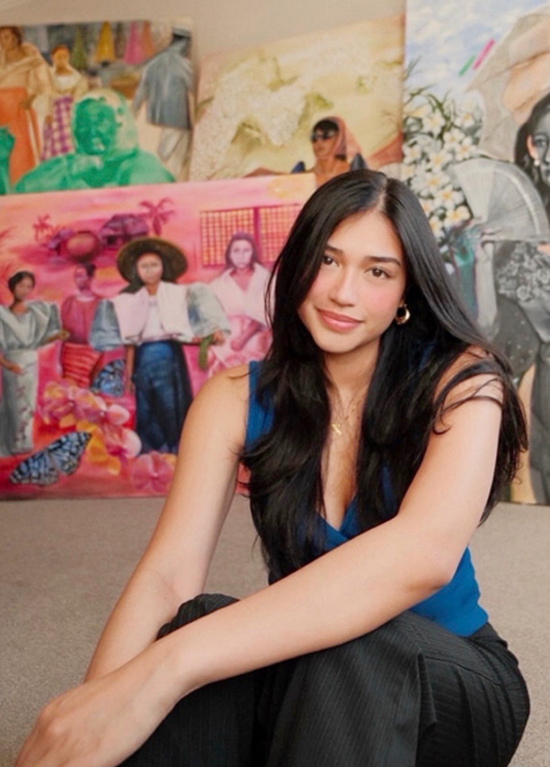
But beyond technique, Carodan’s fascination with fashion communicates the evolution of the women who wore Filipiniana, which was used first as a sign of modesty and submission under Spanish rule, and then a symbol of revolution worn by historical figures like Gabriela Silang and Melchora Aquino, the “mother of Balintawak.”
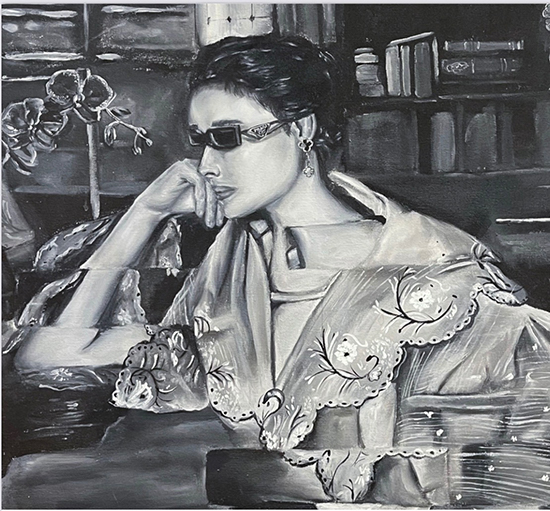
Today, Carodan uses Filipiniana as a metaphor for heritage, bodily autonomy and indigenous pride, rejecting the outdated idea that “traditional” means submissive. In “Material Girl,” the finely embroidered scallop and floral details of the woman’s panuelo contrast yet sit comfortably alongside the luxury of Prada sunglasses, Van Cleef and Arpel earrings and a designer hand bag. In a world of consumerism, she has made Filipiniana chic, relevant and desirable to her generation.
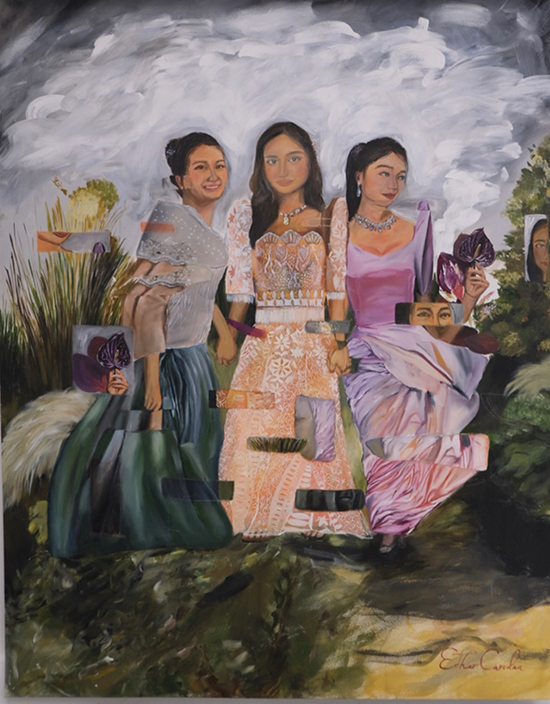
In “The Three Graces,” Carodan reimagines Greek mythology where the daughters of Zeus representing joy, youth and elegance are communicated by three figures: a happy woman in a softly feminine balintawak, followed by a self-portrait in a modern cropped terno top, then a woman inspired by Blue Lady Edith Nakpil in Slim’s iconic draped terno. The message is that beauty isn’t measured by the physical features or wealth, but rather by character, humanity and uniqueness.
In “Sampaguita 1,” the time-traveling woman in the rose-colored balintawak and sunglasses clutches a Vogue dated 2019, the year the Philippines gained independence from America. Filipiniana became a badge of women empowerment during American colonial times, when Filipina feminists and suffragettes wore the baro’t saya while fighting for women’s right to vote and access to education.

The woman in “Fresas” could be any of us Filipinas as she steps out confidently in her big sunglasses, holding a basket to remember what she has achieved and where she has failed in the past, putting her best face forward in a bold blue terno with architectural butterfly sleeves, softened with dainty white embroidery and a flowing cape. Her strength comes from within her and the brilliant costume is a manifestation of the determination to press forward into the future.
Even the old woman in “Ale (Elderly Woman): Soul of Time” may have a face and hands worn with time, yet she still taken the effort to wear a striped camisa under her sheer baro and ties her hair back with a floral headpiece.
Rooted in her environment, Carodan’s creations must resonate with the UK’s large Filipino diaspora and Filipinos universally. She herself, having moved to London to acquire a Bachelor of Fine Arts and Mixed Media at the University of Westminster, reflects the Filipino desire to find better opportunity overseas.
She is the voice of a young Filipina contemporary artist in the UK introducing the country’s vibrant heritage through the metaphor of Filipiniana while expressing a longing for the home of her childhood. Esther Carodan is currently preparing for an exhibit at the Philippine Embassy in London.

WATCH: Is Philippine cinema still thriving? (Generations Ep. 19)
September 2, 2026
WATCH: Is Gen Z too soft? (Generations Ep. 23)
September 30, 2026