

Rewriting history (through reimagined maps)
Most artists seize on symbols to reimagine reality, history, or identity. Some artists dive straight into cartography. For Cian Dayrit, “counter-mapping” is a strategy for reinterpreting the meaning of being Filipino.
I first saw his work during the last Singapore Biennale, among a series of Southeast Asian artists displayed at Fort Canning Centre whose work explored memory, identity, and recontextualization. Dayrit’s maps stuck out: ostensibly woven reproductions of historical Philippine maps, they’re actually wry, layered reinterpretations of hacienda histories, showing the incursions of colonialism. Amid the pseudo-aged tapestries you’ll find markers for the Luisita Golf and Country Club, Voice of America, but also the paramilitary CAFGU or citizen resistance outfits. Some maps delineate history through official US, Spanish, and Marcos-era policies that appropriate land. Along the borders you’ll find attached anting-anting symbols, and even carefully inscribed QR codes, leading to further research.
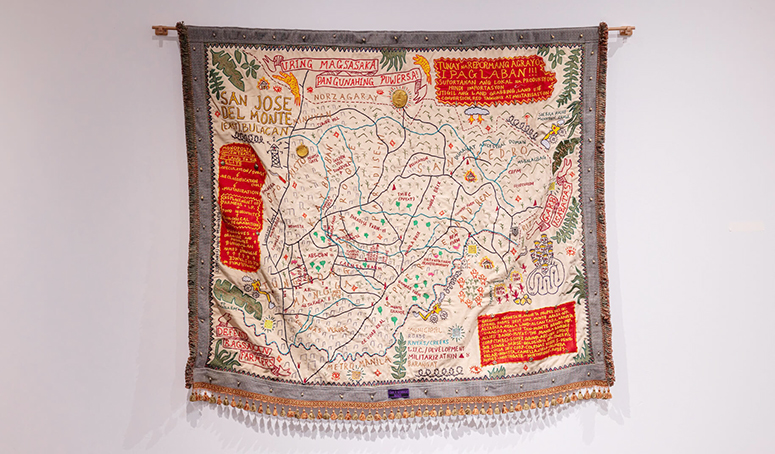
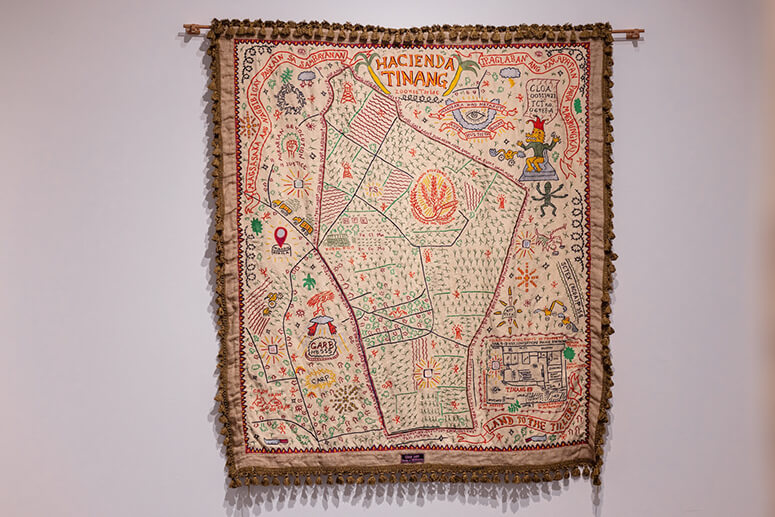
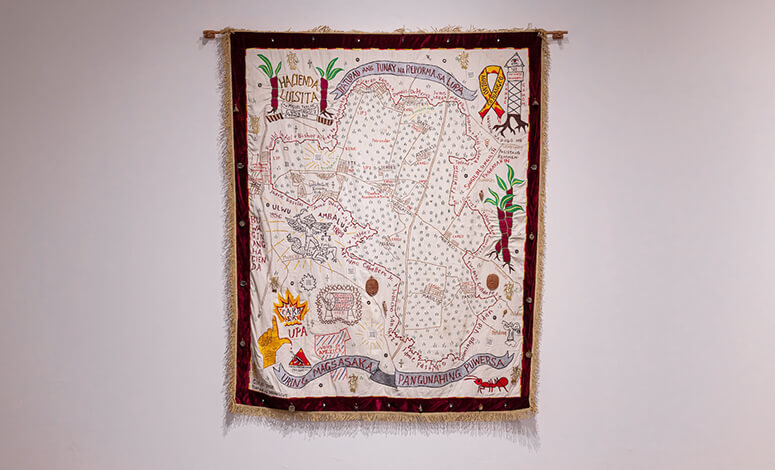
The recent series, “Feudal Fields: San Jose Del Monte,” highlights “contested spaces” in our geography, and more importantly, in our mental landscape. It’s an ongoing series Dayrit began in 2018. “In essence, this is about land monopoly by the ruling elite (political dynasties) or corporations to generate super profit while further marginalizing farmers and farm workers.” He notes the “counter” in counter-mapping is “a deliberate reorientation, shifting the agency from authoritative bodies to the people who are silenced and rendered invisible.” It’s mapping from the ground up, which “inevitably exposes the contradictions of dominant narratives.”
From this historical perspective, Dayrit is quick to distinguish his work from, say, Afro-Futurism, which he calls “speculative”: “This is not an art trend, it’s a human gesture to speak truth to power by claiming authorship of space and narrative.”

Born in 1989, Dayrit studied art at UP, but his interests include geography, and his work explores notions of power and identity as represented in public monuments, museums, and official mapping. His work offers proof of an old maxim: If you want to get somewhere, you have to know where you’re coming from.
I had some questions.
PHILIPPINE STAR: How does “Feudal Fields” further your examination of cartography, history, and myth-making?
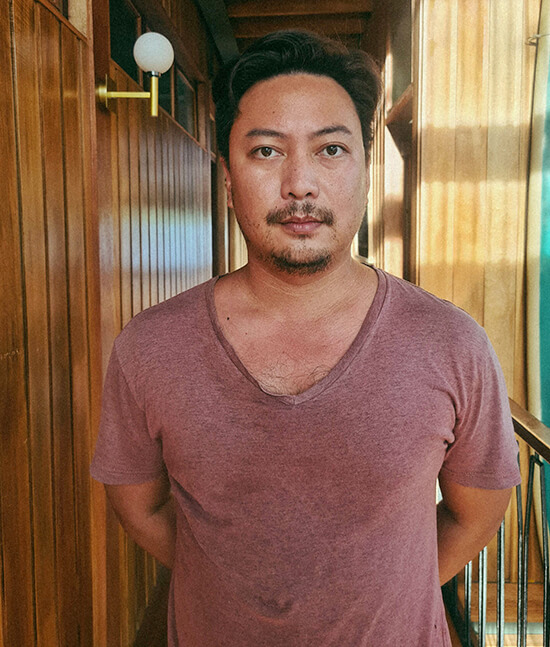
CIAN DAYRIT: It recognizes the role of cartography as a tool of conquest. By subverting its function to highlight the perspective of the people who are systematically rendered invisible in maps (authored by centralized bodies), my works attempt to lay bare histories from the ground, from the vista of social movements, the masses.
There’s a great deal of craft involved—embroidery, added symbols, and anting-anting objects. How do you approach making each piece?
I never work alone on these tapestries. My embroiderer collaborator Henry Caceres (signs “Henricus”) works at Pasig Palengke. We have been working together for over a decade now. Some of the objects and anting-antings are bought while some are alsofabricated from my drawings. All of the works are done in consultation with peasant organizations and other researchers. Some research material can be accessed via QR code patches sewn into the textiles, which serve as links to articles from Bulatlat, Ibon, and other alternative media outlets.
How did you start this project with Singapore Biennale?
This is an ongoing body of work (loaned to) the Biennale. In 2022, I was part of a group exhibition about resource flows and supply chains. My work was about the proliferation of corporate plantations in the Philippines, particularly on the production of Cavendish bananas for export. The plantation economy defines a semi-feudal condition which our country has been suffering from historically but more so within the past few decades of neoliberal restructuring and austerity measures.
You’ve said “I’m interested in plotting the spaces of state terror and abuse, as well as resistance and hope.” How does this play out in “Feudal Fields”?
The struggle for land is rooted in colonial relations from the Spanish times to today’s neo-colonial condition. The state is complicit in (or rather perpetrates) this systemic oppression by preserving the interests of the ruling class. Militarism (by way of activating the armed forces or the police or private armies or armed goons) has always been a method to maintain land monopolies. Massacres, mass arrests, harassment of farmers and farm workers, the weaponization of the law against critics are all age-old tools to gain and maintain land monopoly. Naturally, people resist. They stake their claims and uphold their rights. These moments of resistance are always based on hope!
Is there any significance to the female names of haciendas? “Luisita”? “Tinang”?
Luisita is named after the wife of a top official when the land was a Tabacalera in Spanish to American times. A similar story goes for Tinang and other haciendas. From the Regalian Doctrine to the corporate and elite takeover of lands during American occupation, land grabbing in the form of surveying and titling has been used to delineate the archipelago into territories and properties that can be monetized and exploited. (The Philippines was named after a king who knew nothing of us.) Naming a space is claiming a space. Is there a level of intimacy or endearment when a space is named after a loved one? Does this make the violence more easily forgettable?
“Assumed authority” is central to your investigation. Do you see future examinations?
Maps are tools to communicate spatial narratives, waypoints, and patterns in a given space. By default, they are anchored on the perspective of the map’s author—the cartographer, the people who supplied the data, and the logic used in the design. My artistic intervention assumes the responsibility of challenging assumed authority, normalized violence, and pathologized oppression, all of which remain as the status quo.

WATCH: Do you still believe in marriage? (Generations Ep. 17)
August 19, 2026