

TalaAnyo artists devise a mural as current as your news thread
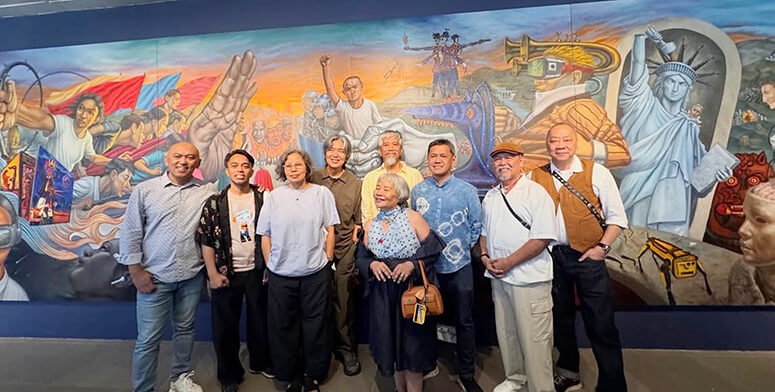
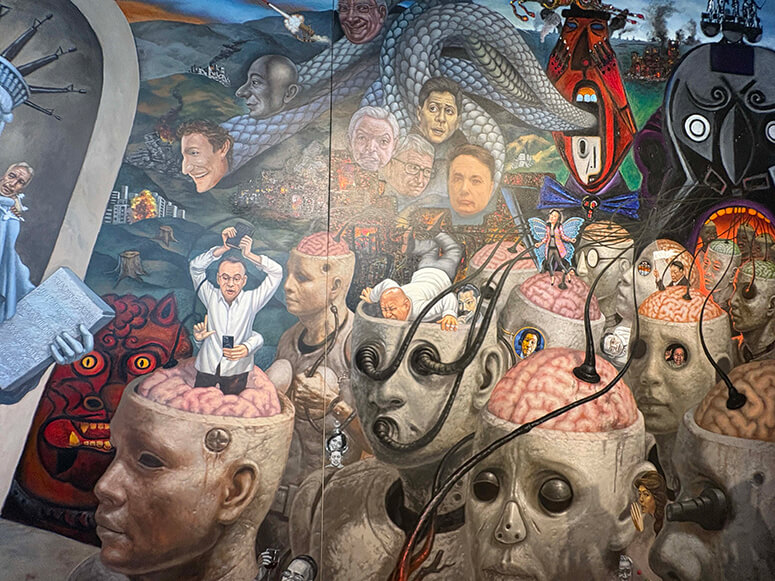
Alfredo Esquillo Jr. remarks on the Bosch-like panels at the right side of the collective work “Habang Tanaw,” which now spreads along the 3rd floor hallway at Ateneo Art Gallery: “We finished it on the night Bato fled Congress,” he recalls with a grin, and maybe that’s why it’s speckled with so many familiar faces that feature in the latest heist of public funds. No “Garden of Earthly Delights,” this 35-foot mural was accomplished over five months by eight artists who have worked together on social realist commentary before: Esquillo, founder of Eskinita Art Farm (Tanauan, Batangas); Renato Habulan of Agos Studio; Alfredo Emmanuel Garibay of Linangan Art Residency (Alfonso, Cavite); Charlie Co of Orange Project (Bacolod, Negros Island); Elmer Borlongan and Plet Bolipata of Pasilyo Press (San Antonio, Zambales); Leslie de Chavez of Project Space Pilipinas (Lucban, Quezon); and Mark Justiniani and Joy Mallari of Tungtung Alon Art Foundation (Tanay, Rizal).
Together, they form TalaAnyo, derived from tála (“star,” “to mark”), anyo (“form” and “appearance”), and talanyo (“constellation”), a loose art collaborative that’s been barnstorming such murals and projects since 2023, with their first exhibition “Pagtitipon-tipon” opening in 2024 at Orange Project, Bacolod.
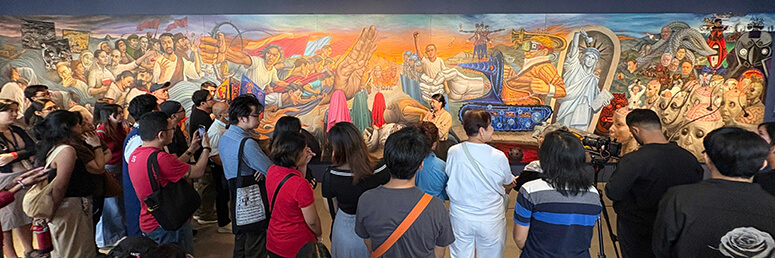
This particular piece focuses on movements of resistance, captured in a fired-up left third that features heroes and people protests from Philippine history, along with Jesus and others. There’s a violent confrontation in the middle—haunting images of fallen protesters, cauldrons of evil global leaders, and a persistent theme of technology as a tool and an opiate of sorts. The right side, as mentioned, seems to be as timely as the headlines, capturing the conflux of tech bros and trapos in our midst, raping and pillaging in the bowels of Bosch.
Habang Tanaw—“in plain sight”—indeed.
If there’s a lead conceptualizer on “Habang Tanaw,” according to Manny Garibay, it was Esquillo. But this is clearly a group effort, with individual styles—Charlie Co’s, for instance—distinct amidst the neo-social realism of Elmer Borlongan, Justiniani and others. In front of the mural, there’s a glass case with early studies and nearby a stand with each artist’s palettes.
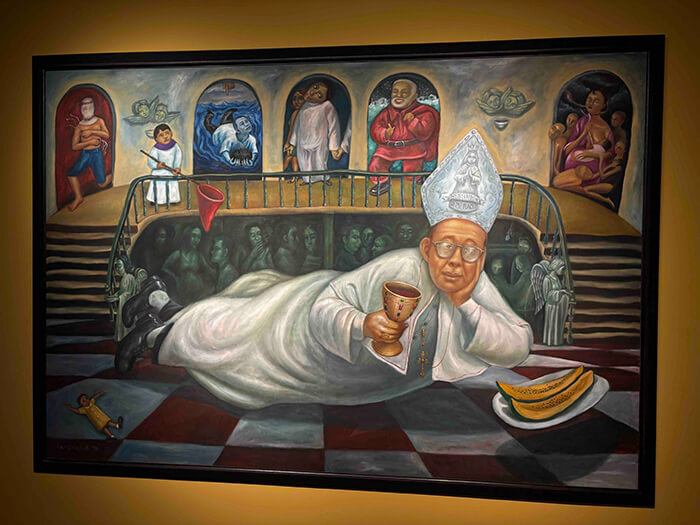
The hallway then leads straight to “Orion in Sight: A View of Collective Work,” an overview of selected works and collected material from earlier artist collabs, such as Kaisahan, Tambisan sa Sining, Artista ng Bayan, Pamilya Pintura, Salingpusa, Sanggawa, Sakay, among others. Curator Lisa Ito-Tapang walked a massive crowd through the exhibit, developed with support from writer-researcher Janine Go Dimaranan and a team of TalaAnyo artists, researchers and community organizers.
CONTINUE READING BELOW

Ito-Tapang spoke about the tools of social realist art employed in large murals—from formal techniques to color palettes, and the “very collective images and ideas, the idea of uniting, opposing, or contradicting elements; techniques from painterly to linear styles; and even composition, where there’s not one horizon here, you have multiple horizons.” Passing through “Orion in Sight,” she notes how “subject matter ranges from individual figures to archetypes or symbolic elements, and this approach can be described as dialectical or arriving at the truth by comparing opposing viewpoints.”
The show ends with a timeline of artist-spawned movements, and it’s almost a visible EKG pulse line of public outrage at political violence throughout the past 50 years: everything from martial law to EDSA to the Million People March to EJK is covered.
At the same time, social realism has always been a pretty hard sell, admits Esquillo: “It can be quite exclusive in its intentions, and for that reason, it doesn’t appeal too much to those who want something more distilled in terms of visual language.”
He says “there’s this immediacy in social realism of telling it how it is, instead of opening a lot of possibilities of how to see. So it’s almost like propaganda—but at the same time delivering it in such a highly polished, well-crafted manner” that you’re won over.
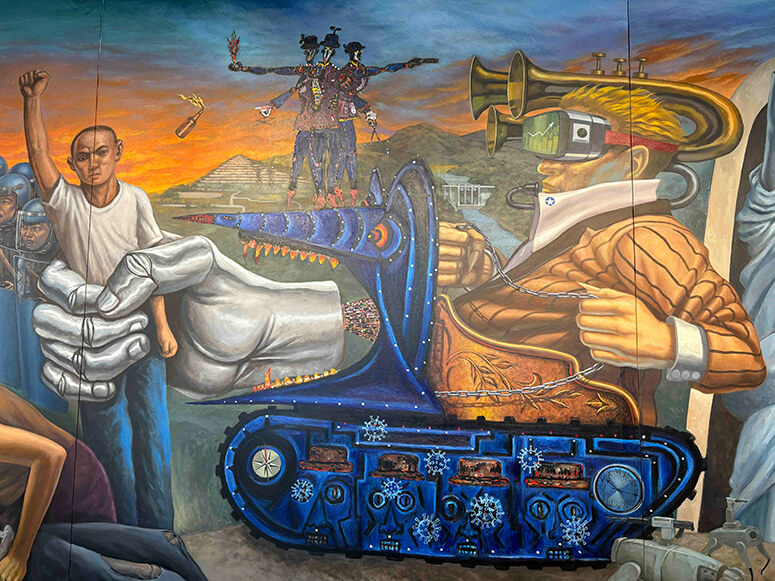
He likens it to “the spirit of classical art, where you try to come up with the best features of a subject, so a kind of elevation happens.” A trick of focusing on what the artist wants you to find important.
Working together as artists frequently, a common language develops—a kind of telepathy, like the Knicks in Game 5, say. “There’s a lot of familiarity in how we mesh together as a group. The happy part about it is we get to have a lot of conversations in between. We’re not in this mainly to get attention for ourselves; we’re doing it as a vehicle to draw attention to what we want to say.”
Leslie De Chavez, who heads Project Space Pilipinas in Quezon, had opening remarks about the “new global disorder,” and the call to lift brushes and respond to the swirling chaos even as it unfolds: “Right now, we find ourselves in a race with time and history.”
We know what Faulkner wrote: “The past is never dead. It’s not even past.” The artists here know their work is never really done. There’s always something sinister going on in the higher echelons, being shoved right under our noses. What could more clearly capture the horrors one sees today than realism?
Ateneo Areté pulled off a trifecta of sorts this busy Sunday, according to gallery director “Boots” Herrera, opening three exhibits simultaneously in one day.
Downstairs at the lobby, a third exhibit captures the history of Kaisahan, the early buds of social realist art that began around 1976. Outside the entrance, a looming piece hangs, “Saranggola ng Pag-Asa,” consisting of four joined panels done in a “lightning mural” session for the birthday celebration of VP Leni Robredo in 2022. Along with BenCab, 20 artists, including Garibay, Habulan, Justiniani, Joy Mallari, Esquillo and others, rendered this decidedly more optimistic wall-sized vision with a kite-flying theme in mind.
“Orion in Sight” is on view at Soledad V Pangilinan Arts Wing, Areté, third floor galleries (Fredesvinda Almeda Consunji Gallery, Ambeth R Ocampo Gallery, Elizabeth Gokongwei Gallery, and Alicia P Lorenzo Gallery), until Oct. 18. A series of public programs will be held throughout its run, including artist talks, workshops and activities that reflect and build on TalaAnyo’s approach to collective practice, community engagement and socially engaged art.
For information, email aag@ateneo.edu or call (2) 8426 6488 or 8426-6001 loc. 5392/4163.

WATCH: How to experience Bangkok and Kanchanaburi in one trip
October 21, 2026
WATCH: Is OPM still as good as it used to be? (Generations Ep. 20)
September 9, 2026