

Rediscovering joy in 'A Christmas Carol'
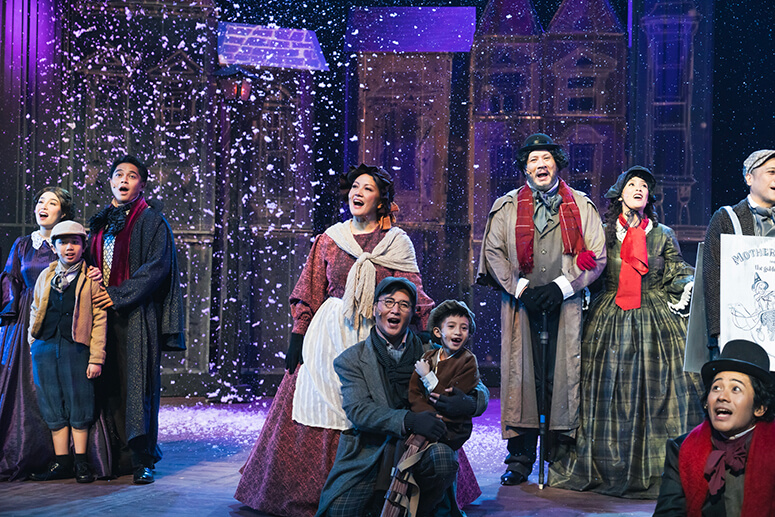
The audience at the Proscenium Theater may see a lot of the country’s political crisis and social discontent in the bleak winter landscape of Charles Dicken’s London of 1854, transposed into a stage backdrop of ominous Victorian houses, but they certainly came to escape all that, children in tow, to revel in a fantasy holiday tale with infectious melodies, soaring orchestral music and spectacular production numbers which A Christmas Carol, presented by Rockwell and 9Works Theatrical, ultimately delivered. But more than high-kicking entertainment, there is a story of redemption and hope that is in tune with the spirit of the season.
After an annus horribilis when stories of shameless corruption have surfaced, it’s easy to see how a character like Ebenezer Scrooge, a grumpy, mean-spirited miser of a businessman, can emerge. He was created by Dickens for the novella on which the musical is based, during a time when living conditions in his city were squalid and miserable for the working class. Scrooge’s cold indifference to the less fortunate reflects the attitudes that the author observed in society and among political economists like Thomas Malthus who referred to the poor as “a surplus population.”
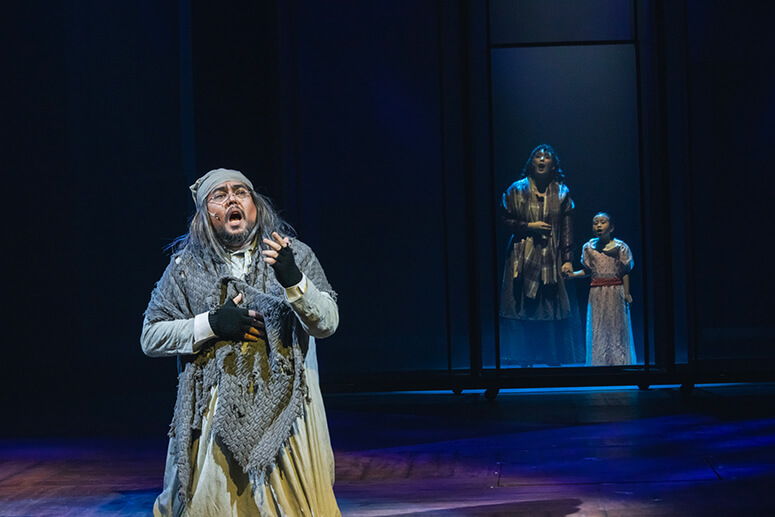
His signature “Bah Humbug!” dismissal of calls for the celebration of the Yuletide season and its spirit of giving as a waste of time that just gets in the way of his love of money and commerce can make the interpretation of this role comically and tragically one dimensional but fortunately, Arnel Carrion does not fall prey to the stereotypical travesty by imbuing the role with much more complexity.
Alan Menken, the composer of Disney hits Beauty and the Beast and The Little Mermaid would seem like the antithesis of everything Dickensian but he was exactly what was needed to adapt the story into a musical that both children and adults can appreciate through songs that go straight to the heart with rich tones, colors and textures that convey the feelings of the characters and dramatize the situations. Musical director Daniel Bartolome interpreted the score with lush orchestration, making the songs hit the mark both in the melodramatic episodes as well as the big, festive numbers.
Robbie Guevarra, directing this for the fourth time (co-directing for Repertory Philippines in 2008 and 2016 and 2017 for 9Works) judiciously calibrates the rhythm and pacing as well as the movement to tell the story clearly while giving characters their moments between the large “set pieces” where PJ Rebullida’s dynamic choreography shines in its graceful, stylized waltzes. The tap dance sequences by Yek Barlongay are a delight, adding a touch of nostalgia.
Santi Santamaria, executive producer of 9Works, shared that they wanted the staging to be like a dream that Scrooge experiences, bringing the audience along for his astral wanderings. This works well to build a fantasy world which may soften the stark, unpleasant realities and social commentary in the Dickens original, but fits perfectly with the intentions of the musical’s creators. Mike Ockrent who wrote the book together with Lynn Ahrens wanted to recreate the wonder and awe that he experienced as a child in London watching the “Pantomimes,” a traditional Christmas variety show.


As part of this oneiric concept, sets by Mio Infante had translucent Victorian cityscapes in shades of blue and grey that reflect Scrooge’s gloomy worldview. This was a good neutral base for actors to stand out, with costumes that are more colorful albeit in a muted palette that was not too jarring, with the appropriate styles beginning with Regency’s slim empire silhouettes progressing to Victorian bell-shaped skirts.
The tableaus were enhanced by Gabo Tolentino’s evocative lighting to simulate the shifting moods from dreariness to terror and festivity as Scrooge goes back and forward in time through ghosts that haunt him.
His departed business partner, Jacob Marley (Boo Gabunada) carries the burden of their greed in heavy chains that threaten to drag them both to hell. Scrooge revisits his childhood and youth with the Ghost of Christmas Past, played by Franco Laurel with an ethereal lightness, much like a sprite in folklore, carrying a torch of illumination to make the miser realize the events that made him what he is today.
Lorenz Martinez is perfect as the Ghost of Christmas Present, with a forceful command as he whisks the old man on a tour of the homes of Scrooge’s nephew Fred, his clerk Bob Cratchit and Mr. Smythe, a recently widowed client, all making do with what they have to celebrate Christmas despite the fact that Bob Cratchit’s fragile son, Tiny Tim, and the children “Ignorance” and “Want” are in a desperate state of need.
Carmelle Ros, Ghost of Christmas Yet to Be, shows her ballet background in an eerie danse macabre in the final leg of Scrooge’s emotional journey of self-realization which Carrion delineates with nuanced gradations of transformation that you empathize with leading to an enlightened finale.
Did it help the audience forget what’s happening outside the theater? Perhaps, as seen in the happy faces of both adults and children. It does bring hope, restoring your faith in humanity, the capacity for change and possible redemption.
* * *
A Christmas Carol runs until Dec. 21 at the Proscenium Theater, Rockwell.

WATCH: Discovering Vietnam in three days
June 9, 2026
WATCH: LGBTQIA+ people with unlikely professions
June 28, 2026