

Mall-cities and the mallnumental
Since its emergence in the Crystal Arcade of Escolta up to the birth of the modern “Supermall” in Carriedo, the mall has become an indispensable part of Filipino culture. Even as the Philippine economy fell further into the sinkhole of neoliberalization in the late ’80s and ’90s, malls served as one-stop distribution channels for surplus products from foreign countries. As labor export and business process outsourcing mushroomed post-1986, the remittance-strapped middle class kept the economy afloat as significant consumers of surplus retail and services in the urban centers. In turn, state neglect and the lack of parks, museums, libraries and other “third spaces” solidified malling as the primary leisure activity for Filipinos.
Curiously, the history of art in the Philippines after the Marcos dictatorship is also tied to the proliferation of the mall form. In Past and Present Alternatives: Artist-Run Spaces in the Philippines, Ringo Bunoan notes how galleries set up shop in malls in the ’80s up to the early 2000s. SM Megamall and Shangri-La Plaza in Mandaluyong City, Alabang Town Center in Muntinlupa City, and Glorietta in Makati were bustling with activity, providing spaces for both established and new artists.
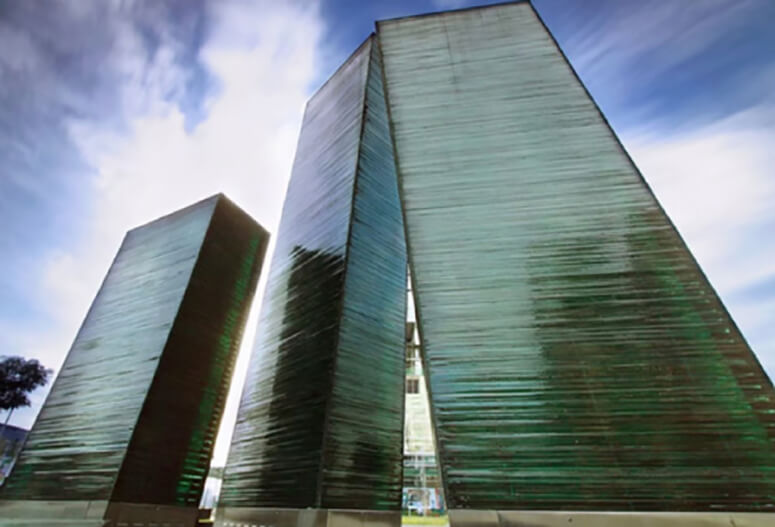
While rising rent and the continuing expansion of the metro eventually pushed galleries to evacuate the malls, these air-conditioned boxes kept their function as civic centers where art shows and other cultural activities are held. But the exodus of art galleries also coincided with a fundamental change in the mall’s orientation. This manifested in the mutation of mall architecture: from segregated zones (where “low” products made for corporeal consumption such as food and beverage are located at the lowest floor, and “high” cultural produce — i.e. art — is placed at the top floors), mall design eventually favored open-ended sprawls which blurred the borders between the enclosure and city.
Ayala Malls’ TriNoma and “The Terraces” in Cebu allowed transversal navigation, giving way for a trance-inducing consumerist dérive. SM North EDSA was retrofitted with a “skygarden” with fake grass, fountains, and mini-trails for curated micro-adventures. Condominiums, bus terminals and mini-parks were eventually assimilated into the emergent mall ecosystem.
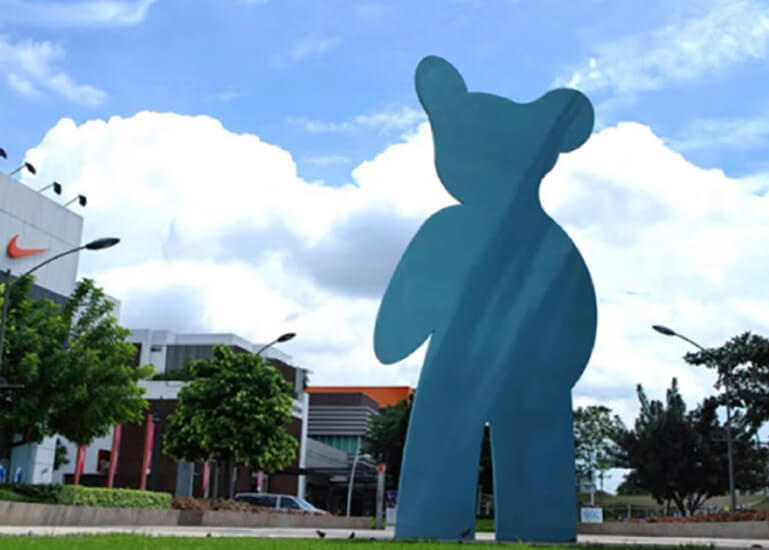
Eventually, the mall form metastasized into something else entirely. Eastwood City and Bonifacio Global City (which still dubs itself as “an urban art form”) marked the total merging of the mall and the city: the Mall-City. The latter, a literal “malled city,” saw the expansion of the mall into a semi-autonomous zone of rampant consumerism.
Linear architecture gave way to non-linear urban planning, one that integrates commerce public art and an entire range of human activities. From “Araneta City” to proposals for turning the Baguio City Market into an SM-controlled public-private commercial center, the absorption of the city into a mall has imposed a commercial trajectory onto urban development.
CONTINUE READING BELOW

This evolution saw the emergence of the “mallnuments”: massive and ostentatious public installations that serve a largely ornamental function, dashed with corporate social responsibility. As contemporary art fled to cheaper spaces, the Mall-City maintained its hold on the cultural field through its new interest in public art.
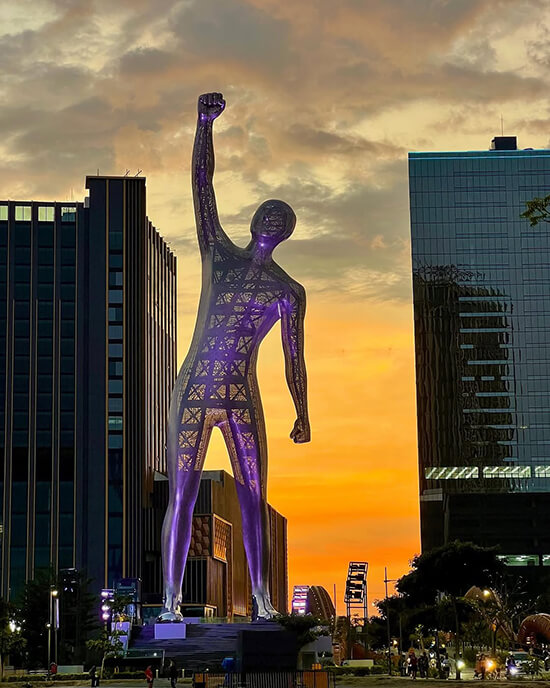
Armed with an abstracted modernist aesthetic and an obsession with verticality, mallnuments can be aesthetically dull and symbolically barren. Take, for instance, Jefrë’s 60-metre “The Victor,” the centerpiece of Robinsons’ Bridgetown project. Publicized as “larger than the Statue of Liberty,” a monument to Filipino resilience, the piece’s human model is uncannily featureless. The victorious figure can be male or female, brown or white, an OFW or a CEO, depending on the marketing department’s peg of the day. What is peddled as a flexible, “universal” silhouette exemplifies what Sylvia Winters calls the “monohuman”: an image of the human devoid of conflict, a genuine sense of place, or anything remotely human.
The statue’s metallic smoothness lends itself well to “multiple interpretations,” which frankly, could include nothing at all, except a harmless depthlessness that warrants, at best, a quick snapshot or a selfie.
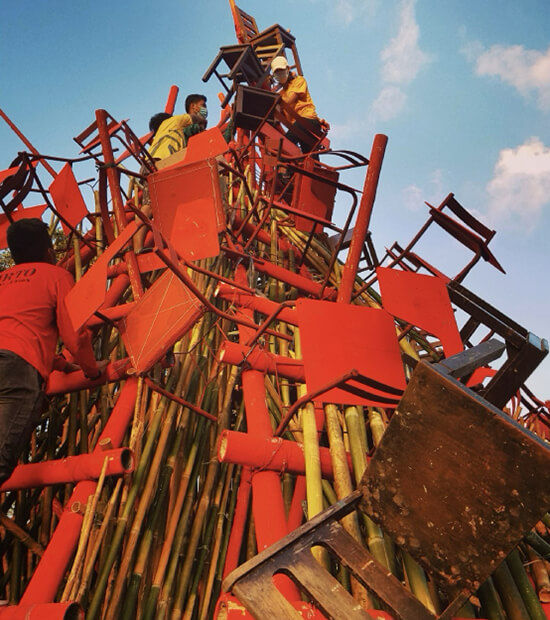
But because of their public nature, mallnuments demand deeper interrogation. It’s worth mentioning some other works that converse with current discourses on monumentality and corporate edifice complex. Christina Lopez’s “Untitled (Obelisks)” (2020) responds to the vanity of monumental projects, portraying three toppled obelisks or “non-monoliths” on top of each other, illustrating what Elle Yap calls “the detritus of culture-building.” Meanwhile, the very existence of Toym Imao’s “Barikada” (2021), in commemoration of the 1971 Diliman Commune, questions the function of the monument itself. As it asserts the importance of an event that official state history refuses to recognize, “Barikada” also functions as a condemnation of the fascist entry of the Armed Forces of the Philippines in the cancellation of the UP-DND Accord in 2021. In both instances, the pieces challenge public art’s cosmetic function and the position of the artist as mediator between history and the public.
While it would not be fair to compare commissioned installations in commercial spaces to these two works, we need to underscore the seriousness of the issue of the monumental commons. As non-commercial public spaces shrink and malls expand to our doorsteps, we risk losing control of space to private entities, boosted by the individual artist’s badge as purveyor of taste. This is just another testament to how neoliberalism slowly yet aggressively ensnares public life, wherein everything from public services to the places where we spend our time free from wage bondage is shaped by a few individuals. Rather than spaces where we can congregate, discuss public issues, and reflect on our private lives without large statues preaching corporate dogma, we have malls and mallnuments.
Mallnuments can only be ahistorical, not only because they are dreamed up in closed boardrooms, but also because (in the words of critic Rolando Tolentino) they are “the metaphysical substantiation of redemption from poverty.” Inside the mall, the truth of poverty is always outside, in suspended animation. By extension, the mallnument’s appeal is that it is the fantastical opposite of the depressing world that assaults it from all angles.
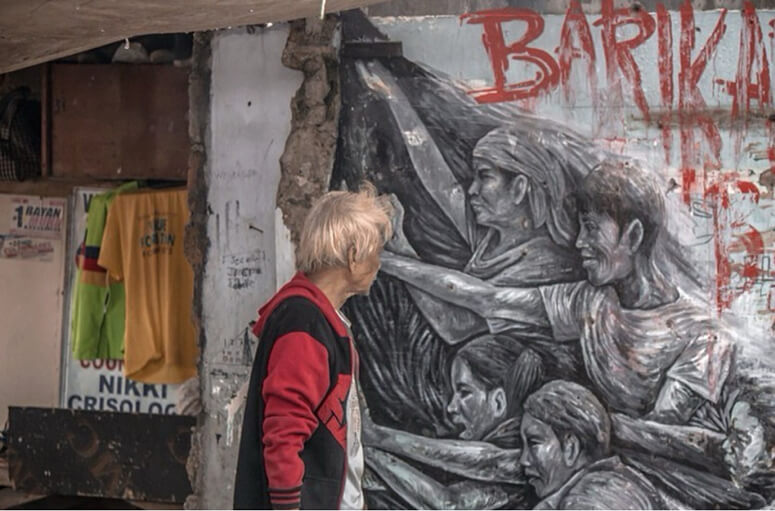
The erection of malls almost always means the demolition of urban poor communities, the gentrification of working-class areas, and the encroachment on the city’s diminishing green spaces. But there are also outright brutalities. Housing rights advocates such as KADAMAY and Save San Roque, who have launched campaigns against forced evictions on lands that are being cleared for mall expansions, are under constant attack and state surveillance, black propaganda, and outright violence.
While malls and shiny public installations are being built on the trampled lives and human rights of the city’s urban poor, other artists are making art that seeks to address these very issues. Members of the cultural organization SIKAD, for instance, integrate themselves in these very communities, holding workshops, creating artworks and empowering communities. Art is nourished by their engagement with people’s lives and struggles; at the same time, their art-making invigorates the community and contributes to the protection of its rights for home and decent livin
SIKAD and other similar groups testify that there is more to art than commercial validation and elevation; that there is beauty in making art that is grounded in the struggles of the common people. By creating alongside the displaced and not the ones who do the displacing, these artists reclaim their power and also continue to shape the fraught, shared history of art and capital in the country.

WATCH: Discovering Vietnam in three days
June 9, 2026
WATCH: Save for retirement or enjoy life now? (Generations Ep. 21)
September 16, 2026
WATCH: Do you still believe in marriage? (Generations Ep. 17)
August 19, 2026