

The Palanca Awards celebrates its Diamond Jubilee
It was on Sept. 1, 1951 when Don Carlos Palanca Sr. established what would become a hallowed tradition of honoring our country’s literary writers as an important facet of nation-building.
The original genres for the first year of the Carlos Palanca Memorial Awards for Literature were the Short Story and Maikling Kuwento. In 1953, the One-Act Play and Dulang May Isang Yugto were introduced. Ten years later, in 1963, Poetry and Tula were also added.
Over the years, the rising popularity of other literary genres led to their subsequent addition—until these included the essay, the full-act play, the film script, stories and poems for children, the novel, and the Kabataan or youth essay, some of these in regional languages.
From the pilot year’s first six winners, the Palanca Awards have since rewarded a total of 2,634 winning authors, with a total of 2,735 winning works. They have also involved an increasing number of literary judges who have heartily welcomed generations of their younger peers.
On the Diamond Jubilee Celebration held last Wednesday at the Manila Polo Club, the total number of entries reached a historic high of 2,359 entries in 20 categories—as overseen by 57 judges, resulting in 58 winning works by 54 authors.
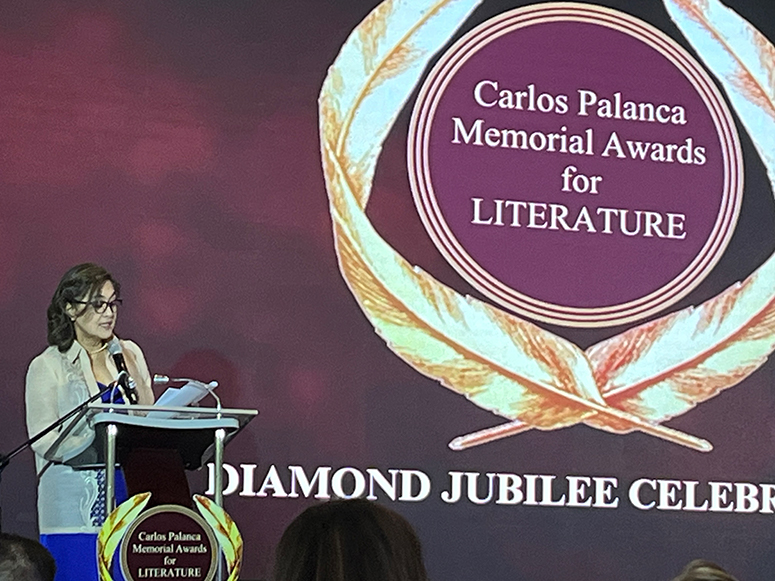
As Criselda “Dang” Cecilio-Palanca recounted in her Sponsor’s Remarks, in 2023, what has come to be known lovingly, with simple familiarity, as “Palanca Night,” underwent a surprising change in venue, from the customary Manila Peninsula Hotel to the Philippine International Convention Center or PICC. “This was when we decided to start our National Heritage Series—to honor our traditional milestone with appropriate attachment to institutions that are unmistakable hallmarks of Philippine heritage.”
CONTINUE READING BELOW

Palanca Night was also held at PICC last year. But “this long-acknowledged pride of marvelous architecture had to undergo necessary rehabilitation, which explains why we grace this fitting alternative of another historic ballroom this evening.”
The Manila Polo Club is well over a century old, having been founded on Aug. 8, 1909, by Governor General William Cameron Forbes. Through the years, the Club expanded its boundaries, until it became, “in every respect, a place where families have found a second home.”
Historical events marked the evolution of what used to be called the Cogons. These drew parallel with the inevitability of the times, starting from the increased percentage of Filipinos accepted as members, to that of women members, and eventually, women leadership. It became a microcosm of the Filipino’s socio-cultural development.
In the words of past president Isabel Caro Wilson, the historical passage of the Manila Polo Club “is an important chronicle of memories and recollections, a compilation of life so that our generation can keep alive a remembrance of things past. For it is in understanding the past that we can appreciate the present and prepare for the future.”
Cecilio-Palanca summarized: “Similar to this historic venue where we celebrate tonight, the Palanca Foundation, also hopefully heading towards its first century, maintains its tradition of honoring a continuum of generations that are stalwarts of Philippine heritage.”
The 75th anniversary celebration began with an audio-visual presentation: “A Legacy of Literary Excellence.” Some of the winning poems written for children were then read by Dr. Ani Almario and Dr. Michael Coroza.
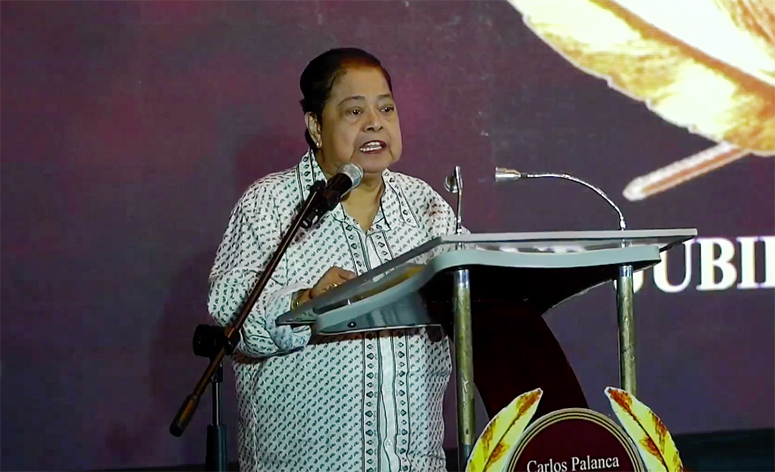
Receiving the Gawad Dangal ng Lahi was Ruth Elynia Mabanglo, one of the perennial first-prize winners who had been elevated to the Palanca Hall of Fame in 1995. Assisting her onstage were Maria Karina Africa Bolasco and Alma Cruz Miclat. Elynia delivered her keynote address in English and Filipino, titled “Bakit Ako Tumutula.”
While dining on our guests’ table with National Artist for Literature Dr. Gémino H. Abad, buddies Butch and Beng Dalisay, judges Eros Atalia and Kael Co, and poet Waps San Diego, what I observed as a pleasant surprise as the winners were declared was that most of the names were unfamiliar. Why, that meant that, indeed, the younger generations were taking over.

The only exceptions I recall, of the awardees I was familiar with, were Elyrah Loyola Salanga-Torralba, daughter of our legendary buddy Freddie Salanga, who won first prize in Maikling Kuwentong Pambata, and Rodolfo Vera, who won second in Dulang Pampelikula.
The Sponsor’s Remarks proved quite accurate.
“The future has come faster, pressing us forward to accomplish new feats of agility and resolve. Increasingly, we have realized that we cannot afford to stay put in familiar zones of comfort.
“… Thankfully, we have long acknowledged the equation between crisis and opportunity. All of these features of seeming social chaos, with such conflicting stances, can now actually compel writers to embrace such situations that ask for dramatic if not subtle resolution. The spurious story can still be uncovered in favor of a truthful universal theme.
“Potential conflicts may thus be said to present additional challenges in having to forge literature that keeps in step with the times. Creativity relies on fresh imagination. We must remain confident that it remains as progressive as heroic efforts to do battle with the illusion of terror.
“Seventy-five years of a hallowed tradition can only spur the Filipino writer to be as courageous in determining new ways to chart inventive paths for the attainment of literary fulfillment. Given this resolve, we should look forward to completing a century of welcoming first-time winners in this yearly competition, for whom this special rite of passage will be of memorable significance. Repeat winners will always be welcome, of course, no matter which generation these writers may represent.
“After all, the Carlos Palanca Memorial Awards for Literature hopes to continue to be a timeless fount of opportunity, positive expectation, and generous harmony among torchbearers of succeeding generations.
“Thank you all for sharing in the heritage marked by this Diamond Anniversary.”
