

Technology, patriarchy, and the loss of humanity
It’s funny that A Number, a play on human cloning by Caryl Churchill presented by The Necessary Theatre and WHYNot, was written in 2002 at the height of the cloning controversy of the sheep Dolly, but it actually resonates with what we see in the news and social feeds today, even if the threat of human cloning has faded. The existential dread is ever present as socio-political conditions bring to light the dangers of AI and algorithms that result in deep fakes and manipulated versions of reality, while the truth is bent to the will of those with power and resources.
This couldn’t be closer to home as JC Santos, in his directorial debut, notes how Filipinos “constantly speak about family, but we should also ask what happens when our devotion becomes a way of excusing harmful behavior.” A patriarchal system has indeed trickled down to the point where a father has the last say in the household, exercising control that could be detrimental to the children.
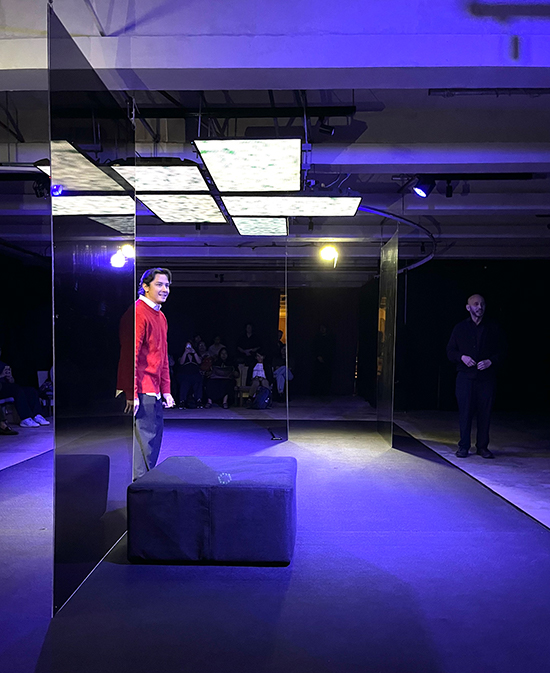
Santos is also acting in this production, reuniting him with Bart Guingona. Both Gawad Buhay awardees for Best Actor, they were last seen together in the 2023 staging of Red which also won for Outstanding Production, but this time instead of apprentice and mentor, they are playing son and father—or rather three sons, Bernard 1, Bernard 2 (B1 and B2), and Michael Black; and the father, Salter.
Salter, who was a negligent father, had his son, B1, genetically replicated so that he can have a second chance to make it right. Unfortunately, there were 20 other unauthorized clones made by the biotech company, an anxious B2 informs him while demanding an explanation about the mishap and his real identity. Salter relates that his first son, B1, and his wife died in an accident; that’s why he had him cloned to produce B2.
This story turns out to be a lie when B1 appears, very much alive and all grown up, to confront Salter about replicating his genes after abandoning him as a child to a care facility when his mother committed suicide. B2 learns the real story upon meeting his brother, and now also hates his father, telling him of plans to get away from him as well as from his brother who he fears might try to kill him.
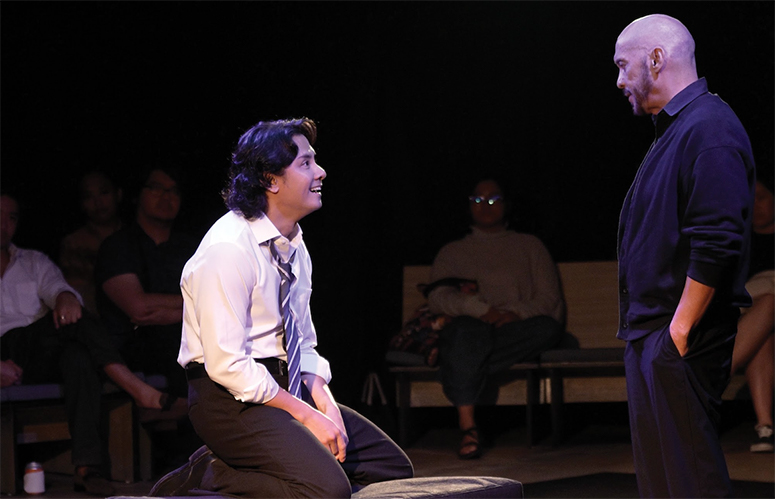

The whole thing explodes in Salter’s face, upending the lives of his sons while igniting an intense sibling rivalry where one’s identity and originality is at stake and the love and intentions of a father are questioned and put to the test in a riveting drama with an intellectually dense script packed into a compact running time of 60 minutes.
The production succeeds thanks to the actors who naturally inhabit their characters and skillfully navigate the slippery dialogue and the shifting power dynamics of psychological confrontations.
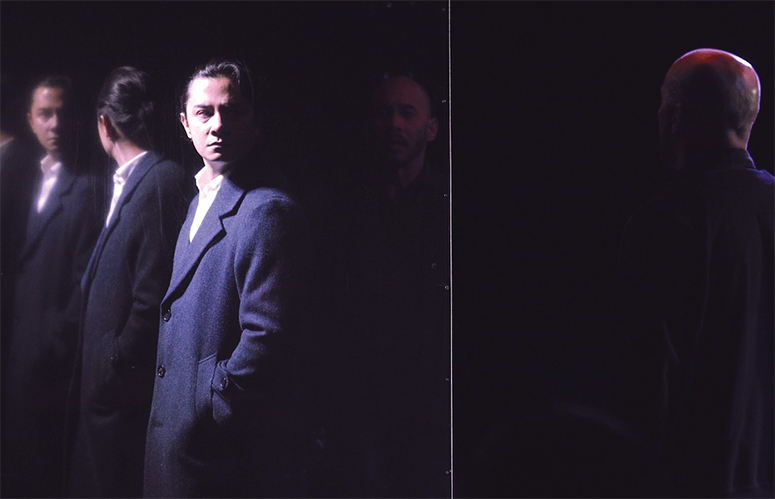
Although Salter could easily be portrayed as the selfish, manipulative father who plays God with his children’s lives, Guingona gives him a more complex persona of contradictions. He seems to love his sons but his kind of love is tainted with the need to control, rectify and possess them. His Freudian slips of referring to their clones as “things” is telling, as are the pauses and silences that are rife with subtext.
Santos amazingly makes each of the brothers distinct through nuanced characterizations that display his range: B1’s anger and instability isn’t just manifested through loudness and physical menace but through the internalized pain of a frightened child underneath the adult aggression. B2 is gentle and fragile but with a profound existential crisis after discovering that the story he has told himself about his entire life could be false. Michael Black is a counterpoint to the two angst-ridden brothers: cheerful, a tad clueless and too disarmingly normal that he upsets Salter for proving that despite nature, nurture has made him a well-balanced individual.
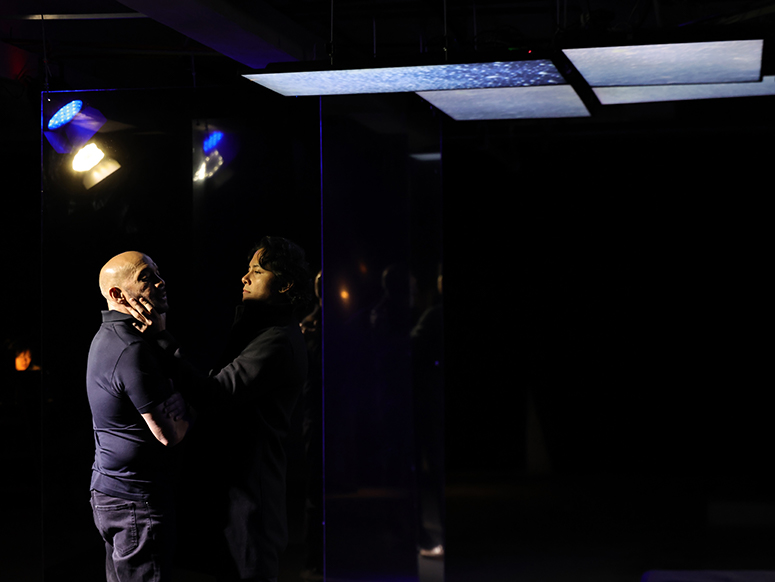
The production benefits from Santos’ directorial choice of a sparse staging that lets the emotional confrontation do the heavy lifting without resorting to melodrama and without making it too futuristic a sci-fi thriller. His framing the play as a memory also makes it more relatable.
Visual artist Miguel Uy creates an environment akin to a psychological laboratory that focuses on the relationship of father and sons with just hanging translucent mirrors replicating and fragmenting images and ceiling panels with video images of his DNA. Together with sound artist Frankie Lalunio’s sound design of electronic textures and environmental sounds that establish the invisible technological world surrounding the characters, you feel the tension and instability.
There is a chilling effect so that ultimately, when the play ends, one realizes that with technology in the wrong hands, there is the terrifying possibility that who we become is shaped by forces we didn’t choose—making us lose our agency, our dignity and our humanity.
A Number runs until Oct. 18 at WHYNot, 4/F Karrivin Studios, Makati.

WATCH: Discovering Vietnam in three days
June 9, 2026
WATCH: Do you still believe in marriage? (Generations Ep. 17)
August 19, 2026