

Retinal afterburn
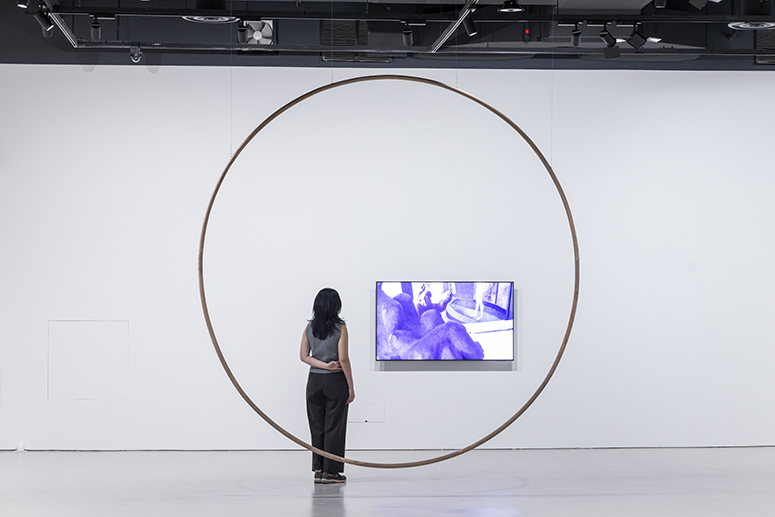
What must initially strike viewers entering Maria Taniguchi’s current show “Afterimage” at Singapore Art Museum are the large wood-sculpted hoops and sticks suspended from the ceiling: like a field of zeroes and ones, defining a binary code space, they suggest the Dumaguete-based artist’s fascination with hidden processes: the intensity of repetitive outlines beneath the surfaces of things created in this world.
But they’re also carved from duhat tree wood, known elsewhere as Java plum, and that tree’s fruit has personal associations: “This is a work that is based on a deep biographical connection with the wood of the duhat tree. It’s about our idea of ‘lihi’—when you crave something so much that the qualities of the food or object that is the interest of this craving then becomes a quality that is passed on.” In Maria’s case, it was her mother, artist and literary scholar Kitty Taniguchi, who passed down the story of her craving duhat fruit while pregnant with Maria.
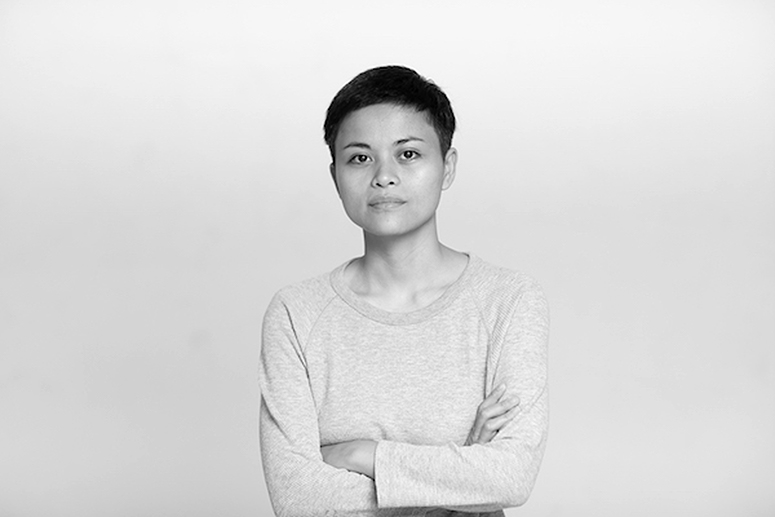
That initial site-responsive piece, “Runaways” (2026), merges personal memory with traditional craft, and it gets to Taniguchi’s practice: examining the durable nature of practice, time, repetition and labor.
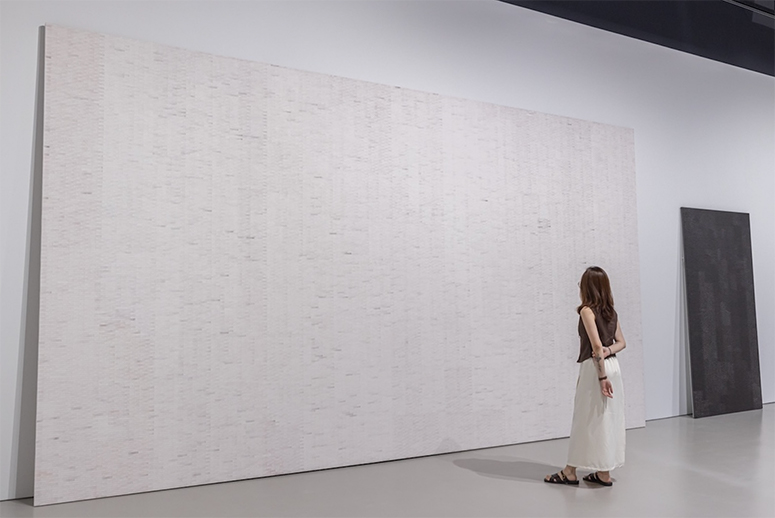
Throughout SAM, she surrounds this large-scale work with recent video installations and her well-known and evolving “brick paintings,” in which she outlines field after field of uniform, pencil-drawn rectangles. Belying the machine-ness implied by minimalism, the bricks—on massive canvases begun in 2008 and leaning against the walls—show the process of creation and a steady dedication to repetition as both method and meaning.
Taniguchi wants you to see the hands behind the labor, as in the two video series titled “Figure Study” from 2016 and 2018, which focuses on workers in a jungle lifting clay from the ground and placing it in white bags. Paired with “Mies 421” (2010), which details the crisp lines and architecture of the 1929 Barcelona Pavilion designed by influential German architects Mies van der Rohe and Lilly Reich, the photos and videos convey an attention to minimal development and progression of detail over time.
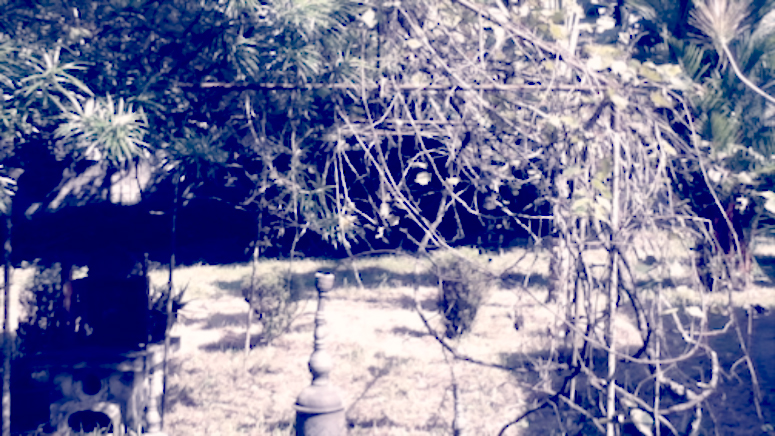
Most personal is the newly commissioned video, “A painter, if black were a place” (2026), which explores Taniguchi’s artistic lineage through images of her mother Christina (“Kitty”): grainy, pixelated still images captured in the artist’s hometown of Dumaguete City in 2012 suggest the gradual decay of memories, interwoven with images of her mother’s paintings, terracotta sculptures from her mother’s garden, and closeups of surfaces that tie into the architectural obsessions of “Mies 421.”
CONTINUE READING BELOW

“Maria Taniguchi’s art asks us to slow down and consider how time, labor and material decisions become form,” notes Shabbir Hussain Mustafa, chief curator of SAM. “Across painting, sculpture and moving image, her practice is quiet but exacting, transforming repetition into a way of thinking about perception, process and the conditions of making,”
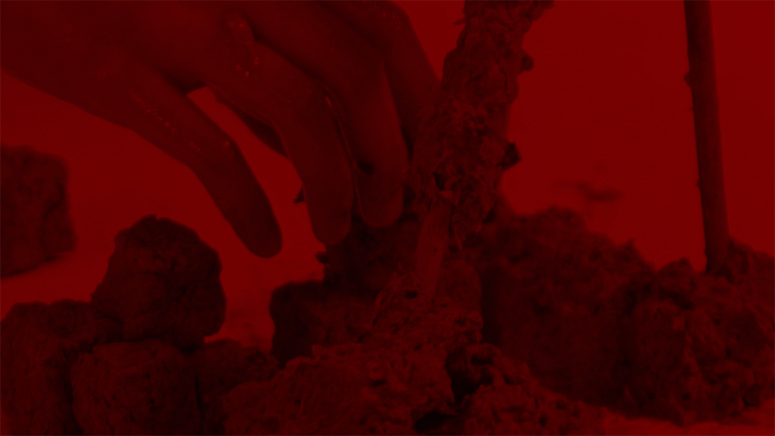
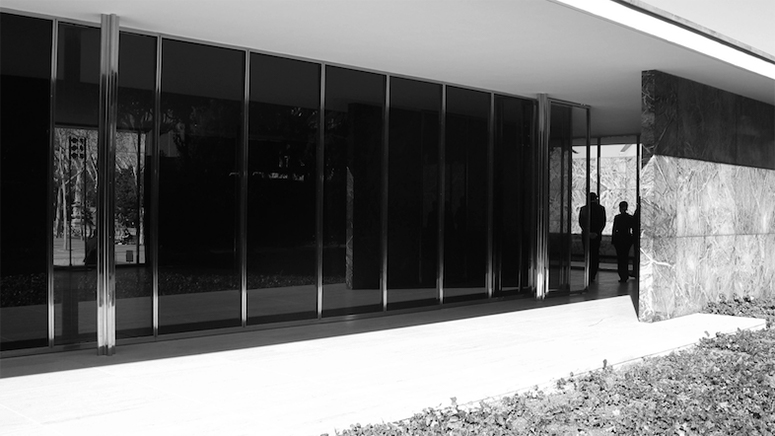
An afterimage is itself an optical illusion that occurs as we retain a neural imprint of a bright light or strong image even after it is removed — something Taniguchi’s work evokes in the viewer, again and again.
I asked her a few questions.
PHILIPPINE STAR: How did you end up studying at Goldsmiths in London, and what was your experience there compared to undergraduate studies at home?
Another artist helped me to study abroad, actually. It was an act of generosity that really changed my trajectory. Before then I was a sculpture major at the University of the Philippines in Diliman. I think what the move to the UK did for me was to demystify certain things. It was more information, more experience, that came at the right moment.
Can you talk about your background and experience growing up in the Philippines?
I grew up in Dumaguete. My first languages were Cebuano and English. Tagalog came more naturally much later, when I was a student in Makiling. I didn’t grow up going to museums, but I was surrounded by the paintings and terracotta sculptures by my mom, the artist Kitty Taniguchi.
How did you arrive at your “brick paintings” series? What was the pathway toward that visual language?
I’ve been working on these paintings for a bit less than 20 years. So I guess you could say it took a long time. In the current survey exhibition at SAM and last year’s at the Museum of Contemporary Art and Design, you see how the works shift slowly from year to year—small adjustments in color, scale, surface preparation. Language requires time, I think and talk through painting, but it’s also true in reverse. You don’t see what the work is saying immediately, even if you’re the one making it.
Your work explores questions of labor, repetition and temporality. How does your choice of materials address these questions?
I think it’s really amazing that paint as a material can be a vessel of so many things—thought, feeling, history. But to be more precise it’s painting that can do this. It’s because painting is a language and we all can speak it to certain degrees. Painting is transhistorical and transcultural.
How did you approach the SAM environment in showing your work?
We installed a new sculptural commission that spans the length of the SAM gallery space (“Runaways”). The sculpture also functions like a line drawing in space—directing bodily movement around the other work in the space.
Can you talk about the concept of repetition in your work, and in a broader context of viewing it?
Well, my advice for looking at art would be to be patient, with the work and with yourself. It takes a lot to make an artwork, so why would you expect to understand it in the 10 minutes that you’re in the gallery space with it?
Maria Taniguchi’s “Afterimage” runs until Nov. 22, 2026 at Gallery 3, SAM at Tanjong Pagar Distripark, Singapore.

WATCH: How to experience Bangkok and Kanchanaburi in one trip
October 21, 2026
WATCH: Is OPM still as good as it used to be? (Generations Ep. 20)
September 9, 2026
WATCH: LGBTQIA+ people with unlikely professions
June 28, 2026