

Private devotions: A conversation with an esteemed collector of religious art
I first read about Dr. Jaime C. Laya as the head of the Central Bank while studying current events in school. It would be because of an aunt, however, that I would have the honor of meeting him as a respected figure in culture and the arts.
When told this, he replies, “Thank you for your kind words, but neither my collection nor my knowledge of art and antiques is vast. There are other, much larger and better art and antiques collections, and other persons here and abroad who have done scholarly work on the subject.”
With razor-sharp focus, he responds to correspondence from his study. Surrounding him are numerous paintings and sculptures collected over many years. It soon becomes apparent that many of the beautiful art objects he collects are sacred and religious in nature.
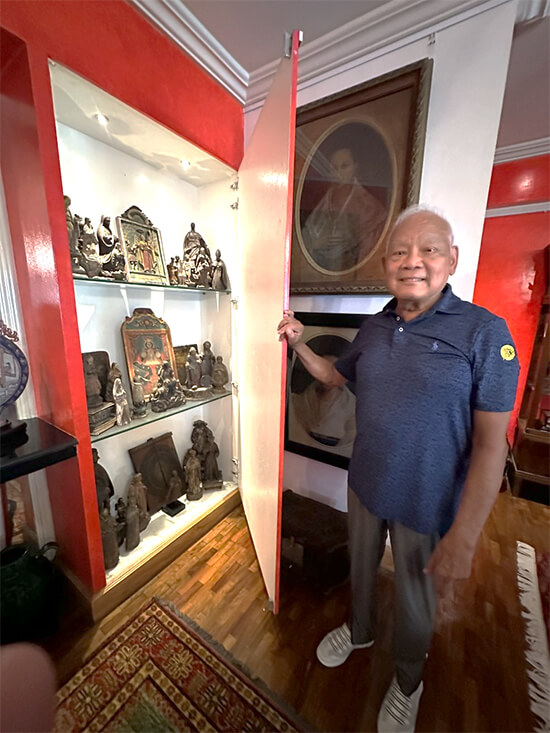
When asked how this came to be, Dr. Laya recounts how he first became interested in collecting.
“I am attracted to objects primarily because they are excellent works of art and appeal to me for artistic reasons or some sentimental attachment. I’ve always been interested in history, influenced by my mother, who was a history teacher, and by my father, who was an English teacher and a writer with a broad range of interests. This attracted me to objects that illustrate or are associated with some aspect of our past and my own ancestry, including books, coins, stamps, and all kinds of objects that eventually included furniture, farm implements, bulul, and others, including paintings and santoses. Name it and I probably have one or two of the kind.”
THE PHILIPPINE STAR: Do you remember the first santo that you acquired?
DR. JAIME LAYA: I bought my first santo around 1965 from a shop on Mabini Street. I walked in without anything in mind and bought what I could afford—the head of a saint that cost about P20. I had just arrived from several years abroad, and I didn’t know anyone who collected santos. I liked many things in that first shop that I visited, but that was all I could afford. Years later, I decided it wasn’t all that good, being rather battered and having no trace of its original color.
CONTINUE READING BELOW

I eventually learned about the shop of Nene Cortes, but on a UP teacher’s salary and with a new family, the only object I liked and could afford was a P30 image of the Virgin that I still have, incidentally.
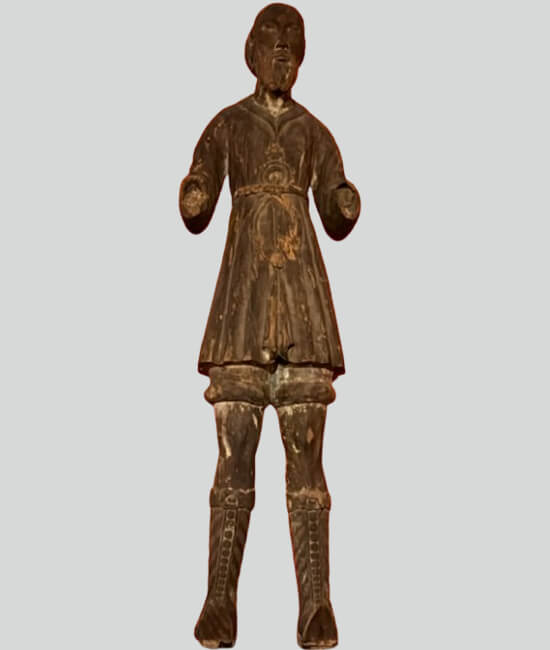
I continued to be interested in santos. A year later, on Nov. 18, 1966, I bought a two-foot San Isidro. I remember the exact date because I was getting married the following morning, and to calm my nerves, I browsed an antique shop in the now-defunct Maranaw shopping center, about where Shangri-La Hotel now stands. I liked it and paid the P50 or so that it cost. I still have it, in my library at home. I’ve always had rather challenging jobs, and for years I considered Saturday afternoons as priority antiquing time. I went around Mabini and Del Pilar shops, just browsing and looking for something interesting and affordable, without anything in mind.
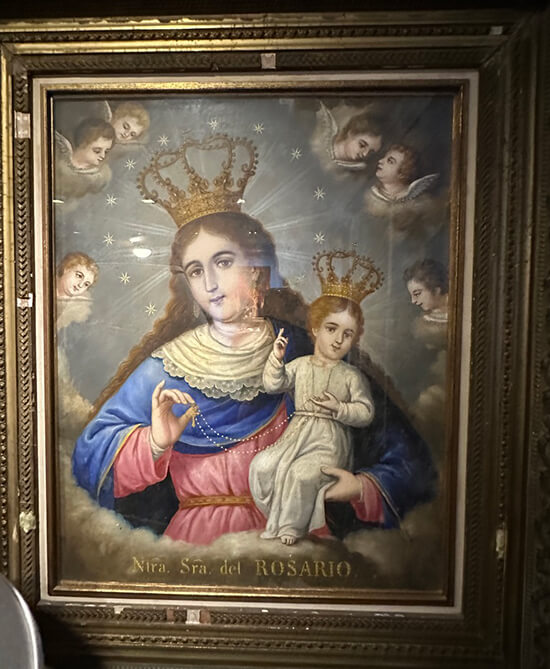
Do you have devotions to particular saints?
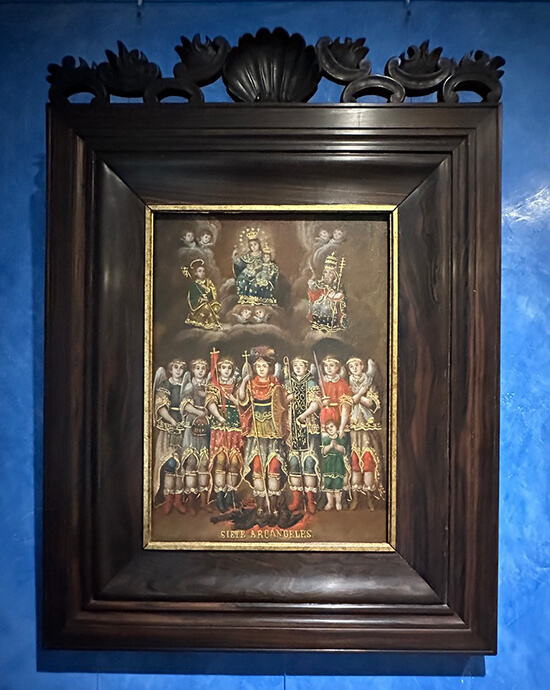
Not exactly a devotion, but I particularly like San Miguel as protector, San Jose as the good father, and St. James the Greater as my name saint. It’s probably not politically acceptable nowadays, but I have several images—a painting, a processional image, and a couple of small carvings—of Santiago Matamoros (St. James the Greater) on a horse, sword in hand, sending some moros to kingdom come.
My mother was devoted to San Antonio and used to wear the brown San Antonio habit every Thursday, if I remember right. This is probably why I have quite a few San Antonio images.
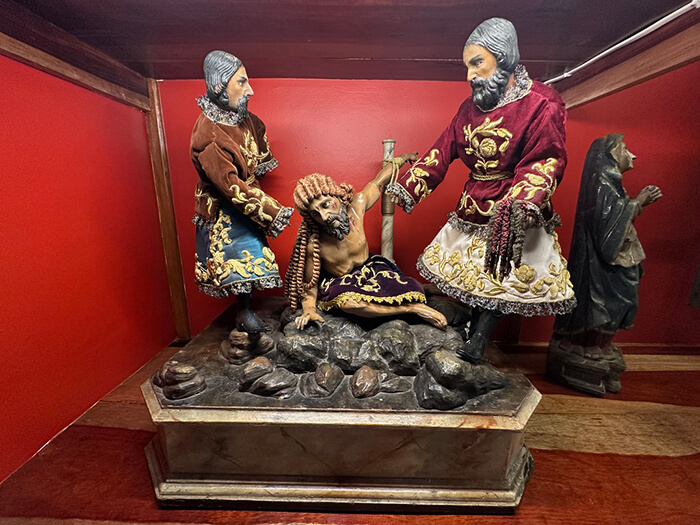
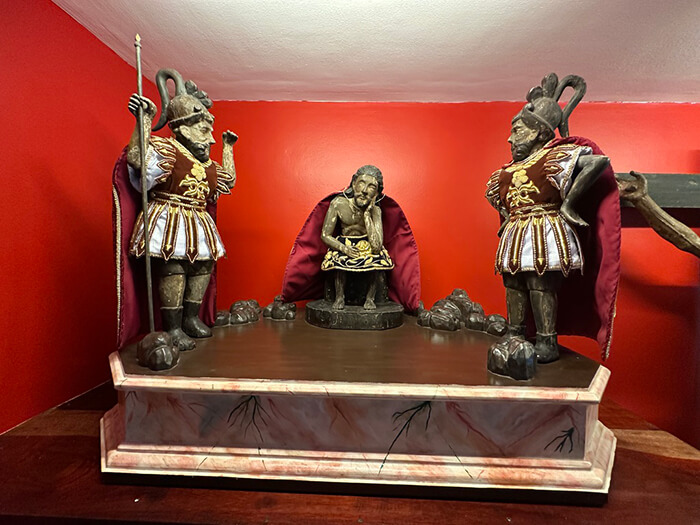
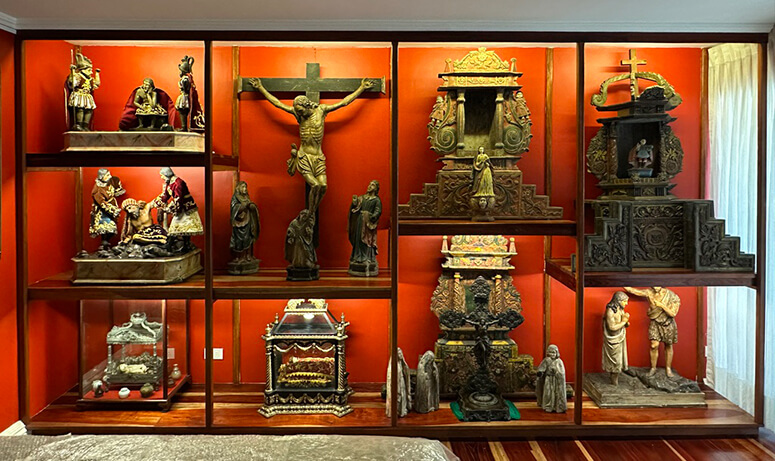
An entire wall in one of the rooms is symbolically painted red—a backdrop for scenes from Christ’s life, passion and death.
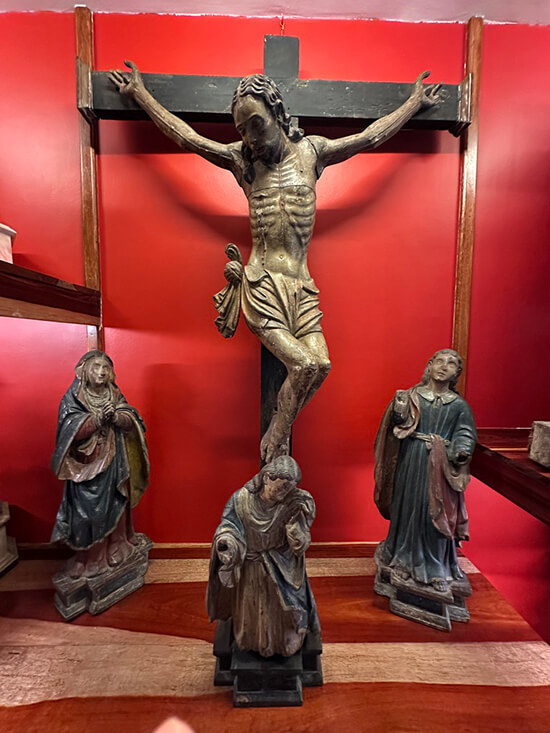
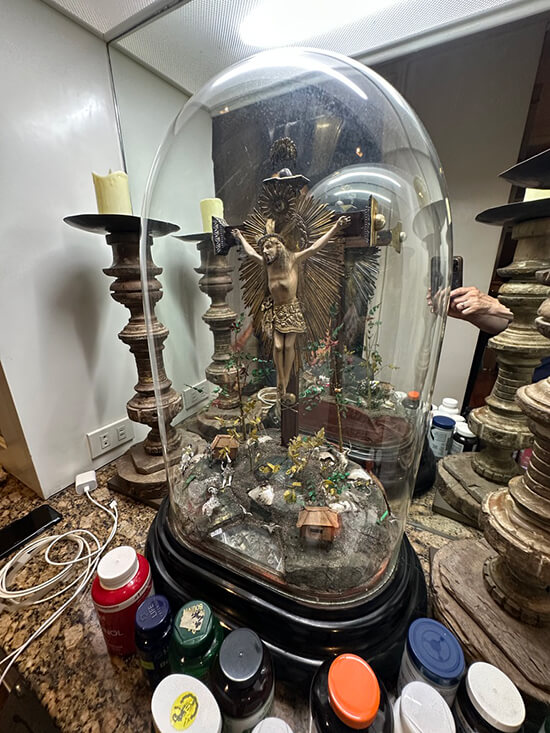
I do not deliberately collect images or tableaux on the Passion of Christ. The large crucifixion I got because of the graphic depiction of Christ, the Virgin, Mary Magdalene and St. John. The miniature tableaux are unusual and, I understand, were carried in Lenten processions in barrios that could not afford grand carrozas. Not all are Holy Week images. One is a Niño Dormido that came from a Manila family.
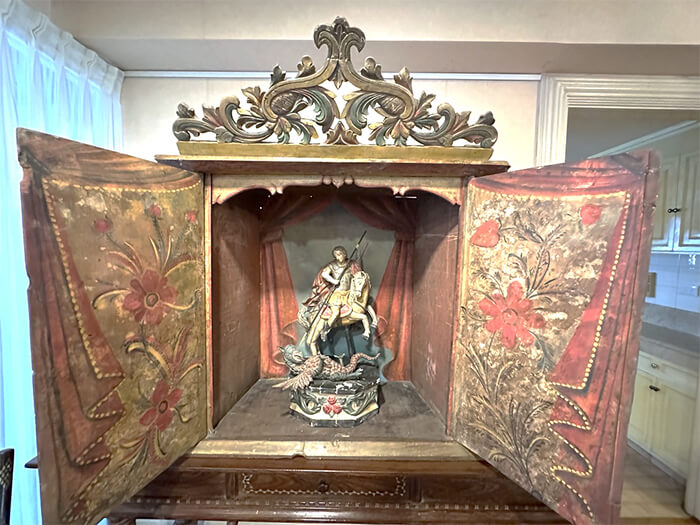
In addition to religious images, you are also an avid collector of urnas (or altar cabinets where sacred images are placed).
The wall has several Bohol urnas, some of the best that I have. Urnas are among the objects that I collect. I have a couple dozen of them, of different sizes and styles. Homes in Bohol and nearby islands have them in home altars. I saw one in a humble home in Boljoon, Bohol, on an altar table in the family bedroom, still venerated. They are also very decorative, with elaborate carvings and cheerful colors, some with stepped bases. I placed some of the larger ones there.
Aside from appreciating the beauty of these religious-themed artworks, does their presence in your home, office, and personal spaces offer you some other intangible value or consolation?
They also remind me of where they came from, the time I got them, and events associated with them. For example: an image of Sto. Niño that my mother gave me upon my return from a trip to Iloilo—she got it from Mrs. (Lourdes) Dellota; the San Antonio that was exactly as tall as my eldest daughter when she took her first steps; that San Isidro I got on the eve of my wedding; the icon that Teyet Pascual decided to give me because he got tired of me asking him to sell it to me; the San Fernando Rey that Dr. Arturo de Santos reluctantly sold me after prolonged persuasion; the San Antonio that Bacolod’s Fulgie Vega had refused to sell me after years of persuasion, but which he asked his wife to give to me when he passed away; the Niño Dormido that Doña Charing Escudero (Ado Escudero’s mother) herself designed and completed for me, with a miniature bed, curtains, and cushions, all under a small glass dome; and so on.
Do you have a favorite piece among your santos or religious paintings?
I like them all.
What would you advise collectors of sacred or religious art?
I have a rule not to give unsolicited advice.
***
As Dr. Jaime Laya looks back on his journey as a collector, it becomes clear that his devotion rests not only on the religious objects, whom they represent, or where they came from. He is also deeply devoted to the arts, to history, and to the preservation of culture.

WATCH: LGBTQIA+ people with unlikely professions
June 28, 2026
WATCH: Do you still believe in marriage? (Generations Ep. 17)
August 19, 2026